Rigo Casillas
Fictional. Generated by AI — not a real person, and no likeness of one is intended.
47, line cook in Miami · rolled by @colin.hasbrook · card — no film
History
who has worn him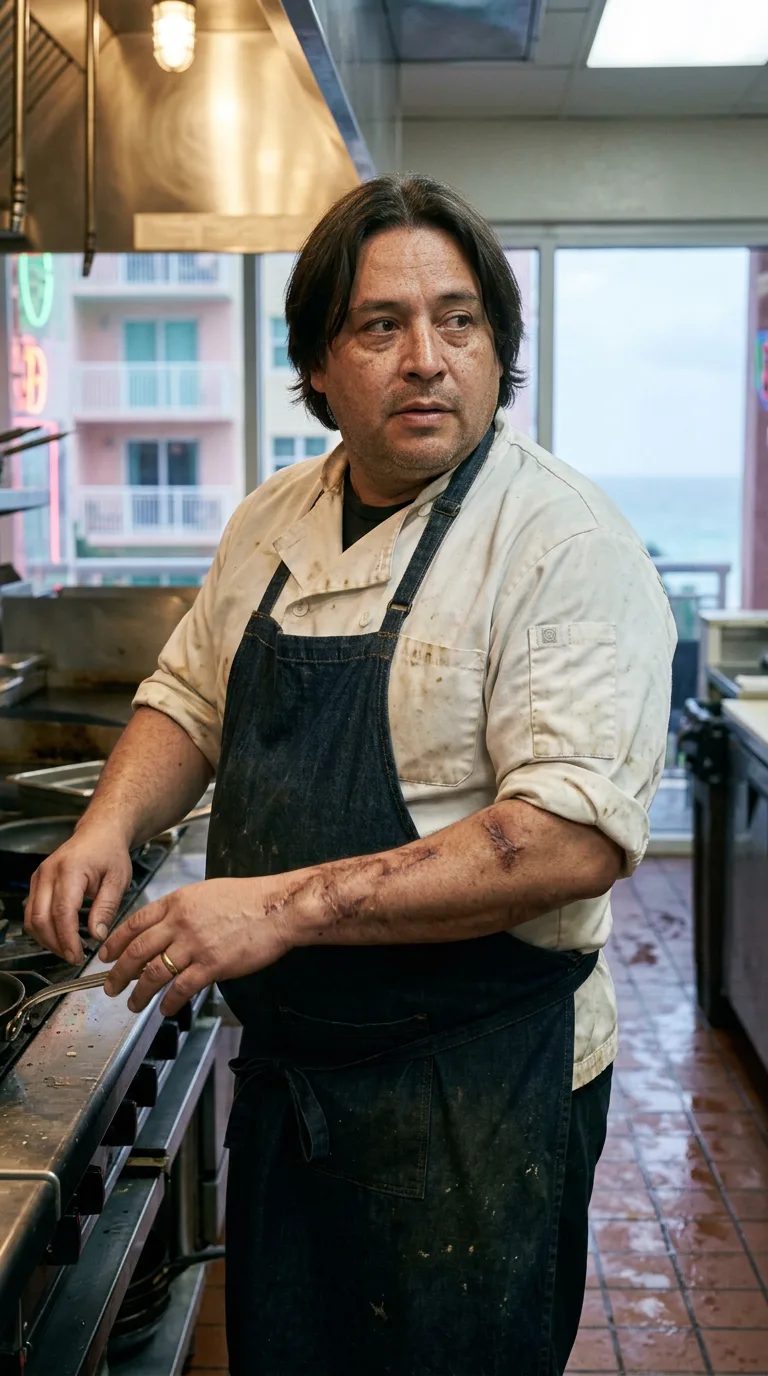
Rarest thing about him: Gay — epic, 1 in 40
Season 0seed 1530178693 · engine v10
Character card
lineage 2NZHHJ
His body-swap story
@colin.hasbrook, wearing Wallace Kanahele, rolled the wheel on and woke up as Rigo Casillas, spent under a minute in him, then spun the wheel and woke up as Gary Trembicki
Wallace Kanahele's hands are wrong on this body — too soft, dimpled at the knuckle, gray hair on the forearm where there should be none. Wallace has been sitting less than a minute, on a cheap kitchen chair in a Honolulu apartment that smells like cardboard boxes and a stranger's cooking, and already you are done with him. That is the truth of it. You spun the wheel to get away from being Darius Whitfield — 44, Nashville, a cleft chin and a temper you rode hard for eight bodies running, a man who owed people money you spent gladly — and Wallace was what the wheel gave you next, and Wallace is nothing. A furniture mover with a bad knee and a landlord who calls twice a week. You sat down in him, felt the ache in that knee settle into you like a debt you hadn't agreed to, and thought: not this. Not this for one more minute. Your thumb finds the little glass wheel on the screen, still open on Wallace's cracked phone from the last time, and you spin before the boredom can even finish arriving.
—
The spatula is already turning in your hand when it happens — one flip done backward, sauce going the wrong way across the pan, and you correct it a half-second late, slow and deliberate, like a man relearning his own name. The kitchen is loud around you, ticket printer chattering, someone yelling for a fire on table nine, and the heat off the flat-top is a wall against your face. Your body is heavier than Wallace's ever was, planted lower, a gut you didn't have yesterday pressing against the apron string. The next ten flips come out checked, each one, deliberate as a man walking a line he's supposed to be able to walk drunk.
Nobody notices. That's the terrible mercy of a kitchen at the tail end of service — everyone's too tired to watch anyone else.
The apron strings are the first thing that gives him to you — worn thin at the knot, tied the same way ten thousand times, and through them comes a whole morning: standing in front of a mirror that fogs from the shower, pulling a chef coat over his head because the buttons take too long when Mateo's crying in the next room and needs a lunch packed. Three kids, and you feel the exact weight of that thought land in his chest the way it lands in his every single day — not a burden exactly, more like ballast. He rolled his sleeves the same two turns he always does, checked the tattoo wasn't showing past the cuff out of a habit older than the marriage, though nobody at work would care. The unit insignia, half hidden. Something from before Miami, before the ring.
The ring. Left hand, plain gold band, and it comes up hot against your palm where it's pressed to the spatula handle — his husband's face arriving whole and unbidden, saying something about the electric bill this morning over coffee, not even a real argument, just marriage doing its ordinary weather. Ruben. The name comes with the face. Twenty-two years, or close to it, and three kids between them that call you Papi and call Ruben Dad, and the difference has never once mattered to either title.
Your feet know this floor — the give of the rubber mat, the two inches of standing water always pooling by the ice well no matter how many times he's told Hector to mop it. Forty-seven years old and your lower back tells you about every one of them, a dull permanent ache from bending over a flat-top since you were twenty-three. There's a tightness behind your eyes that isn't stress, that's the sugar, that's the thing you're supposed to check and don't, not mid-service, not ever mid-service. Your hand finds your own cuticle without you asking it to — picking, worrying the skin by the thumbnail, the thing this body does whenever the head gets ahead of the hands.
Through the window past the line you can see the ocean going gray-gold, neon starting to bleed pink and green onto wet pastel stucco across the street, and it lands as a whole feeling rather than a memory — evenings ending like this one, exactly this tired, exactly this far into a Monday, coming home to find the boys already half-asleep and Ruben saving him a plate.
You stand in forty-seven years of a stranger's ordinary devotion and feel how little of it you understand and how much of it you are, right now, standing inside.
You look down at your hand. Freckles across the knuckles that weren't there a minute ago in a body that isn't a minute old to you at all — it's forty-seven years old, it just doesn't know you yet. You turn it over once, like checking it for damage, and something in your chest — his chest — aches in a way that has nothing to do with sugar.
"Order up," you say, to nobody, because that's what the hands expect of the mouth, and you lift your eyes toward the pass, toward whatever comes next in a life you didn't build and don't yet know the shape of.