Darius Whitfield
Fictional. Generated by AI — not a real person, and no likeness of one is intended.
44, line cook in Nashville · rolled by @colin.hasbrook · card — no film
History
who has worn him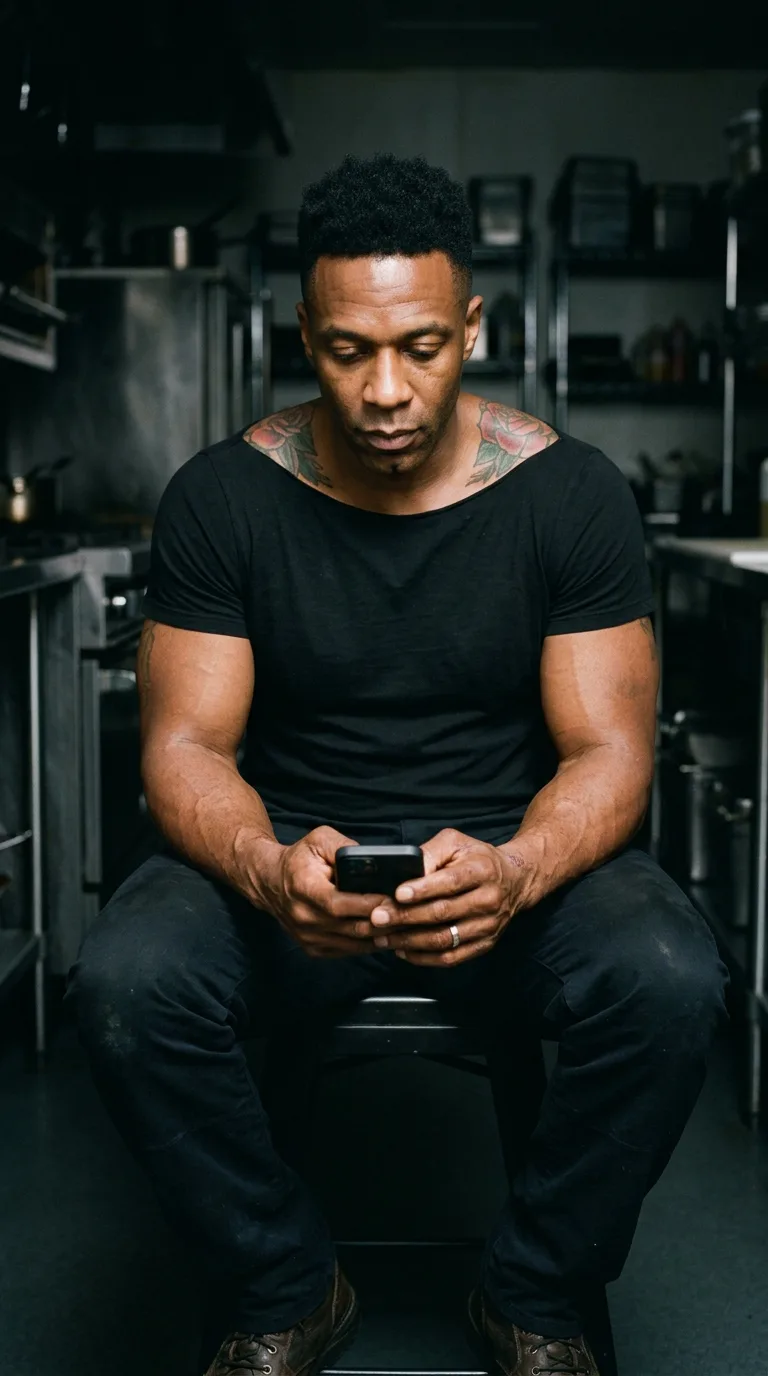
Rarest thing about him: Back piece — rare, 1 in 36
Season 0seed 829256120 · engine v10
Character card
lineage 2NZHHJ
His body-swap story
@colin.hasbrook, wearing Héctor Marroquín, rolled the wheel on and woke up as Darius Whitfield, spent under a minute in him, then spun the wheel and woke up as Arjun Malhotra
Héctor Marroquín's hands smell like blood and lime by the end of every shift, and forty-eight minutes ago they weren't his hands at all. You stand in the back of the butcher shop after close, freckles catching the fluorescent buzz, and you flex fingers that still feel borrowed even though they've been yours for years now, on and off, between other men. Six minutes inside Nadim Farhat taught you something you didn't ask to learn — a gap-toothed, gray-haired tailor with a bad knee and a roommate he loved like a brother without ever once saying so — and you left him fast, spun again, landed here, in Héctor, in Miami, at the end of a long day of cutting meat for other people's dinners. Héctor is fine. Héctor is comfortable and healthy and unremarkable in the specific way that starts to itch after enough hours. You didn't come back to the wheel because anything went wrong. You came back because you remember, now, whose roommate Darius is — and that fact has been sitting in you for forty-eight minutes like a coin in a shoe. You pay. You spin. The wheel doesn't care what you're chasing.
The scroll stops on a price four digits deep, more than a month of a line cook's rent, and the thumb that was dragging it lifts and hangs a half-inch off the glass, uncertain of whose decision this now is. The phone turns itself face-down on stainless steel. The hand that set it there does not pick it back up. Around you the kitchen is dark and half-lit by exit signs, mid-afternoon outside but night in here, service done, the fryers cooling, and you are sitting on a low stool in a black t-shirt with roses inked across both shoulders, a wedding band cool against a cuticle you did not chew.
It comes in through the shirt first — cheap cotton, softened by a hundred washes, and underneath it a flash of this morning: pulling it over his head in a bedroom with the blinds still drawn, his wife already gone to her shift, the mattress dipped where she'd been. Darius Whitfield, forty-four years old, married twelve years to a woman named Renata who calls him "baby" only when she's not annoyed at him, father to one daughter who is eleven and thinks his tattoos are the coolest thing about him. The apron ties come back through his fingers — muscle memory, no thought in it, the same double-loop knot he's tied six nights a week for two decades, ever since he was nineteen and burning his forearms learning to sear on a flat-top in a kitchen that's since closed. The pain arrives too, low in the back, a dull permanent thing that lives in him the way the tattoos do, both of them just part of what this body costs to run.
The stool under him gives another flash — sitting here between tickets, thumb picking at a hangnail before he even opens the phone, an old habit from before he could afford to want anything and had to just not think about it. The back piece pulls at his shoulders when he shifts, faded roses and a dagger done fifteen years ago in a shop two blocks from here, bold lines gone soft the way American traditional does, and with it comes the memory of the woman he got it for — not Renata. Casey. The ex who still, somehow, texts him on his birthday, whose name he's never once said out loud to his wife without a held breath first. Nothing happened. Nothing ever happens. But the ink under your borrowed shoulders remembers her mouth saying *hold still* while the needle went, and that's a year of his life you didn't ask for and can't put back.
The phone, face-down, gives the last of it: rent due Thursday, a watch he will never buy, a daughter's dance recital he already promised he'd make even though service runs late, a marriage that is good, genuinely good, in the unglamorous way nobody puts on a screen. He was happy four seconds ago. He didn't know it. Nobody ever does.
You turn the hand over. Thick fingers, a burn scar you don't remember getting because it isn't yours, the wedding band catching what little light the exit sign throws. You lift your eyes off it, into the dark kitchen, and you say, to no one:
"Rent's not that bad."
You don't know yet how long you'll be the one saying things like that.