Arjun Malhotra
Fictional. Generated by AI — not a real person, and no likeness of one is intended.
21, waiter in San Francisco · rolled by @colin.hasbrook · card — no film
History
who has worn him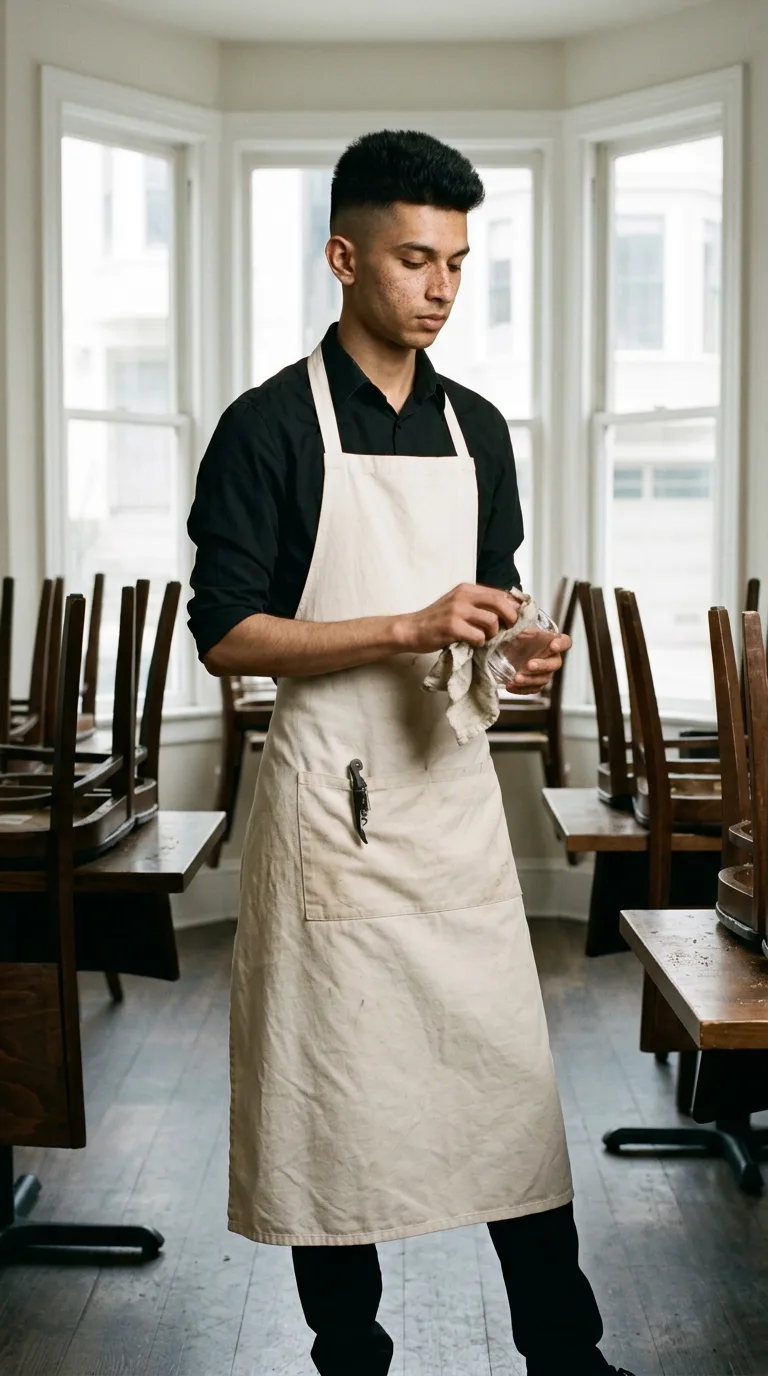
Rarest thing about him: Hazel — epic, 1 in 25
Season 0seed 173728381 · engine v10
Character card
lineage 2NZHHJ
His body-swap story
@colin.hasbrook, wearing Darius Whitfield, rolled the wheel on and woke up as Arjun Malhotra, spent 5 minutes in him, then spun the wheel and woke up as Ramón Iglesias
The griddle ticket rail is empty and the fryer's ticking as it cools, and Darius's forearms — burned pink along the left one in a line he got in 2019 and never stopped noticing — are propped on the steel edge like they've earned the rest. Less than a minute in this one and already it's wrong in a way that has nothing to do with him. It's the smell. Grease and dish-pit steam sitting low in a Nashville kitchen at two in the afternoon, and under it, so faint it might be memory already, the specific boredom of a body that has been a line cook for forty-four years without ever once wanting to be one. You didn't pick him for the job. You picked him because line cooks have forearms like that, shoulders like that, and for three hundred and fifty-four spins that had been enough. Today, watching the pass sit empty, you understand it will never again be enough by itself. Something in you has started asking not what a body can take but what it can be handed. You wipe Darius's hands on his apron, the last thing he does as the one steering him, and you go back to the wheel still wearing him, the way you always do, because leaving him empty on a stool is easier than admitting you're already gone.
The wheel spins and there is no in-between. One instant you are looking down at burned forearms; the next you are looking down at a rag and a water glass, and the hands holding them are narrow and unmarked, brown-skinned, a little chapped at the knuckles from bleach water. Your motion is already wrong before you know why: you twist the rag inside the glass counter-clockwise, and something under you — some ten-thousand-time memory that is not yours yet but is already correcting you — insists it goes the other way. You stop. You do it again, slow, correct, clockwise, the felt sense of *right* arriving a half-second after the movement, like a subtitle catching up to speech. The next ten glasses come out checked. Every one. A job that has not needed checking in years, checked, by you, standing in a dining room with upturned chairs on every table and grey San Francisco light coming flat through a bay window at your back.
The glass is the first thing that gives him to you. Cold, a little soap-slick, ordinary — and under your fingers, without asking, a whole shift arrives: the particular ache across the shoulders that comes from setting a hundred and forty of these down since three, the manager's voice from the pass calling a table number, a Tuesday-quiet room he's wiped down alone a hundred times before open. His name comes with it the way a smell comes with a room — Arjun — not spoken by anyone, just sitting there the way your own name never has to be said to be known.
The apron next. Canvas, stiff with old flour and a smear near the hem he never got out, a bottle opener clipped at the pocket that isn't for bottles anymore, just habit, something he clipped there his first week and kept clipping there for two years because taking it off felt like admitting the job was temporary, and it wasn't supposed to be temporary, it was supposed to be money for design school, and design school is a laptop folder he still opens sometimes at 1 a.m. and closes again without applying to anything. The apron ties come back to you as a memory of tying them this morning — his hands, doing this, hooking the loop over his head, cinching the waist twice because once never sits right on him, he's too narrow for the standard cut, always has been, since he was fourteen and the smallest boy in every photo. Freckles across his nose from a childhood in Fremont, summers at a pool his cousins had and he didn't, skin that never tanned even, just spotted, and a girl once — Priya, recent, gone three months now — used to trace them with a finger while he tried to fall asleep, and losing that is a specific kind of quiet that lives behind his sternum even now, even here, even while you are the one standing in it.
The black shirt against your back gives up the smallest thing: he rolled the sleeves twice this morning, exactly to the same fold both times, because an unrolled sleeve in a fryer station is how you learn not to do it again. Under the shirt, his body: 5'8", underfed-looking but not weak, a wiriness that comes from being on his feet nine hours and never once sitting to eat. A tightness low in the chest that isn't the job — it's the pouch tucked in his lip, mint gone flat an hour ago, a habit that replaced a habit, and a bottle of something small and white in his apartment that he takes every morning without telling anyone at work, because telling people at work feels like handing them a reason. He believes, in the unpushy way of someone who stopped going to temple but kept the incense, that something is watching all this and doesn't much mind what you call it.
You feel how used to unnoticed motion his hands are — wiping, stacking, setting, folding, a whole vocabulary of small competent gestures built over three years of double shifts — and you feel, underneath that, how tired twenty-one can already be.
You look down at his hands. Narrow, chapped, a rag still folded in the left one. You turn the right one over slowly, like you're checking it's real, and in Darius's kitchen four thousand miles and three hours behind you, a body stands abandoned at a cold griddle, waiting for whichever of the both of you comes back to it, if either ever does.
"Okay," you say, out loud, to the empty dining room and the upturned chairs, in a voice thinner than you're used to. "Okay."
Somewhere, the wheel is still warm from your last spin. You don't know yet if you're done touching it today.