Nadim Farhat
Fictional. Generated by AI — not a real person, and no likeness of one is intended.
50, tailor in Rural Texas · rolled by @colin.hasbrook · card — no film
History
who has worn him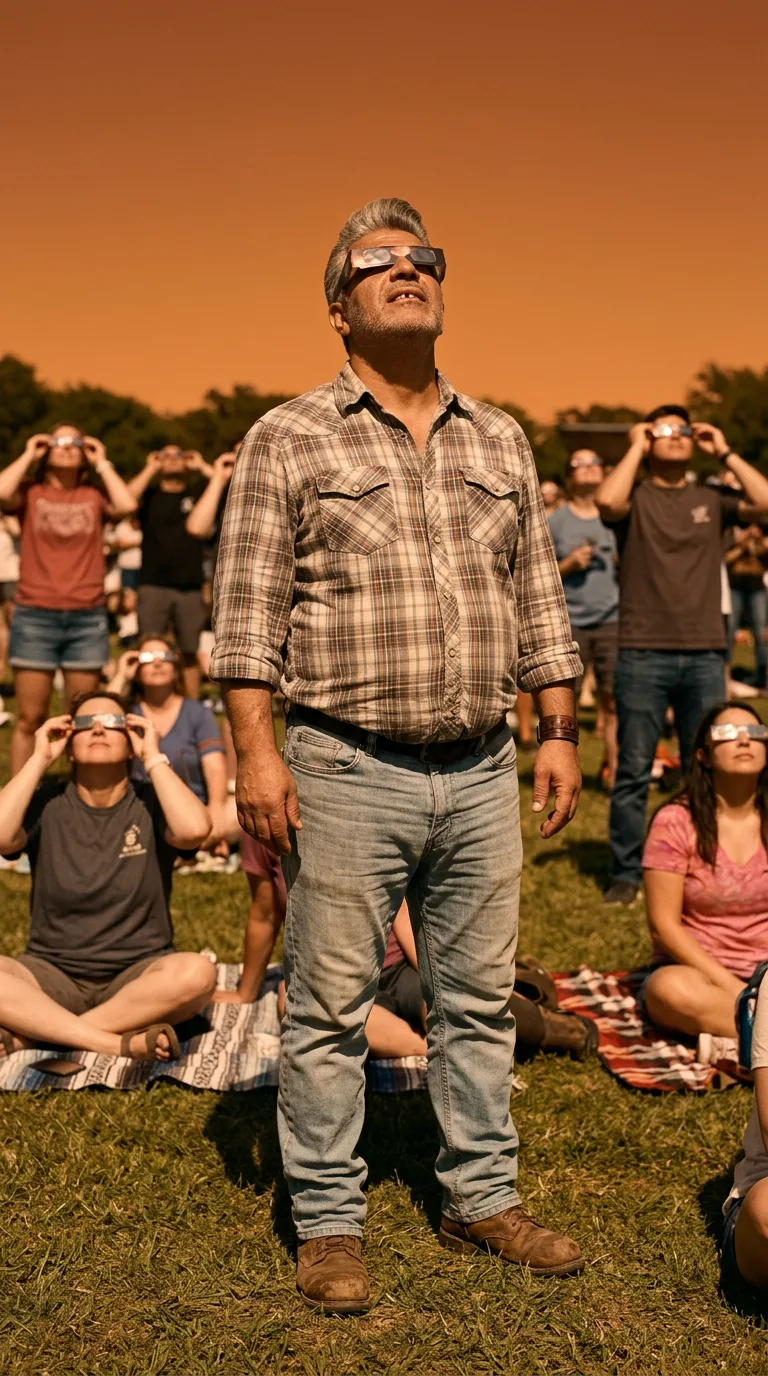
Rarest thing about him: Watching the eclipse with everyone else — rare, 1 in 318
Season 0seed 334775066 · engine v10
Character card
lineage 2NZHHJ
His body-swap story
@colin.hasbrook, wearing Rafael Quintero, rolled the wheel on and woke up as Nadim Farhat, spent 7 minutes in him, then spun the wheel and woke up as Marcus Adeyemi
Rafael Quintero's office window is doing that thing at the end of the day where the glass turns into a mirror and shows you a face you have been in for less than a minute, according to some clock that isn't the one on the wall. Thirty-five, skinny in the way lawyers who don't eat lunch are skinny, black hair combed with product that smells like a hotel, blue eyes that a woman at the firm once called "unreasonable." He has a good deposition tomorrow. He has a corner office he did not earn by looking like this. And already, less than a minute in, there is a specific, familiar itch behind those blue eyes — not hunger, exactly, more like the feeling of a good meal eaten twenty minutes ago, when the body starts wondering what's next before the mind agrees to it. You did not spin again today because Rafael's life is bad. You spun again because it is fine, and fine, three hundred and forty-six men in, has become the thing you cannot stand. You open the laptop, you find vessel.cards without needing to type the whole address anymore, and you pay, and you spin, already gone before the wheel stops.
The sky is the color of old film and there is a paper cutout of a sun burning a ring of fire into it, and forty or fifty strangers are making a single enormous sound, and you are looking up at it out of eyes that are not blue anymore. Your neck has weight it didn't have a second ago, a solid double chin tucked under a jaw, and there is warmth on your face that isn't the eclipse, it's a body that runs hot, fifty years of a body that runs hot. The paper glasses are still up over your — his — eyes when the cheer breaks over the lawn, and something in your hand — his hand — is nothing, empty, just hanging there at his side, fingers already curling like they want a task. The glasses come down. The sky goes. His face comes down out of it and lands on a pair of brown leather shoes, scuffed at the toe, and for one second there is nobody in the eyes at all.
Then the shirt. Plaid, western-cut, snap buttons instead of real ones, and the moment your skin — his skin — registers the fabric against his back, something opens like a door left unlatched: a Sunday morning three weeks ago, this same shirt off a hanger in a closet that smells like cedar blocks and pressing starch, a woman's voice from the next room saying *you're not wearing that to the eclipse thing, people are gonna see you on TV,* and him — you — laughing, the gap in his front teeth catching air, saying *let 'em look, Denise,* and buttoning it anyway because it's soft and it's his and forty years of getting dressed for other people has not once made him dress for other people. Denise. Girlfriend. The name comes with a whole weather system behind it — the smell of her car, a laugh that goes up at the end, the particular quiet of loving someone at fifty after already having loved someone else at twenty-five and having it not last.
The jeans against your legs bring the shop. A cutting table in window light, a half-finished herringbone jacket slumped over a dummy like a man asleep standing up, the smell of chalk and hot iron and wool that never fully leaves a tailor's hands no matter how much he scrubs them. Nadim Farhat, thirty years in that same square footage of a rural Texas main street, gravel lot out back, water tower visible from the fitting-room mirror if you angle it right. He came from a family of tailors the way some men come from a family of farmers, and he still remembers his father's hands more clearly than his father's face, the way the thumb pressed the seam flat before the needle ever touched it. He built this from nothing into something that let him buy land nobody thought a tailor could buy, three kids through college on hems and lapels and a reputation that outran the town. His hands — your hands now — know things without being asked: the drape of tweed off a shoulder, the half-inch you always leave in a waistband because bodies change and people don't like to be told. Right now those hands twitch at his sides, wanting to crack the knuckles the way they do a hundred times a day, an old tell nobody's ever pointed out to him because everyone who knows him has simply stopped hearing it.
His left hip returns something else, lower and duller — an old fall off a ladder hanging Christmas lights, a bone that set wrong because he was too proud that winter to go back to the doctor and have it reset right, and it has told him the weather ever since, a small permanent bill he pays for a temper he had at forty that he does not have at fifty. The boots on his feet remember standing twelve hours at the table on a bad flare-up, gritting through a fitting for a bride's father because the wedding was Saturday and there was no such thing as *the tailor's not available.*
And under all of it, spirit without steeple — a man who talks to something on quiet drives home past the water tower but has not been inside a building for it in years, who believes in something enough to thank it without ever naming it out loud. A big night out once, twice a month, whiskey with the men from the feed store, laughing too loud, never a cigarette in his life, not even the one time everybody in the parking lot at seventeen said try it. Three kids, grown or nearly, a voice on the phone last week that called him *Baba* and asked to borrow the truck.
The lawn is still roaring. Somewhere above, the moon is finishing what it came to do.
You look down. His hands — broad, soft-callused, a tailor's hands, a ring absent because he never took to wearing one — turn over in the strange light like he's checking them for something he lost. The gap in his teeth shows when his mouth opens, out of habit more than plan, out of fifty years of a face that does that on its own.
"Denise," you say, to no one standing near you, to the whole bright ruined sky, "you're not gonna believe this."