Philip Wachowski
Fictional. Generated by AI — not a real person, and no likeness of one is intended.
49, social worker in Houston · rolled by @marco.villagrana · card — no film
History
who has worn him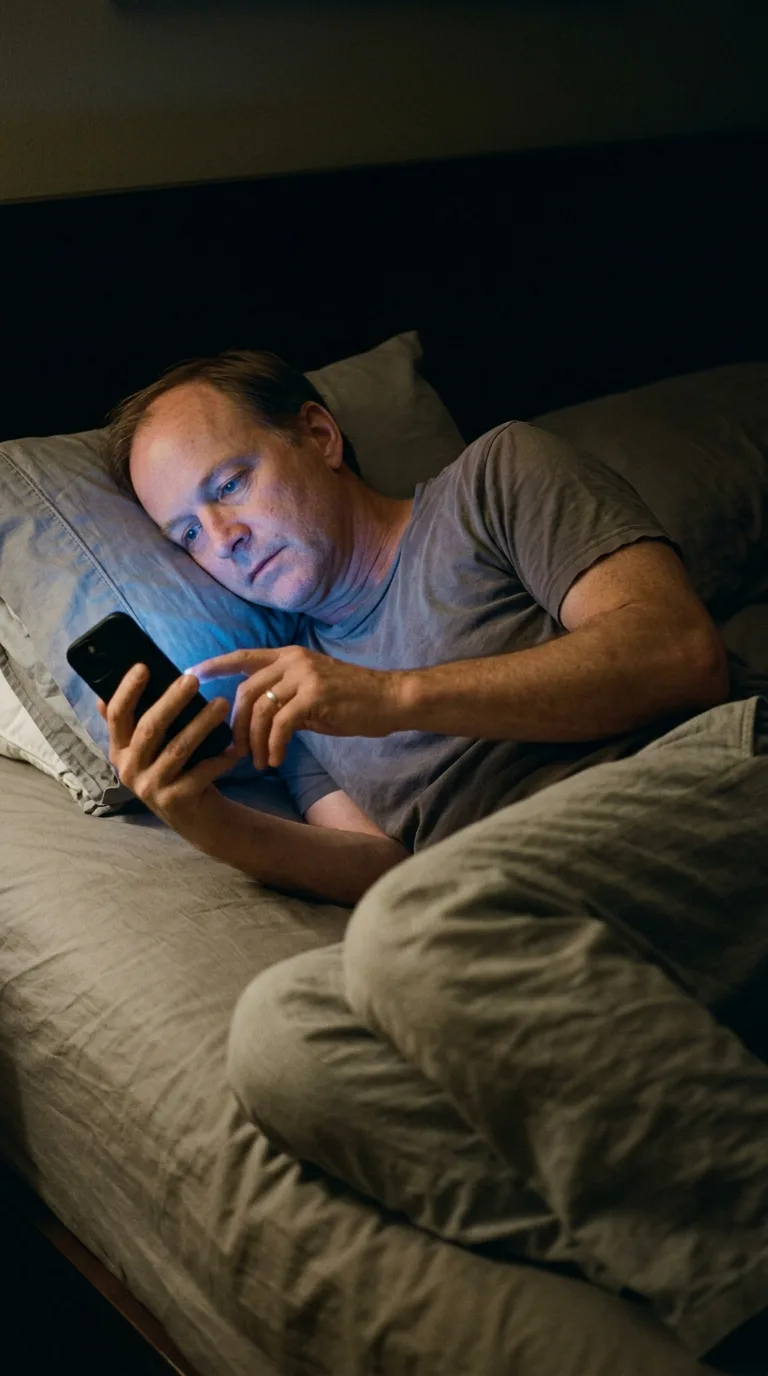
Rarest thing about him: Picks at his cuticles — uncommon, 1 in 34
Season 0seed 580964529 · engine v10
Character card
lineage LJL8SV
His body-swap story
@marco.villagrana, wearing Ben Okonkwo-Reyes, rolled the wheel on and woke up as Philip Wachowski, spent 3 minutes in him, then spun the wheel and woke up as Terrence Ogunwale
Ben Okonkwo-Reyes stands in a supply closet with a mop handle in his fists and someone else's twenty-two hours sitting on him like a wet coat.
You know this body too well already. You know the scar through the eyebrow because you have looked at it in a bathroom mirror for most of a day, wondering whose fight put it there, and never getting an answer, because that is not how it works — you get his hands and his height and none of his history unless something tells you. You know 5'4" is short enough that you have banged this head on the same low pipe twice this shift. You know brown eyes get tired by three in the afternoon under fluorescent light. You know Gary Pelletier works two floors up, moving a dead tenant's couch down a stairwell that isn't built for it, and you know Gary because seven spins ago you were him — his knees, his gray hair, his particular way of grunting through a doorway with a mattress on his back — and something about wearing a man and then meeting him again from the outside, still limping the same way, still calling you "Ben" like Ben is a person he actually knows, sits in your chest like a stone you swallowed. It isn't guilt. It's closer to the itch of a joke that only works if you're the one who gets to laugh at it.
That's the plain truth of why: boredom, dressed up as curiosity. Twenty-one, blond, athletic, a whole shift left to push this mop — and somewhere in Houston a man is lying in the dark with his thumb stalled on his phone, and you have never been forty-nine, never been married, never been a man whose job is other people's collapsing lives. You want to know what that weighs.
You take the phone out of your own back pocket — his pocket, Ben's pocket — and you go to the site with the wheel on it, and you pay, and you spin.
The thumb starts moving again before you've finished arriving.
It flicks past a group chat, past a photo of a birthday cake with too many candles for the number on it, past a text from someone named Deb that says *don't forget Callum's thing tmrw*, all of it gone under a thumb that has suddenly stopped hesitating — steadier, faster, sure of itself in a way the man lying here a half-second ago was not. The blue light sits on a cheek that has quit blinking on schedule. Nobody in the room notices, because there is nobody else in the room.
You are on your side in the dark. A mattress that gives more than a janitor's cot ever did. A pillow smelling faintly of somebody's shampoo, not yours — his, drugstore, the same bottle for years probably. The weight of a body that carries thirty more pounds than the one you left and thirty more years, and none of it hurts exactly, it just *sits* differently, lower in the hips, heavier in the shoulders, a low ache behind the left knee that you understand, in the very next second, is from carrying a car seat wrong three years ago and never once mentioning it to anyone.
The shirt is what opens first — a soft gray T-shirt, cheap, washed pale — and through it comes a Sunday: him pulling it over his head that morning without looking, still half asleep, the fabric loose the way sixty washes make it loose, his wife's voice down the hall telling one of the kids to *put the cereal away, not back in the box, in the container* — and the way he'd smiled at that without her seeing, because it was such a small thing to love someone over.
The ring is next. Plain band, left hand, worn soft at the edges the way rings get after this many years. It comes with a wedding in a backyard in Katy, folding chairs, his mother-in-law crying before the vows even started, and a version of himself twenty-three years younger who had no idea yet how much of his life would end up spent on other people's walkways, waiting to be buzzed in, holding a manila folder against his hip like a shield. Three kids come with that ring too, not as names yet, just as weight — a school play, a fever at 2 a.m., a car door slammed too hard by a fifteen-year-old who didn't mean anything by it. All of it arrives soft-focus and overlapping, the way a marriage does when you touch the one object that's supposed to hold all of it at once.
The mattress under you gives the ordinary stuff — Monday, the kind that ends the way it started, tired. A caseload that doesn't close on schedule. A home visit that afternoon where a kid wouldn't look at him and he understood exactly why and hated that he understood it. He'd come home and eaten dinner half-present and gone to bed early because his body asked to, and this — the phone, the scrolling, the six inches of light — is the last hour of him being anybody at all today.
His hands know things without asking: how to hold a clipboard so it doesn't slide, how to knock on a door so it doesn't sound like trouble, how to sit on a stranger's couch in a way that says he isn't judging the couch. Right now they know how to hold a phone loosely, and the thumb — his thumb — has a habit of drifting to the cuticle of the index finger whenever a case sits wrong in him, worrying at the skin there, small and unconscious, and it's doing it right now, underneath yours, like a tic that came free with the lease.
You look at the hand. Thumb still moving on the glass, cuticle picked raw at the edge, ring catching what little light there is.
You turn it over once, like you're checking it's real, and then you look up into the dark where a phone camera isn't but a lens somewhere always is.
"Deb," you say, quiet, testing the name in his voice, "I'm still up."
Nobody answers. You don't call again for a second. You just lie there being him, not yet knowing for how long.