Desmond Halvorsen
Fictional. Generated by AI — not a real person, and no likeness of one is intended.
47, teacher in Mexico City · rolled by @klaus.dietermann · card — no film
History
who has worn him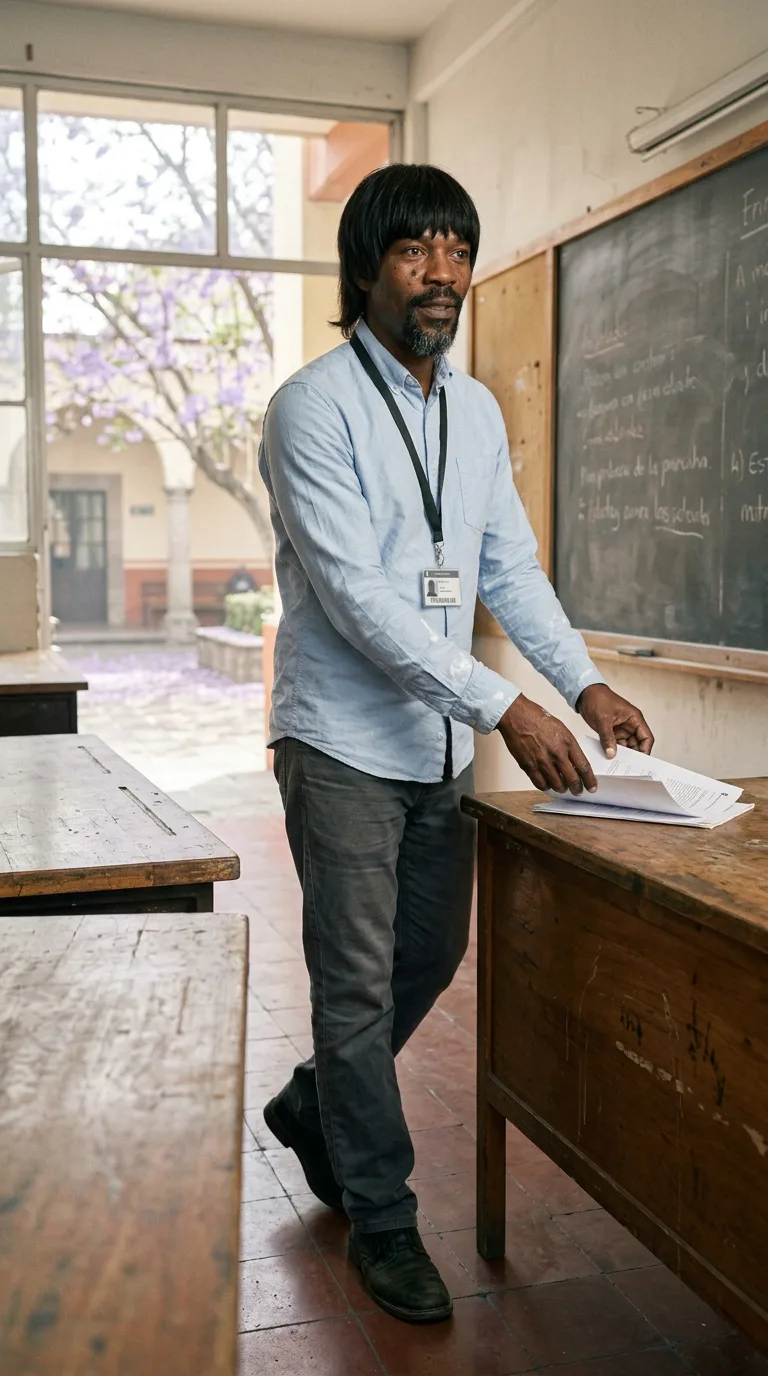
Rarest thing about him: Mexico City — uncommon, 1 in 360
Season 1seed 814985532 · engine v11
Character card
lineage KEPHG1
His body-swap story
@klaus.dietermann, wearing Owen Kittredge, rolled the wheel on and woke up as Desmond Halvorsen, spent 3 minutes in him, then spun the wheel and woke up as Marcus Odell Whitaker
HIS LAST NAME IS Halvorsen. He is Curtis Halvorsen's brother. HOOK: Two hours ago you were his brother. Now you're stacking his papers.
---
The mechanic's coffee is cold in Owen Kittredge's hand, and you have been staring at it for eleven minutes in a body that keeps sitting down at a workbench like there's a job it should be doing. You gave it three minutes last time and it wasn't enough to want it again, but that's not why you're back at the wheel. It's because two hours and thirty-three minutes ago you were Curtis Halvorsen, standing in his own garage in Anchorage, and on the workbench there had been a photograph tacked to the pegboard — Curtis and a brother, dark-skinned, younger-looking, some courtyard full of purple flowers, both of them grinning like they hadn't yet had the argument that made Curtis take the photo down and put it back up twice. You didn't ask Curtis's memory for the story. It gave it to you anyway, the way they always do, uninvited: a brother teaching in Mexico City, a mother who calls Curtis and never him, some rift about who visited when their father was sick. You left Curtis two minutes later without ever learning the brother's name. It has been sitting in Owen's cold hand ever since, an unfinished thing. So you go back. Not for a reason you'd say out loud — just that Curtis's memory of him had a texture to it, unclaimed, and you want to be the one standing inside it instead of just brushing past it in someone else's recollection. You open the site on Owen's phone with Owen's thumb. You spin.
The classroom exhales around you — chalk dust, wet stone, jacaranda coming in sweet off the courtyard — and your hand is on a stapled packet of papers, squaring its edges against a scarred wooden desk. The motion goes wrong first: you set the corner down crooked, lift it, do it again slow and correct, like a man double-checking a thing his hands have done ten thousand times without asking his eyes to help. Then nine more, each one checked, each one deliberate, on a job that stopped needing checking before you — before he — ever thought about it.
The lanyard is the first thing. It swings against your chest when you shift your weight and gives you a morning: him looping it over his head in a mirror with a crack across one corner, laughing at something his wife said from the next room in Spanish too fast for you to have caught if it weren't already inside his ear, already understood without translation because it is his understanding, arriving whole. Her name comes with it — Renata — and the particular exasperated fondness of her voice telling him he'd be late again, and him telling her the last bell doesn't care what time he starts, only what time he finishes, and that's a joke eleven years old between them by now, worn smooth as a stone in a pocket.
The shirt gives you more. Cotton gone soft at the elbows, a coffee stain scrubbed pale near one cuff that never fully came out and that he stopped minding around year three of owning it. Getting dressed this morning: him standing in the half-dark so as not to wake her, working buttons by feel from collar down, the wedding band catching once on the second button the way it always does, a small permanent annoyance he has never once considered fixing because the catching is, in some unexamined way, proof the ring still fits, still means what it meant. Grey trousers, ironed the night before by nobody — himself, standing over the board at eleven at night because that's when the apartment goes quiet enough to think, three kids' worth of quiet finally arrived.
The desk under your palm gives you years. Not one memory but the sediment of hundreds — report cards, a boy caught cheating whom he chose to teach instead of report and never regretted, the smell of this exact chalk in September and again in September and again, a colleague who became something almost like a friend and then didn't, a raise that didn't come, a raise that did. It gives you the ex-wife too, briefly and without much heat left in it — an early marriage, young and wrong-shaped, ending in a courthouse hallway with more relief than grief in it, and how strange it still is that a man can carry two marriages and have only one of them mean anything by the time he's this age, forty-seven, goatee going grey at the chin same as his father's did, same as his father's did.
The body under all of it is honest in the way bodies are when nobody's performing for them. Athletic still, the shoulders remembering a younger man's habit of moving furniture himself instead of asking. A low ache behind one knee that flares on the tile floors of this specific building and nowhere else. Hands that know without being told how to fold a stack of essays into thirds, how to hold three pieces of chalk at once and never drop one, how to write a name on a board in a hand still legible from the back row.
You look down at those hands. Brown, a mole high on the cheek you can't see but can feel like a fact, ring catching the grey light off the courtyard.
"Bueno," you say, to no one, to the empty desks, and it comes out in his voice, easy, unbothered, a man talking himself back into a task — and underneath it, only yours, the small flat wondering of how long you'll let this one run before the wheel starts pulling at you again.