Dennis Halloran
Fictional. Generated by AI — not a real person, and no likeness of one is intended.
64, welder in New York · rolled by @marco.villagrana · card — no film
History
who has worn him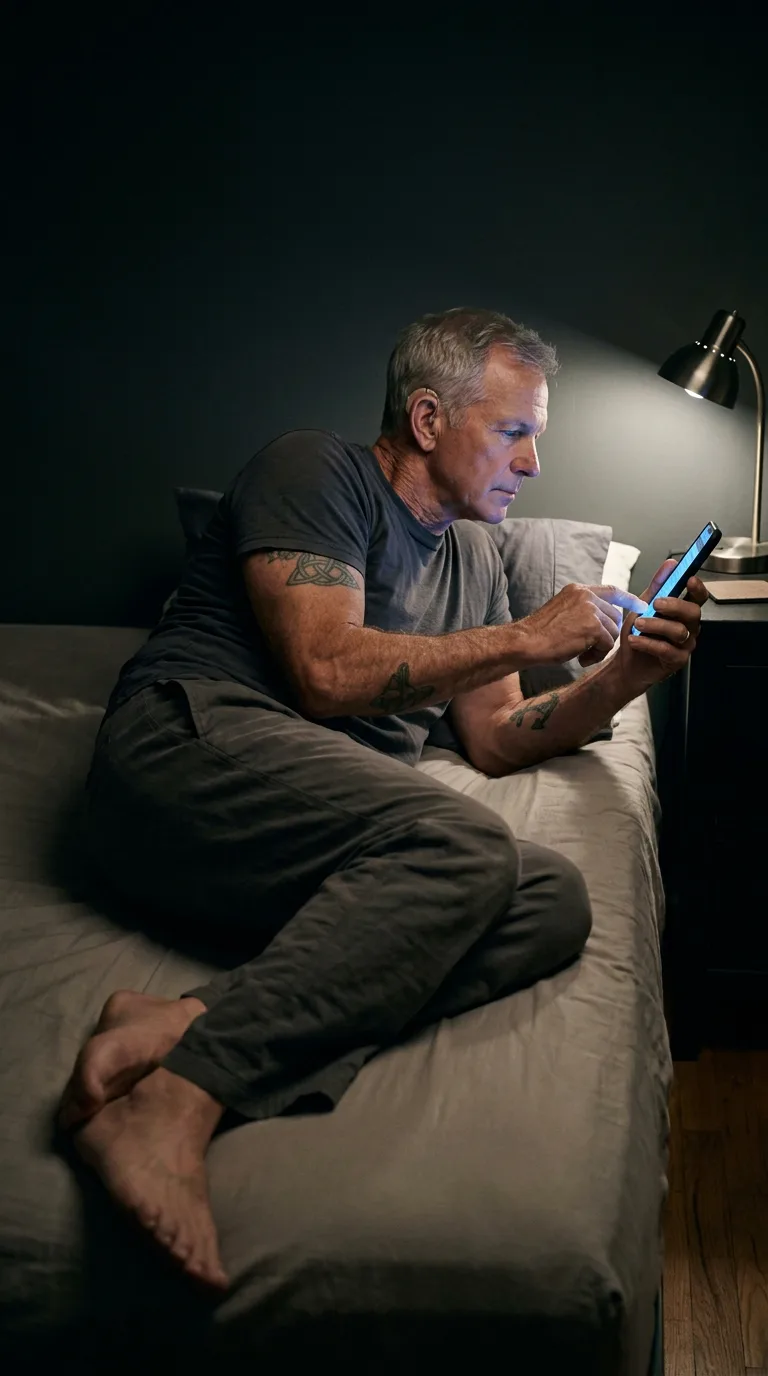
Rarest thing about him: Welder — rare, 1 in 105
Season 0seed 1739695068 · engine v10
Character card
lineage LJL8SV
His body-swap story
@marco.villagrana, wearing Gary Pelletier, rolled the wheel on and woke up as Dennis Halloran, spent 3 minutes in him, then spun the wheel and woke up as Liam Sowards
Gary Pelletier's apartment smells like cardboard and take-out grease, and his knees ache from thirty years of dollies and stairwells, and none of that is why you're already back at the laptop. You spun into him for a favor, basically — a body built for lifting, good for a job you don't even remember wanting done — and you were him for two minutes before the wanting curdled into something else, the way it always does. Two minutes is not enough to learn a man. It is enough to know you don't want to be him for a third.
You are still sitting there, Gary's spine curved over the keyboard, Gary's hearing perfectly fine, when the itch starts. You know exactly where it's pointed. Fourteen minutes ago, in a farmhouse outside Lexington, you were Douglas Kimura, and for three minutes you had a friend on the phone whose voice made Douglas's whole chest go warm and easy in a way nothing else that spin had. A voice that said *call me Sunday, I mean it, don't just text like a coward* — and you, wearing Douglas, said you would, and meant it in Douglas's mouth, and then you spun out of him before Sunday ever arrived for either of them.
You want to know what it's like from the other side of that promise.
You pay. You spin.
—
The scroll under your thumb speeds up before you've finished arriving, like the hand already knew what it wanted to do and only needed you to stop getting in the way. Bed under you, narrow and cool at the edges where a second body used to sleep. A phone six inches off, blue and patient. Somewhere behind your ear a small device hums at a frequency you didn't ask for and now can't unhear.
You are on your side, sixty-four years of him arranged around a phone, and the light does not blink out at the right times because you are learning, right now, in real time, that this face has quit doing the polite unconscious things a face does.
—
The shirt is the first thing. Thin gray cotton, soft from a hundred washes, and it gives you a Tuesday morning — him standing in front of a dresser that used to be a shared dresser, half of it empty eleven years now, pulling this exact shirt over his head one-armed because the other hand was holding a coffee he'd regret drinking that late in the day. The tattoo under your left sleeve prickles with a memory that isn't a story so much as a temperature: a boat, a summer, somebody laughing at him for getting it, him getting the second one anyway out of spite two years later.
The leg. God, the leg — it's already going, jackhammering against the mattress the second the shirt's memory lets go of you, and it doesn't stop for anything, not for grief, not for good news, just runs underneath him like a second heartbeat he never asked for and stopped noticing around 1998.
The wedding band isn't there but the ghost of it is, a pale strip of skin his thumb finds without being told to, worrying at it the way tongue finds a missing tooth. Marianne. Not gone, exactly — gone from the bed, gone from the dresser, still very much in two grown kids' faces at Christmas, still on the other end of a phone call about a grandkid's recital that he will absolutely go to and sit two rows behind her at. Some griefs finish healing. This one just got quiet.
The hearing aid gives you the shop — the actual roar of it, gone soft and rounded now by the tiny machines, sparks landing on concrete like a shower he's stood under ten thousand times, the good clean tiredness of a body that still knows exactly what it's for. Hands that don't shake at a bead of weld even now. A boss twenty years younger who still calls him "the guy who taught me the hood trick." Pride, plain and unfussy, the kind that doesn't need saying out loud.
And under all of it, quieter, persistent as the leg: Douglas. Best friends since a summer job forty years back that neither of them stayed at more than a season, and everything after built on top of that like scaffolding neither man ever bothered to take down. A dig site he flew out to once just to see, hard hat on over a straw hat, embarrassing photos. A voice on the phone last week — Sunday, he said, don't just text like a coward — and something in this chest that trusted the promise completely, because Douglas has never once broken one, not in forty years, not even the small ones.
He does not know yet that the man who said that to him fourteen minutes ago isn't the one who'll pick up when he calls.
—
You look at the hand still holding the phone — his hand, tan-lined, steady, a welder's hand that has never once been afraid of heat — and you turn it over like it belongs to somebody you're meeting for the first time, which, in the only way that matters now, it does.
"Sunday," you say, out loud, to no one, and something like a laugh gets stuck halfway up. "Guess I'm not calling."
The leg keeps bouncing. You let it.