Liam Sowards
Fictional. Generated by AI — not a real person, and no likeness of one is intended.
23, bus driver in Eastern Kentucky · rolled by @marco.villagrana · card — no film
History
who has worn him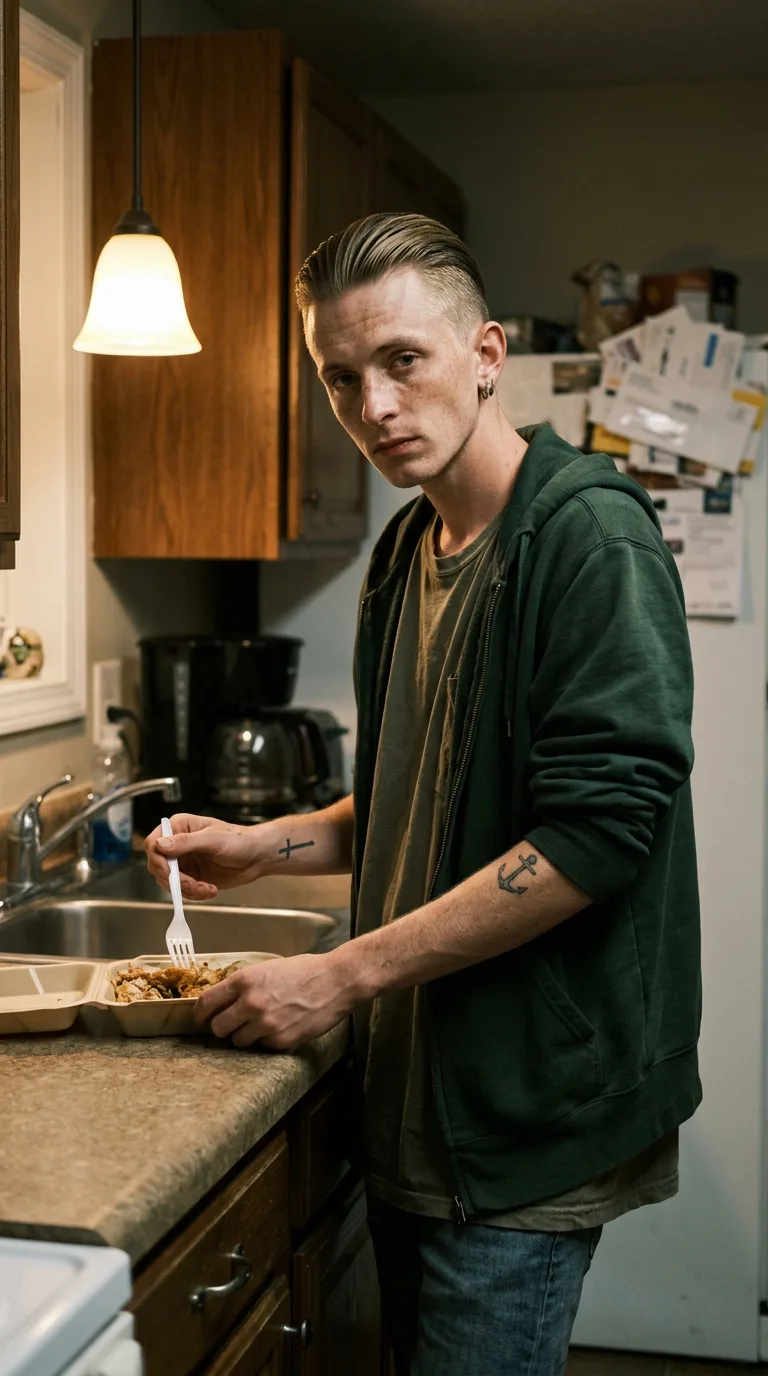
Rarest thing about him: Migraines — rare, 1 in 34
Season 0seed 1582739038 · engine v10
Character card
lineage LJL8SV
His body-swap story
@marco.villagrana, wearing Dennis Halloran, rolled the wheel on and woke up as Liam Sowards, spent 5 minutes in him, then spun the wheel and woke up as Miguel Otero
Dennis Halloran's hands are steady in a way yours never learned to be, and that is the whole problem with him: three minutes in and the body already knows too much, wants too little. He is standing over a sink of gray dishwater in a New York apartment that smells like flux and old coffee, and you can feel sixty-four years of tired sitting in the shoulders like a coat that fits too well. There's a Sunday quiet in the building. Somewhere below, a radiator knocks. You spun and got a welder with silver hair and blue eyes and a wedding ring he stopped wearing years before you arrived, and for three minutes you wore his fatigue like it was interesting. It isn't. There's no ache in him worth keeping, no unfinished hunger, nothing left to spend. You already miss the feeling of being new somewhere. You set his mug down — his mug, not yours, nothing here is yours — and you go to the wheel again because that itch behind the ribs never actually belonged to Dennis Halloran, it belongs to you, and it wants to spin.
The fork stops a half-inch from his mouth.
It comes back down against the plastic lip of the container with a small tap, and you feel that tap land in a wrist that is thinner than the one you just left, bones close to the skin, no weight to spare anywhere on this frame. You are still standing. The coat is heavier than it looks, canvas gone soft at the elbows, and under it a body that runs narrow all the way down — 5'8" of a man who has never in his life had to duck through a doorway. You shrug the coat off one shoulder, then the other, and it drops onto a chair behind you without your telling it to, muscle doing what muscle already knew before you got here. You sit. You finish the container in even mouthfuls, and the whole time your eyes are on the black window over the sink, which is giving back nothing but the pendant light and a stranger's outline, and you do not yet know whose.
The fork is the first key. Cheap, white, tines slightly splayed from being run through a garbage disposal once, and holding it brings back a hundred meals eaten standing up exactly like this — after ten, eleven hour shifts, too tired to sit at a table built for people who weren't alone. Liam. The name arrives with the taste of the food, cold chicken and rice from a gas station deli case, and behind the name comes the route: forty-one minutes each way, Route 6, the cable footbridge over Troublesome Creek that he crosses on his walk home some days just to feel the sway of it under his boots, water the color of strong tea moving slow beneath, green light coming down soft through sycamore leaves. He loves that bridge in a way he's never told anyone, the ten seconds of nothing it gives him between the bus yard and his own front door.
The hoodie is next — dark green, zip pull worn smooth — and it gives you the morning he bought it, three winters back, at a Walmart forty minutes from here with his last paycheck before rent, because his old coat had a rip at the seam and his mother used to say a man ought to at least look put-together even if the truck he drives is government-owned and dented. His mother is two states over now and they talk on Sundays, sometimes, when the migraine isn't sitting behind his left eye like it is tonight, low and dull and building, the kind that makes the kitchen light go a little sharp at the edges. He knows this one. He knows to eat something plain and get horizontal before it climbs. He is not going to make it to horizontal tonight — not because of the migraine.
The shirt underneath — no, wait, there is no shirt yet, that was this morning's shirt, folded now in a hamper down the hall — but his hands remember dressing it anyway, memory running ahead of the object: the navy uniform shirt, sleeve by sleeve, right arm first out of habit from some order lost to time, the CITY TRANSIT patch cool against his chest before his own warmth caught up to it, the badge clip that always sticks and has to be worked twice, his own photograph on the little laminated card looking younger than he feels standing at twenty-three. He remembers the earring going in last, cold hoop, a habit from age sixteen that his mother hated and then stopped hating. He remembers the sunglasses pushed up into his hair out of pure reflex though there was no sun left in the sky by the time his shift ended, just gray highway and the taillights of the car ahead and his own leg going under the dash the whole ride home, bouncing, bouncing, a rhythm his body keeps without asking him, the only motion in him that never gets tired.
The counter under your — his — hands is laminate, warm from the tap water still running somewhere close, and it gives back nothing dramatic, just years: rent due on the first, a girl two summers ago who didn't stay long enough to become a story worth telling, church on the Sundays his head lets him, the particular loneliness of a one-bedroom with mail stacked on the fridge that he keeps meaning to sort. No wife. No kids. No debt big enough to matter and no savings big enough to matter either. Just a route, a bridge, a mother's voice on Sundays, and a headache that has been coming for him since noon.
You look down. The fork is still in his hand, tines catching the light off the one bulb over the sink, and the fingers holding it are longer than Dennis's were, freckled clear to the knuckle, a hoop of silver visible at the edge of your vision when you turn your head toward the black glass of the window. You set the fork down slow, on purpose this time, and turn the hand over like you're checking it for damage, though nothing is damaged, nothing has been touched at all except everything.
You look up into the window, into the shape of him looking back at you out of the dark, and you say, "There you are."