David Ouyang
Fictional. Generated by AI — not a real person, and no likeness of one is intended.
45, electrician in Philadelphia · rolled by @colin.hasbrook · card — no film
History
who has worn him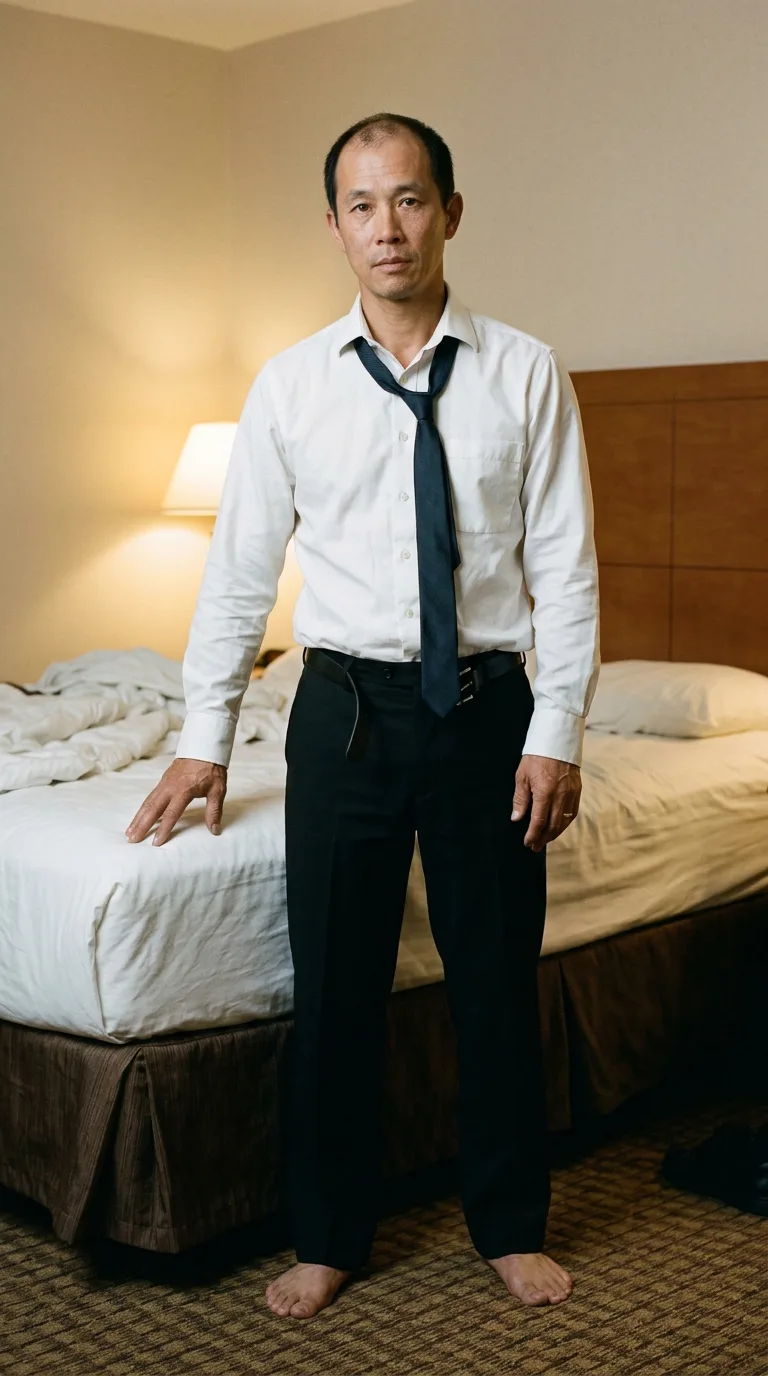
Rarest thing about him: Getting dressed for work — uncommon, 1 in 34
Season 0seed 1130179949 · engine v10
Character card
lineage 2NZHHJ
His body-swap story
@colin.hasbrook, wearing Douglas Merchant, rolled the wheel on and woke up as David Ouyang, spent under a minute in him, then spun the wheel and woke up as Curtis Yoder
You are Douglas Merchant for less than a minute, standing in the delivery man's cramped kitchen in Atlanta, the fridge humming, a unibrow you didn't ask for casting a shadow over eyes that aren't yours to keep. There's a phone on the counter with a lock screen you already know without looking — Douglas's route sheet for tomorrow, boxes and addresses that mean nothing to you. What sent you back isn't on the counter. It's smaller than that. It's the memory, still warm, of standing in a lifeguard chair in Ohio eleven bodies ago, freckled forearms, whistle around a bald neck, and beside you on the next chair over, sunburned and complaining about his knees, a man named David who used to needle you — needle Darnell, whoever was wearing Darnell — about being too old for the tower. You liked him. You left him laughing. And now, wearing this stranger's unibrowed face in a kitchen that smells like microwave rice, it occurs to you that David is still out there somewhere, still being David, and you have never once gone back for somebody you liked. You have only ever spun forward into strangers. Tonight that seems like a waste.
You open the site. The wheel turns the way it always turns, indifferent, and you feel the old drop in your gut that isn't fear anymore, hasn't been fear in four hundred spins, is just the elevator-feeling of falling toward a floor you can't see.
Your hand is flat on your own chest, feeling ribs that are narrower now, harder, ridged with a strength that isn't from a gym. The shirt under your palm is half-buttoned and wrong, one hole off, and your fingers — his fingers, yours now — go to it without being told and fix it, three motions, done before you've caught up to doing it. A tie hangs loose at the collar and your hands take it and knot it in a shape your last body's hands never learned, over and under and through, the motion arriving ahead of the thought. You are standing barefoot on hotel carpet. There is a bed with the sheets thrown back on one side only. A lamp. A window with the blinds cracked on a sky that has already gone past sunset into the flat dark blue that comes before the streetlights matter.
The shirt is the first thing that talks to you. Cotton gone soft from a hundred washes, a collar that knows the exact shape of this neck, and through it comes a flash of a laundromat in Northeast Philly, a hamper by the bedroom door, a wife's voice from the bathroom saying something about the kids and a permission slip, and then — sleeve by sleeve, the way the fact promised — the whole morning replays through your own borrowed arms: right cuff first, always right first, a habit from thirty years of dressing one-handed while the other hand held a phone or a coffee or a kid's shoe. Left arm through. Collar up. Third button skipped by habit and caught by habit too, his fingers correcting an error they'd already half-made a thousand mornings running.
The tie gives you more. Not this hotel — a different one, a conference two years back, his hands tying it slower, unpracticed, because ties aren't a rowhouse man's daily wear, and a memory surfaces whole: him at nineteen, his father's hands over his hands, teaching the knot in a bathroom mirror in the house on Sixth Street, his father's English thin and the lesson wordless, just pressure and repetition. David never got good at it. He still isn't. The knot under your fingers now is passable and no better than that, and there's a small, real embarrassment in it, buried decades deep, that you can feel like a splinter that healed over.
Your back tells you something the clothes don't — a dull ache low along the spine, old, permanent, the specific complaint of a man who has spent twenty years hunched under joists and crawling through crawlspaces with a headlamp and a voltage tester, knees on plywood, reaching up into ceiling cavities until his shoulders locked. It flares faintly even standing still, a tax paid daily. Your hands remember a pen — not this room's pen, no pen here at all, but the ghost motion is in the fingers anyway, click click click, a tic from a thousand invoices written on clipboards balanced on a knee. There's a wedding band on the left hand, plain, unremarkable, and it carries the heaviest thing in the room: a wedding fourteen years ago in a church neither of them believed in, done for his mother, and a woman's laugh afterward in the parking lot that he still, on ordinary Mondays, hears without warning. Two kids' names arrive with the ring too, quick and warm and gone, the specific weight of a school photo on a hallway wall you haven't seen and already miss.
You know why he's dressing barefoot in a hotel and not the rowhouse — a job out of town, a bid on a commercial rewire, an early flight tomorrow that this body is dreading in its bad hip already. It is late here, late enough that the hallway outside has gone quiet, late enough to be alone with it. Somewhere behind you, in the version of tonight you just left, Douglas Merchant is asleep in a bed thirty years younger in style and grief. You do not think about him again.
You look down at your own hand — his hand, tanned across the back, a thin white line of a life spent working outdoors, the ring catching the lamp — and you turn it over slowly, watching the tendons shift, feeling how little it resembles the last one.
You lift your eyes to find the mirror across the room, and hold there.
"Wrong knot," you say, to no one, and almost smile at how much that would have bothered him.