Curtis Yoder
Fictional. Generated by AI — not a real person, and no likeness of one is intended.
31, student in Small-town Ohio · rolled by @colin.hasbrook · card — no film
History
who has worn him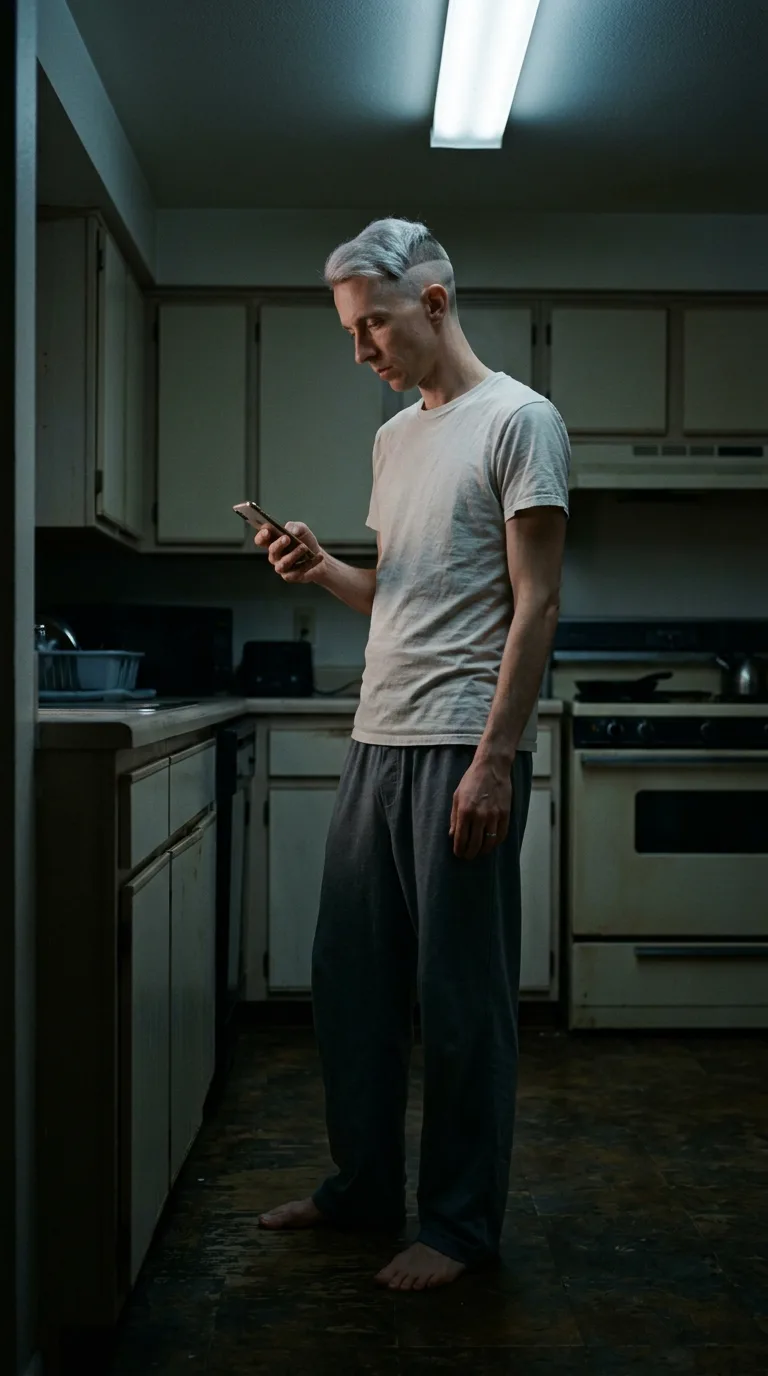
Rarest thing about him: Platinum / silver — epic, 1 in 71
Season 0seed 213321704 · engine v10
Character card
lineage 2NZHHJ
His body-swap story
@colin.hasbrook, wearing David Ouyang, rolled the wheel on and woke up as Curtis Yoder, spent 8 minutes in him, then spun the wheel and woke up as Marcus Deveaux
You are standing in David Ouyang's kitchen, in David Ouyang's body, forty-five years old and good with your hands in a way that isn't yours either, and you have exactly one thought that is entirely your own: this isn't enough anymore. It's Monday evening, Philadelphia, and the row house is quiet in the particular way a house gets when nobody is arguing in it and nobody is happy about that either. You spent the day pulling wire through a ceiling in Fishtown, and it went fine, and that's the problem — four hundred and five men and it still went fine, and fine is a texture you've had before. You wash the drywall dust off two hands that aren't yours and you think about the wheel the way another man might think about a drink. Not need. Appetite. You dry your hands on a towel that smells like a stranger's fabric softener, and you go to the site, and you pay, and you spin, already halfway gone before the wheel stops.
It stops on a kitchen in Ohio, dark except for one bad fluorescent tube, and a phone screen, and a thumb that is not lifting anymore because it is now yours. The weight drops onto you all at once — five inches shorter, forty pounds lighter, standing barefoot on cold linoleum with a body that runs thin and quick and strung a little tight, like it's always half a second from flinching. The phone in your hand shows a watch. Fourteen hundred dollars. Your thumb — his thumb — goes still on the glass. Then the hand turns the phone face-down on the counter of its own accord, or what used to be its own accord, and does not pick it back up.
The T-shirt against your back is thin from washing, soft in that worn-through way, and it gives you a morning: him pulling it over his head in a bedroom with the shades still down, sun already too bright at the edges, her voice from the bathroom saying something about being late for the thing at her mother's, and him saying *I know, I know*, patient about it, because he is patient about most things that aren't the phone in his hand at night. The shirt remembers her folding it, once, in a stack of five identical ones, saying *you'd wear the same shirt every day if I let you* and him saying *you do let me* and both of them laughing at a joke that isn't really a joke, it's just the shape of a marriage that works because neither of them asks it to be more than what it is.
The waistband of the sweatpants, elastic gone soft, gives you a whole year: the pills on the nightstand, small and unglamorous, the appointment he almost canceled twice, the relief afterward that surprised him more than the diagnosis had — that it had a name, that the flatness had a name, that it wasn't just him being weak or ungrateful for a life that from the outside looked like it was going fine. He quit drinking around then too, not dramatically, just stopped buying it, the six-pack in the fridge door going stale until his wife finally asked and he said *I don't think it's helping* and that was the whole conversation.
The linoleum under your feet is the kitchen of a rental they keep saying is temporary. The pen he clicks without noticing — it's not in his hand now, it's on the counter by the microwave, and even from here, memory rises off it: office hours, a professor's door, him clicking it through the whole meeting about whether the loan would cover the spring semester. Thirty-one and still in school, going back for something practical after the first degree didn't hold, and ashamed of that in a way he never says out loud, not even to her, especially not to her, because she works the early line at the plant and doesn't complain and he is standing in campus grass with a laptop some days pricing watches he'll never buy at night, and he doesn't know why he does that to himself except that it's a kind of hurt that feels like choosing something, for once.
The wedding band is still on the hand you're wearing. It doesn't come off. You don't try.
You lift the hand — his hand, narrow-wristed, a little cold — and turn it in the bad light, watching the ring catch what there is to catch.
"Okay," you say, to the dark kitchen, to nobody. "Okay."
Somewhere under that, already, quietly, not yet a decision: how long is this one. You don't answer it. You just stand in his kitchen, in his marriage, in his thin tired body, and let the phone lie face-down where his hand left it.