Marcus Deveaux
Fictional. Generated by AI — not a real person, and no likeness of one is intended.
33, furniture mover in Coastal Maine · rolled by @colin.hasbrook · card — no film
History
who has worn him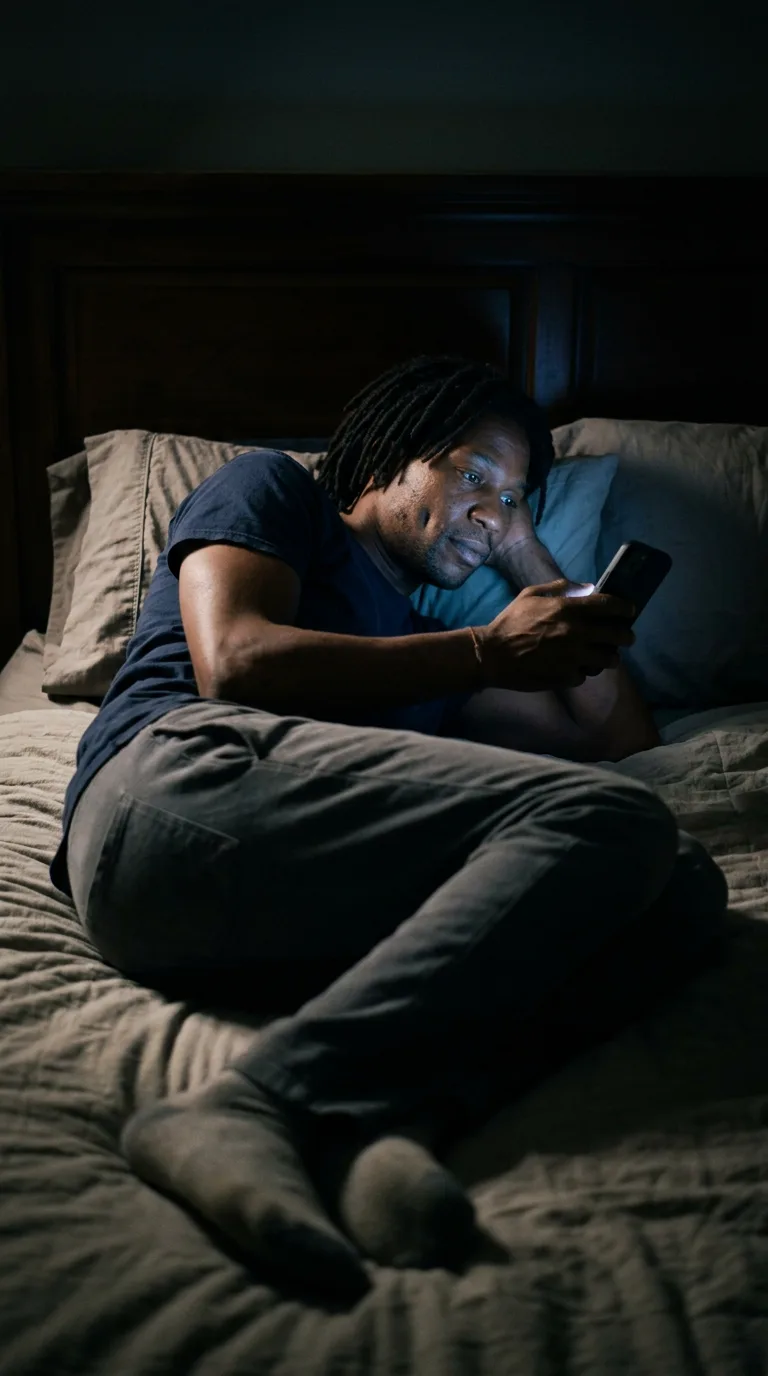
Rarest thing about him: Asthma — rare, 1 in 26
Season 0seed 1677409641 · engine v10
Character card
lineage 2NZHHJ
His body-swap story
@colin.hasbrook, wearing Curtis Yoder, rolled the wheel on and woke up as Marcus Deveaux, spent under a minute in him, then spun the wheel and woke up as Terrell Whitby
Curtis Yoder's dorm room smells like microwaved ramen and unwashed sheets, and you have been him for eight minutes, which is long enough. He is 31 and 5'4" and skinny in a way that has never once been useful to him, and his blue eyes are pointed at a laptop screen showing a discussion board post he was supposed to finish an hour ago. You feel his knee bouncing under the desk, a tic that isn't yours, inherited with the body like everything else. Eight minutes ago you spun and got a boy who does homework at eleven at night and calls his mother twice a week. There is nothing wrong with him. That is the problem. You did not come back to the wheel for Curtis; you came back the way you always do, the itch arriving before the reason for it, and by the time you are standing up out of his desk chair and walking to the laptop you already know you are not finishing his post. You open the site. The wheel is already spinning before you have decided anything, the way it always is, because deciding was never really the part you do.
The room that arrives is dark and smells like someone else's laundry detergent, cedar and cold air, and the weight of you is wrong in a new direction now — longer legs, a looser hang to the shoulders, a phone six inches from a face that is not asking permission to be a face. Your thumb is already moving. It was moving before you got here, mid-flick through something, and you keep its rhythm going a half-second before you understand you are the one making it move, faster now, cleaner, past a photo of a golden retriever and a headline about a storm system and none of it lands because none of it is yours yet. Your body — his body — is on its side, weight settled into a mattress that gives in a way Curtis's dorm bed never did, a knee drawn up, an arm dead asleep underneath a pillow. Blue light on one cheek. The room around the light is total dark, and a window somewhere behind you is doing nothing, black glass, no moon in it.
The phone is what gives him to you first. It is warm from his hand and the case has a crack along one corner that your thumb finds without meaning to, and something surfaces — not a memory yet, just a temperature, an evening like this one, dozens of them, the particular boredom of eleven at night with nothing left in the day to do but hold a small bright rectangle up to your own face. Then the shirt. It's thin, soft from washing, navy going gray at the collar, and it was pulled on this morning over a chest that is narrower than it looks in daylight — you feel that now, ribs close under skin, the give of a body that runs skinny no matter what it eats — and the memory comes with it whole: standing in front of a dresser that used to belong to somebody's grandmother, morning light coming in silver off the water the way it only does here, pulling the shirt down one arm and then the other while somebody in the next room ran water for coffee. Sara. Her name arrives with the smell of the coffee, easy, not a flash but a fact he's always known, the way you know your own name — except this isn't your name, it's his, Marcus, and it settles into your mouth like it was always going to.
There's a boy too. Small, four maybe, a car seat buckled wrong three times before it's buckled right, a laugh that comes from a chest not much bigger than a loaf of bread. That memory comes through the mattress somehow, or through the ache low in the shoulders that never fully quit from a decade of stairs and dressers and other people's pianos, a body that has spent years being paid to be strong in a specific, tiring way. You feel where the strength is — forearms, the flat of the back — and where it costs him, a wheeze starting low and easy just from lying wrong, an inhaler somewhere in a nightstand drawer he hasn't reached for tonight because he hasn't needed to, not yet. He quit smoking years ago and quit drinking without really deciding to, the way things get set down when a kid arrives and nobody notices the glass isn't in your hand anymore.
The dimples come last, strange thing to arrive through touch, but your own face gives it to you — thumb brushing your cheek to itch it, and under the fingers the ghost of grooves worn in by thirty-three years of a face that smiles even when it isn't. Sara likes them. Says so. Has said so on porches and in truck cabs and once, laughing, over a couch wedged sideways in a doorway that would not, for the love of God, go through. That one is a whole afternoon by itself — the customer's dog barking the entire time, the couch finally clearing the frame, Marcus laughing so hard he had to sit down on the curb, dimples out, chest hurting, good hurt, the kind that isn't the asthma.
Your hands crack their knuckles without you telling them to, one after another, a habit that belongs to somebody who has spent a career gripping and letting go, gripping and letting go. You feel the calluses along the base of each finger, the specific roughness of a man who moves other people's furniture for a living and comes home smelling like other people's houses.
You look at your hands in the dark, turn one over, watch the phone's light slide along the backs of fingers that have never been yours until nine seconds ago. Then you lift your eyes off it, into the black glass of the window like it's the only thing in the room looking back.
"There you are," you say, to no one, in his voice, and you don't know yet if that's true for an evening or for years.