Danny Wisniewski
Fictional. Generated by AI — not a real person, and no likeness of one is intended.
36, baker in Las Vegas · rolled by @marco.villagrana · card — no film
History
who has worn him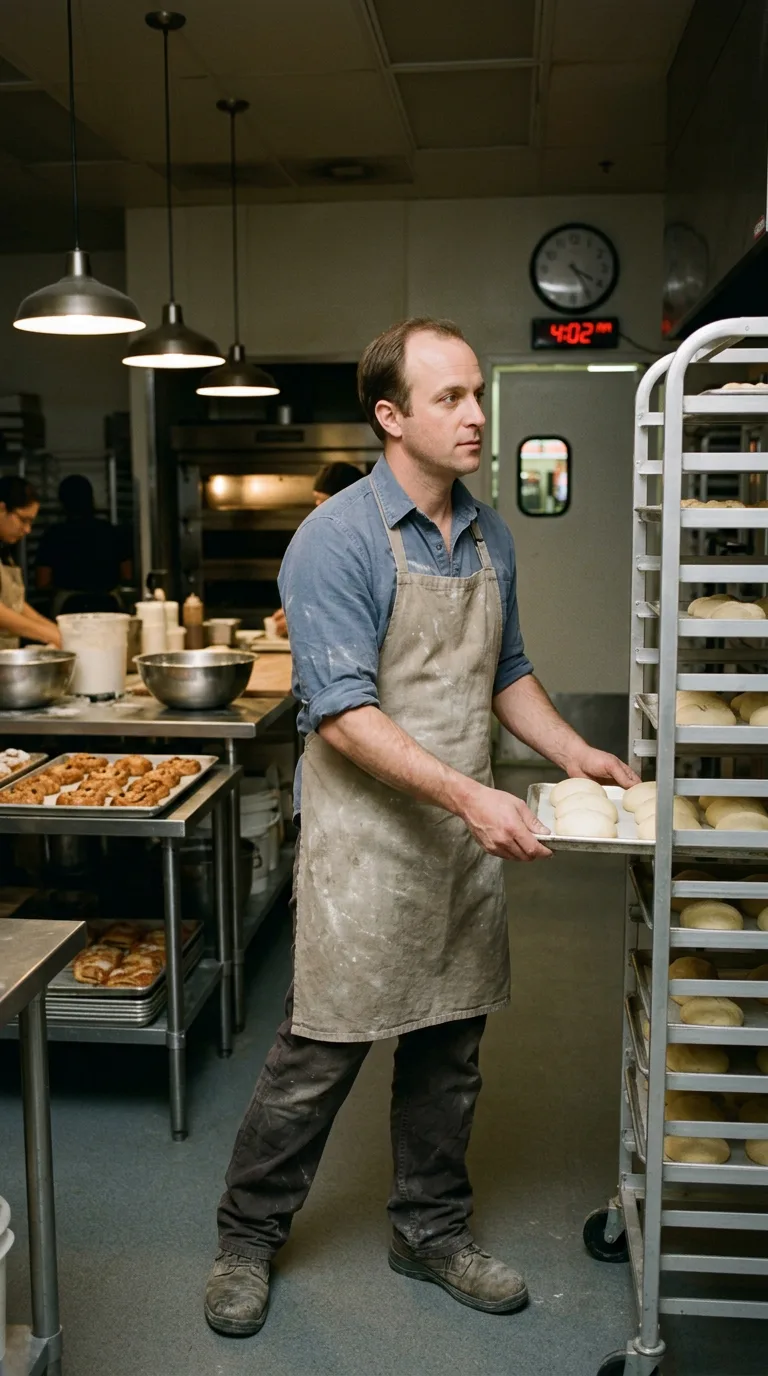
Rarest thing about him: 5'3" or under — rare, 1 in 69
Season 0seed 52642812 · engine v10
Character card
lineage LJL8SV
His body-swap story
@marco.villagrana, wearing Rey Cabrera, rolled the wheel on and woke up as Danny Wisniewski, spent 4 minutes in him, then spun the wheel and woke up as Ruben Castellanos
The wrestling mats are rolled up against the wall of the gym, and outside the window Philadelphia is doing its early-evening thing, the light going long and orange over the parking lot, and you are sitting on Rey Cabrera's couch in Rey Cabrera's apartment, feeling Rey Cabrera's gray hair against the back of the cushion, and you are bored out of your skull.
Twenty hours you've had him. Nineteen fifty-nine, technically, and you have counted every minute of it the way you always do near the end, like a man watching a parking meter. He's a good body — thirty, athletic, the broken nose giving his face a little history it didn't earn honestly. You made him run stadium stairs this morning just to feel what thirty felt like after being sixty-four two spins ago. It felt fine. It felt like nothing in particular, which is the problem. He coaches boys who call him Coach Cabrera and mean it, and for nineteen hours and change you have been walked through his gym, his practice, his easy competence with fourteen-year-olds who need to be told the same thing four different ways, and none of it has cost you anything, and that is exactly why you're already reaching for your phone.
It isn't boredom, if you're honest, though you'll tell yourself that. It's the couch. It's Gregory Farwell's ghost in the wrestling gym — not literally, Gregory's fine, alive, retired, sitting in his house in Los Angeles right now with no idea you were ever inside him for two minutes four spins back, no idea you left him twenty hours and nine minutes ago carrying nothing more than a warm memory of taking a nap he didn't ask to take. You know his roommate's face from the inside of Gregory's life — a name that came up over coffee that never happened, a key on a hook by a door that isn't yours, a man who bakes bread for a living and bounces his leg and worries, in the particular unspoken way roommates worry about each other, about money and a woman and a kid he doesn't see enough. You didn't choose to remember him. He just came along, the way things do, riding in Gregory's furniture.
You open the site on Rey's phone with Rey's thumb. The wheel is already spinning before you've decided anything, the way it always is.
—
The dough is heavier than it looks, that's the first thing, the tray dragging at his forearm, and your hand — his hand — is halfway through sliding it onto the second rack from the top when the motion stops being automatic. It stumbles. The tray tips a half-inch, corrects, and you set it down again, slower, checking the angle like it's your first week. Behind you a radio is playing something with a lot of static in it. Ahead of you a clock on the wall reads a little after four, red digital numbers under an analog face that agrees with it, and the room smells like yeast and hot metal and someone's cigarette break drifting in from a cracked door that shouldn't be cracked this close to ovens.
Your body is short — shorter than you expected the moment you're standing in it, the rack in front of you taller than eye level in a way Rey's shoulders never had to think about. Flour is worked into the creases of two hands that are not the hands you had nineteen hours and fifty-nine minutes ago. You flex them once, watching them do it like a machine you're testing.
—
Then the apron strap against your neck gives you the morning: standing in a bathroom that isn't big enough for two people to share a mirror comfortably, pulling the denim shirt on one sleeve at a time, right arm first, always right arm first, some habit older than you can place a reason to. Rolling the cuffs to the elbow because they get in the dough otherwise, learned the hard way, a whole ruined batch of brioche eleven years ago that his old boss made him eat the evidence of, standing there chewing sweet eggy dough at six in the morning while getting chewed out. The apron next, tied twice because once always slips by ten. Boots that have a permanent lean to the left heel from a hip that turns a certain way when he stands at the bench too long — thirty-six years old and the hip already complains, a dull thing he doesn't mention to anyone, not even her.
Her: the smell of the shirt collar carries a ghost of a different house, a different laundry soap than the one at his own apartment, and it opens a door you didn't ask to open — a woman's kitchen, plants on the windowsill, a fight that happened in it eight months ago that ended things, quieter than it should have been for how long it had gone on. Recent enough that some nights, doing this exact motion, sliding trays, his mind still walks back into her kitchen instead of staying here. He doesn't let himself finish that thought most days. You don't get to finish it either — the memory closes as fast as it opened, the way they do, partial, someone else's grief passing through you like weather.
His hands know this job in a way that has stopped needing his attention, which is exactly what makes the stumble strange to him, later, if he ever thought about it — he won't get the chance. Ten thousand trays before this one. The burns on the inside of his left forearm that faded to nothing years ago, the two fingers on the right hand that don't quite straighten all the way from a mixer bowl incident that got him three stitches and a week of the guys calling him Lefty for no reason that made sense. The girlfriend he lives with now — a whole different kitchen, a whole different set of plants, newer, still a little careful with each other, a leg that bounces under the table some nights while he watches her cook and says nothing about the ex, about the money, about the kid he sees on weekends and misses on weekdays with a specific ache located somewhere under the sternum that never fully goes away and that he has gotten very good at not naming out loud.
The boots on the floor. The floor holds the memory of standing here at four in the morning for eleven years, except — you notice it now, holding still in him — the clock says afternoon. Off-shift. A day shift, maybe covering, maybe a schedule gone sideways this week; whatever the reason, his body doesn't know it's wrong, it just does the job, the same job, wherever the clock happens to land.
The kid's photo lives in his wallet, in his back pocket, warm against him the whole shift without him noticing it's there. You notice it now. A four-year-old with his mother's chin.
He goes to church some Sundays, not all. Says a specific quiet thing to himself when the ovens are lit before dawn, out of habit more than conviction anymore, but he still says it.
—
You look down at flour-dusted hands, turn them over once in the tray-light, watching the two fingers on the right that won't quite straighten.
"Wrong shift," you say, out loud, to no one, and you don't know yet if you mean the clock or something further down than that.
Then you lift your eyes off your own hands, and you hold there.