Ruben Castellanos
Fictional. Generated by AI — not a real person, and no likeness of one is intended.
57, field archaeologist in Las Vegas · rolled by @marco.villagrana · card — no film
History
who has worn him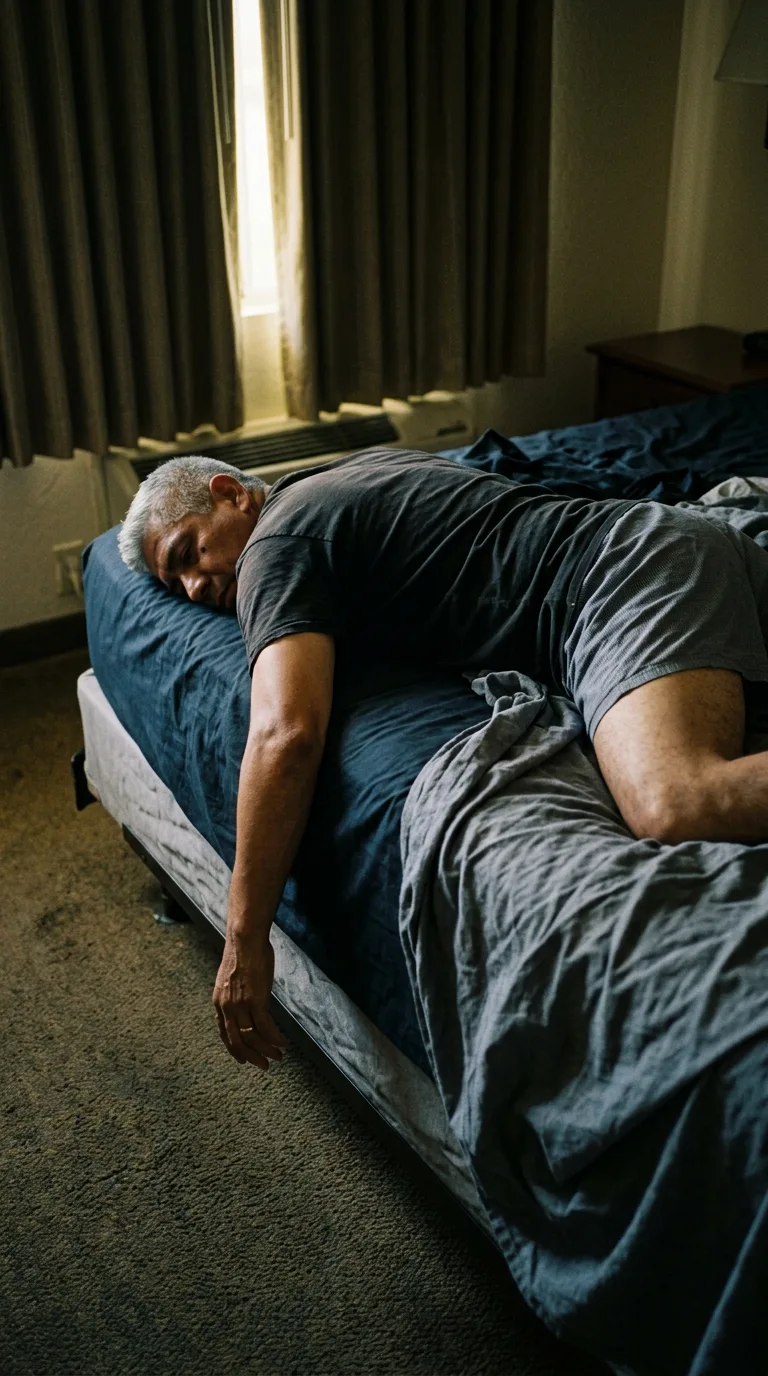
Rarest thing about him: 6'1" — rare, 1 in 50
Season 0seed 1526099882 · engine v10
Character card
lineage LJL8SV
His body-swap story
@marco.villagrana, wearing Danny Wisniewski, rolled the wheel on and woke up as Ruben Castellanos, spent 3 minutes in him, then spun the wheel and woke up as Cody Deschamps
You are Danny Wisniewski for exactly four minutes, and every one of them itches.
It is the flour under the nails you cannot get used to — his nails, short and square, ground with white even after washing. It is the apron string still tied at your back from whatever the last spin did to him mid-shift, dough gone cold and forgotten on a steel table behind you, and the low ceiling of the walk-in you are standing near because his knees, if you can call them that, ache from a floor mat that never sits right. Five-three of him. You keep misjudging the distance to things. Your shoulder catches a hanging rack of pans on the way past and you don't apologize because there is nobody in you left to be embarrassed on his behalf. Green eyes. Light hair, thinning at the crown in a way he was probably vain about, back before there was no he to be anything.
You did not come here for him. He is a placeholder, four minutes of holding pattern in a body that smells like yeast and burnt sugar, and you already know, standing here working his cheap jaw, that you are only here to spend money and time on a screen. The phone is in the apron pocket. It takes his thumb — soft, unused to real labor — three tries to get the passcode right, because his memory of it is not fully wired into your wanting yet, and you don't wait for it to be. You open the site. vessel.cards. The wheel sits there, patient, unbothered, the way it always is.
You spin.
The bakery is gone before you feel it go.
—
The room comes first: a wedge of streetlight through drape gap, air conditioning ticking somewhere in the wall, the smell of a hotel that has been cleaned too many times to be clean. You are face down. There is a mattress under you that is not yours — was not his, either, not really, just a bed rented by the week or the season — and an arm hanging off the edge of it that does not feel like effort to lift. It lifts anyway. Ragged breath goes even in the space of a single inhale, and the arm draws up on its own, folding over a chest that is broader than the one you just left, heavier, the ribs working slower and deeper. Hands come together over the sternum, fingers laced, a posture no sleeping man arrives at by accident. You did not do that. Some current in the meat did, settling you the way water finds level.
Fifty-seven years in this frame and you can feel all of it at once and none of it yet.
—
The shirt is not on you — that comes later, waking, minutes from now that this story doesn't get to — but your hand finds the wedding band on its way past your own face, an old habit surfacing before you've earned it, and that is the first door.
*Alicia.* The name arrives whole, with a smell — coconut shampoo, drugstore brand, twenty-six years of the same brand because she found one she liked and never saw a reason to change — and a small kitchen in Henderson with a window over the sink that caught the morning wrong, too bright, so she kept a plant there that never thrived and never died either. You feel, not remember — feel — an argument from a decade back about moving to be closer to a dig in Chaco Canyon, and how it dissolved into nothing because she'd said, tired, not unkind, *Ruben, you'd dig up the whole state if I let you*, and he'd laughed, and that had been the whole fight.
There is a son. Marcos. Nineteen, at UNLV, wanting to be an engineer, and there is a particular pride in that which does not feel like your pride, sharp and unearned and wonderful anyway, borrowed the way all of this is borrowed — the memory of teaching a nine-year-old to screen dirt through mesh in a backyard sandbox, the boy delighted at finding a bottle cap and being told, gently, that was history too, everything's history eventually.
The khaki shirt is folded over a chair somewhere near this bed — you can smell it before you can see it, sun and someone else's dust, a specific reddish grit that never fully washes out — and through that smell comes this morning, or a morning enough like it that the body doesn't distinguish: standing in a motel room outside Overton, one sleeve at a time, buttons done by feel because his eyes were still on the site map spread on the bureau, a squared trench waiting on him under a sun that would be ninety by ten. His hands know these buttons. They know a trowel's balance without looking, the particular give of dry soil versus wet, the ache that lives now permanently behind both knees from decades of kneeling in the dirt for other people's forgotten lives. He is proud of it in a way he doesn't talk about at church, where faith is supposed to be about souls saved forward, not bodies pulled up out of the past. He carries an inhaler in the truck, not on him, which he knows is stupid, which he does anyway.
He drinks two fingers of something most nights on a motel balcony because the work is lonely in a way marriage from four hundred miles off cannot fix, and there is no vice in it, no shame, just a man easing a long day out of a body that is fifty-seven now and was not always going to be fine with kneeling in a trench eight hours in Nevada July. His jaw is doing something now, has been the whole time you've been in it — clenched, tight at the hinge — an old tell he's never noticed himself doing, the tension going somewhere since his hands never learned to shake.
The strange arithmetic of the clocks needles at you, distant: him mid-morning-turned-midday out at a site hours from here, if this were his day and not the day you arrived into it sideways; you, here, at a Wednesday afternoon that belongs to whoever last owned this hour. It does not resolve. It only itches, like the flour did.
—
You bring the left hand up in front of your face — his hand, thick-knuckled, tanned unevenly at the wrist where a watch usually sits, the band on the ring finger dulled with years of concrete dust and desert grit worked into the metal — and you turn it over slowly, watching the tendons shift, feeling the two fingers that don't fully straighten anymore from an old injury that isn't yours to have caused.
You sit up. The asthma announces itself faintly, a tightness two breaths deep, nothing yet, just a body letting you know its terms.
You look up, into the gap in the curtain, streetlight thinning now toward something that might be dawn or might be nothing at all.
"Okay," you say, in his voice, testing the weight of it. "Okay."