Danny Purcell
Fictional. Generated by AI — not a real person, and no likeness of one is intended.
48, delivery driver in Los Angeles · rolled by @colin.hasbrook · card — no film
History
who has worn him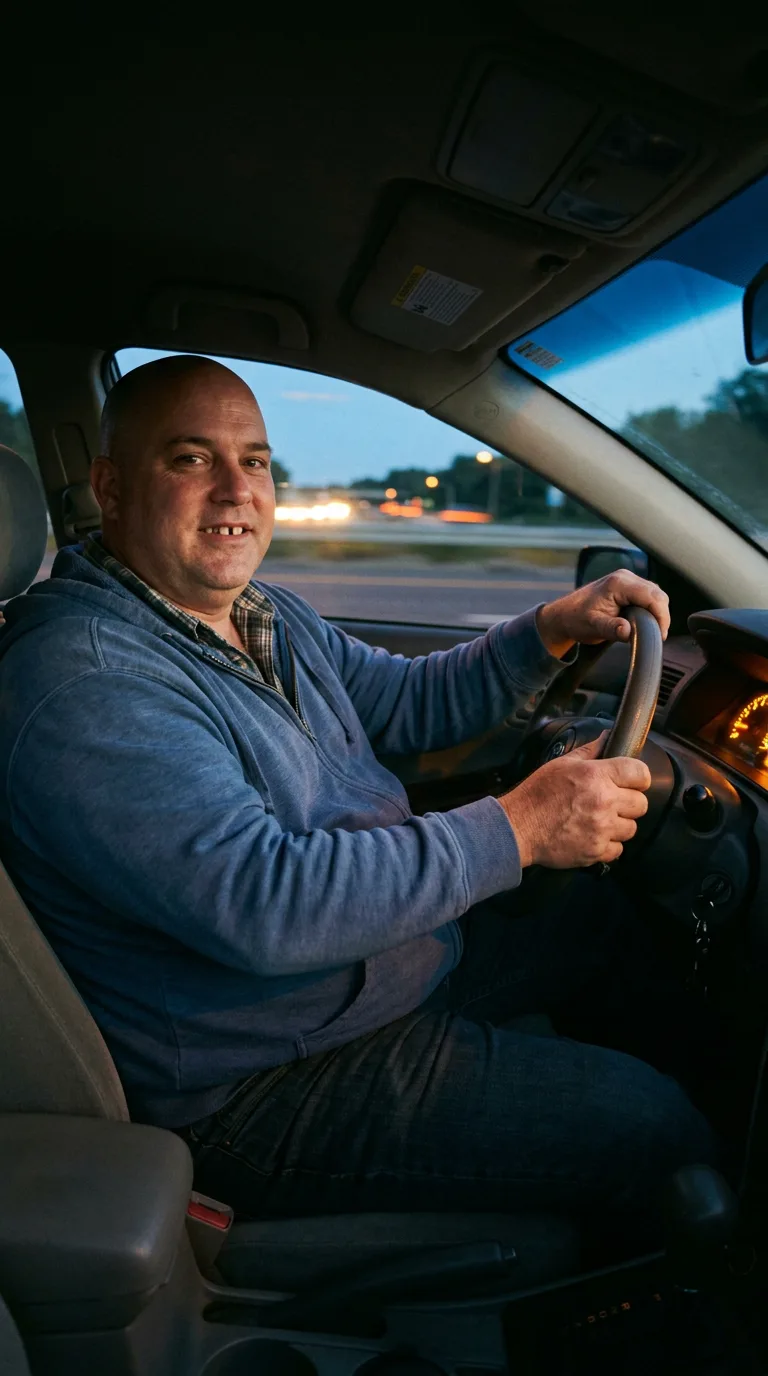
Rarest thing about him: Flips a lighter — common, 1 in 37
Season 1seed 106320596 · engine v11
Character card
lineage 2NZHHJ
His body-swap story
@colin.hasbrook, wearing Wade Corliss, rolled the wheel on and woke up as Danny Purcell, spent under a minute in him, then spun the wheel and woke up as Wallace Griggs
---
The Dallas evening comes in low through a window you have owned for one minute, and already you want to be somewhere else.
You are Gary Halvorsen. Fifty-nine years old, dad bod softening a shirt that smells like the inside of a gas station, gray hair thinning at the crown, hazel eyes that are not yours looking out at a kitchen that is not yours either. Sixty seconds ago you spun and got him, and that was the whole point — you knew this house, you knew this man, you'd been him before, twelve spins back, and something in you wanted to stand in his doorway again just to check it was still there. It isn't. The recliner is the same recliner. The register receipt on the counter has his handwriting on it, a coupon he clipped and never used. You know already, in the sixty seconds you've had him, that you are not going to stay. There's a particular boredom that comes from a house you've already lived in once — every drawer already opened, every ache in the lower back already catalogued — and it arrives so fast it's almost insulting to him, whoever he was to himself. You paid for this and you are already reaching for your phone to pay for the next one.
You spin.
—
The van door is open behind you, warm exhaust and hot asphalt, and your hand is on a box marked FRAGILE and your other hand is on nothing, on air, because a half-second ago it was resting on a scanner holstered at a hip that isn't there anymore.
You are shorter. That is the first thing, the drop in your eyeline, the ground closer than it has any right to be. Heavier too, but low and solid, weight sitting in the gut and the thighs, a body built for lifting rather than reaching. Your scalp prickles where the last sun of the day is landing on bare skin — no hair, none, just heat directly on skull. Your tongue finds a gap between your front teeth before you've decided to look for it, an absence it keeps checking, a habit that isn't yours yet and already is.
The box is heavier than it looks. Your knees already know how to take it.
—
The polo shirt is doing it first — brown, damp at the collar, a shirt that has been worn through ten thousand identical evenings, and touching its collar gives you a flash of a locker room smell, of clocking in at 6 a.m. in a lot that's already shimmering with heat, of Danny Purcell laughing with a guy named Ovando about a dog that chased the truck on Vermont. Then more: an entire route unspooling, Crenshaw to Baldwin Hills to a stretch of Culver City where the gate codes never work, three hundred and forty stops today alone, his back a permanent low complaint he has stopped mentioning to anyone. He is forty-eight. He has been doing this for eleven years and his knees know every driveway grade in three zip codes.
The scanner in the holster at his hip — you feel its weight swing when you shift, and it gives you the sound of it, the particular click-beep-click of the whole day, thousands of them, each one a doorstep, a porch, a dog barking behind a screen, a woman in a robe signing for something she forgot she ordered. His hands know this motion without him: scan, tuck, lift, walk. You didn't learn it. It was already there, sitting in the muscle like a language.
The shorts — brown cargo, a phone-sized bulge in one pocket that's actually a folded lighter, unlit, never lit, because he doesn't smoke and never did, just likes the flip of it, the click, something to do with his hands at red lights — bring back a Tuesday two years ago sitting in the cab outside a Ralphs, flipping it open-shut-open-shut while Marisol texted him a photo of the kitchen she wanted to repaint, and he'd smiled at his phone like an idiot in an empty van.
Marisol. The name comes with weight, with a whole apartment courtyard of dry palms and stucco going gold in evening light, with the specific creak of their unit's screen door, with a couch they picked out together at a warehouse in Van Nuys, with her laugh loud enough that the neighbor upstairs bangs on the floor sometimes, half-joking. Four years together. She keeps a candle lit on the counter even in summer and he's never told her it's a fire hazard because he likes coming home to the smell of it.
And under that, older, quieter — Renata. An ex from a decade back, the one whose name he still turns over sometimes without meaning to, not with wanting exactly, just the specific ache of a person you built a whole self around once and then didn't. She used to fold his shirts a particular way. He still folds them that way. Marisol has never noticed.
This morning — this same brown polo, pulled off a hanger in a dark bedroom while Marisol slept with one arm thrown over her eyes, the smell of her shampoo still on the pillow, the belt threaded through the loops one-handed because his other hand was already holding his coffee, the boots laced sitting on the edge of the bed because bending all the way down at his weight, at forty-eight, costs him something in the lower back that it didn't used to. Sock, sock, boot, boot. A kiss on her shoulder she didn't wake up for. The gap in his teeth catching the rim of the coffee mug the way it always does, a small familiar clumsiness he stopped noticing years ago.
None of this is remarkable. That's what lands hardest — the sheer, ordinary weight of an actual life, three hundred and forty stops and a woman asleep in the next room and a lighter that's never lit anything, and how none of it knew this was coming, how there was no moment in any of those years shaped like a warning.
You are still holding the box. Your knees still know how to take it.
—
You set it down on the van's back gate and look at your hand — thick fingers, a faint white ring-groove around nothing on the fourth finger, though he never married, gap-toothed scar-free skin, a callus at the base of the thumb that a scanner trigger put there year over year. You turn it over once, like checking it's attached right.
Then you look up, off the van, toward the courtyard light coming through the dry palms, and you say, out loud, to no one:
"Three miles. I was three miles out."
The lighter is already moving in your other pocket, thumb finding it on its own, flip, click, flip — his hand doing it before you've caught up to wanting to. Somewhere behind you a phone is buzzing with Marisol's name on it, and you don't know yet how long you're going to be the one who answers it.