Wallace Griggs
Fictional. Generated by AI — not a real person, and no likeness of one is intended.
61, forklift driver in Phoenix · rolled by @colin.hasbrook · card — no film
History
who has worn him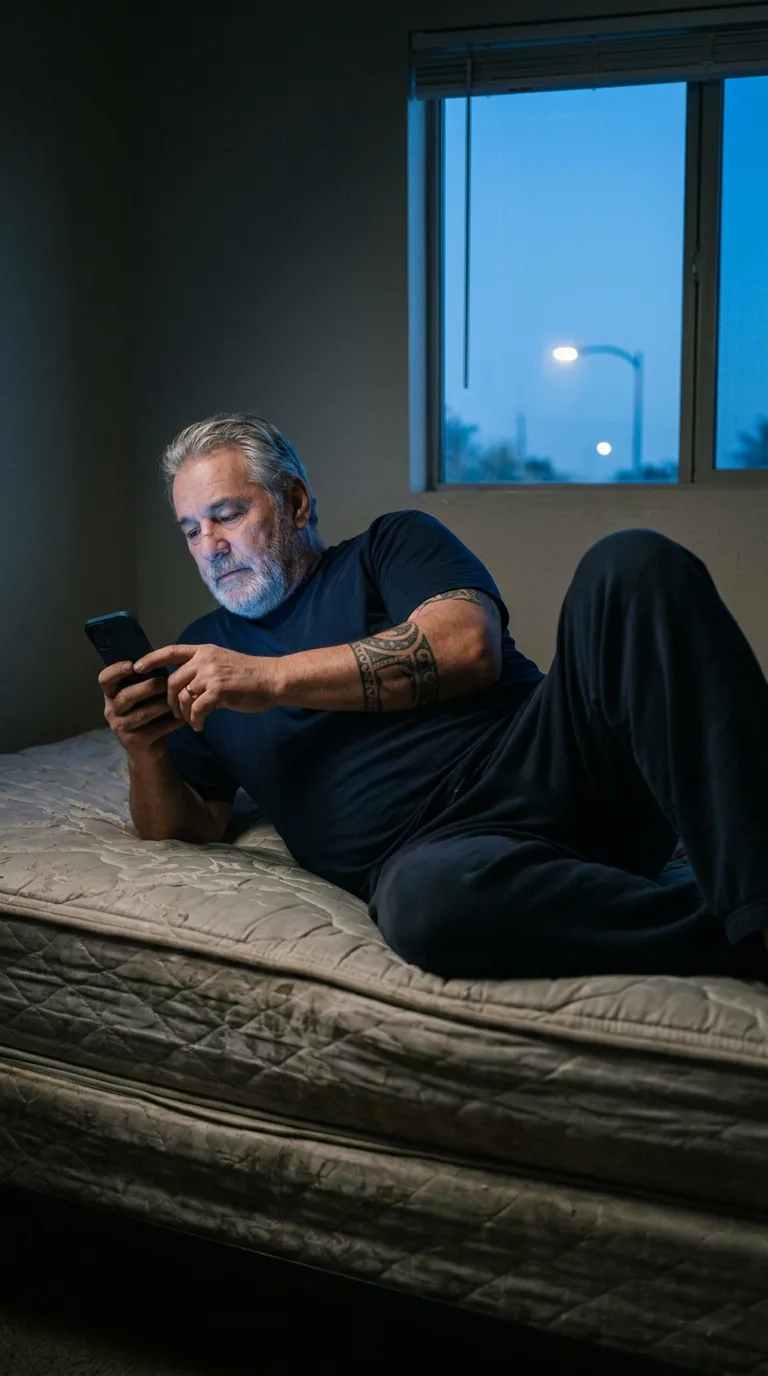
Rarest thing about him: Picks at his cuticles — common, 1 in 34
Season 1seed 1919446778 · engine v11
Character card
lineage 2NZHHJ
His body-swap story
@colin.hasbrook, wearing Danny Purcell, rolled the wheel on and woke up as Wallace Griggs, spent under a minute in him, then spun the wheel and woke up as Justin Feng
Danny Purcell's gap-toothed mouth is still open on a laugh that isn't yours when you make the decision, forty seconds into being him. The delivery route sheet is on the passenger seat, the shift is over, and this body is small and soft in a way that stopped being interesting the moment you noticed it. Bald head sunburned at the crown. Bad knee already. You spun three times to land here and you are not spending the evening in it. That is the whole reason, and it is enough: you were bored inside a man before his key was even out of the ignition. You open the site on his phone with his thumb, because it is the only thumb you have, and you pay, and you spin.
The bed takes your weight wrong for a second — heavier, lower, a mattress gone soft in the middle from years of one man's shape — and then it takes it right, because it is your weight now. The room is dark and blue. A phone is six inches from your face, too close to read, and the thumb below it is moving before you have told it to, fast and even, clicking past photos of grandchildren who are not yours yet, a truck for sale, a meme about coffee, none of it stopping. Somewhere behind the sternum there is still a slight rise and fall that isn't panic, because the body doesn't know to panic. It is just breathing. You are just here.
The shirt is what starts it. Thin cotton, warm from a body that ran hot all day in vest and gloves, and through it comes the memory of pulling it over his head that morning, both arms up, the half sleeve pulling tight at the elbow the way it always does, black tribal ink dragging against fabric, a habit of tucking it in even though nobody at the yard cares. Wallace Griggs has been tucking his shirts in since his father made him do it at fourteen and it never stopped being what a man does. The shirt gives you that, and then it gives you more: thirty-one years on a forklift, first for a produce distributor that folded, now for a steel supplier out past Van Buren where the yard is gravel and the saguaros throw long black shapes across it at five in the afternoon and the cold storage bay is the only relief from a heat that has broken men younger than him. His hands already know the wheel before you do — the particular give of it, the mirror check that is pure reflex, forty years of never once backing into a rack. He loves the forklift the way some men love a boat. Nobody asks him about it and he has stopped expecting them to.
The ring is next, cool and plain against your — his — finger, and it opens on Carol. Twenty-six years married, and what comes up first isn't the wedding, it's an ordinary Tuesday: her at the stove, him coming in dust-gray from the yard, her saying something about their daughter's tuition without turning around, and the specific, unglamorous comfort of a marriage that has worn its rough edges smooth. But under that, quieter, someone else — a woman two decades gone now, a name that still catches when he lets it, Renata, who left for Tucson before Carol, before any of it, and who he thinks about at red lights sometimes and is ashamed of thinking about and thinks about anyway. That's just the man. You didn't put it there.
The phone itself, still warm, gives you the last hour of his actual evening — a long shift, a body that aches in the lower back the way heavy men's backs ache at sixty-one, a shower, sweatpants, the particular relief of lying on his side with nothing left to do. He quit drinking nine years ago without a program, just stopped, the way he quit the cigarettes before that, both times for Carol and both times something he's quietly proud of and never mentions. Catholic in the unexamined way — a cross on a chain in the nightstand drawer he touches on bad days, mass at Christmas and Easter and his mother's death anniversary. His hand, you notice now that you're paying attention to it, has gone to the pad of his thumb and started working at the cuticle there, worrying it the way it does when the mind is somewhere else, which is always.
His daughter's name arrives with the phone's lock screen — a girl at maybe nine, missing a tooth, laughing at something off camera — and it comes with an ache that has nothing to do with anything you did, an entire small life he helped build and mostly missed the middle of because of double shifts, and the specific hope, worn thin from handling, that she still calls him Thursdays.
The nose is the last thing, and it isn't touch that opens it, it's the mirror across the dark room catching just enough streetlight to show its shape — broken at twenty-two in a parking lot outside a bar in a fight he started and doesn't remember starting, set crooked by a doctor who didn't much care, worn on his face for thirty-nine years like a signature.
You stop scrolling. You let the thumb go still. You bring the hand up in front of your face, both broad fingers, the ring catching what little light there is, the cuticle already picked a little raw at the edge, and you turn it once like it's something you're checking for damage.
"Christ," you say, out loud, to the dark room, in a voice lower and rougher than the one you had forty seconds and eight hundred miles ago, "I forgot what it felt like to be big."