Dalton Braswell
Fictional. Generated by AI — not a real person, and no likeness of one is intended.
24, help desk technician in Small-town Ohio · rolled by @colin.hasbrook · card — no film
History
who has worn him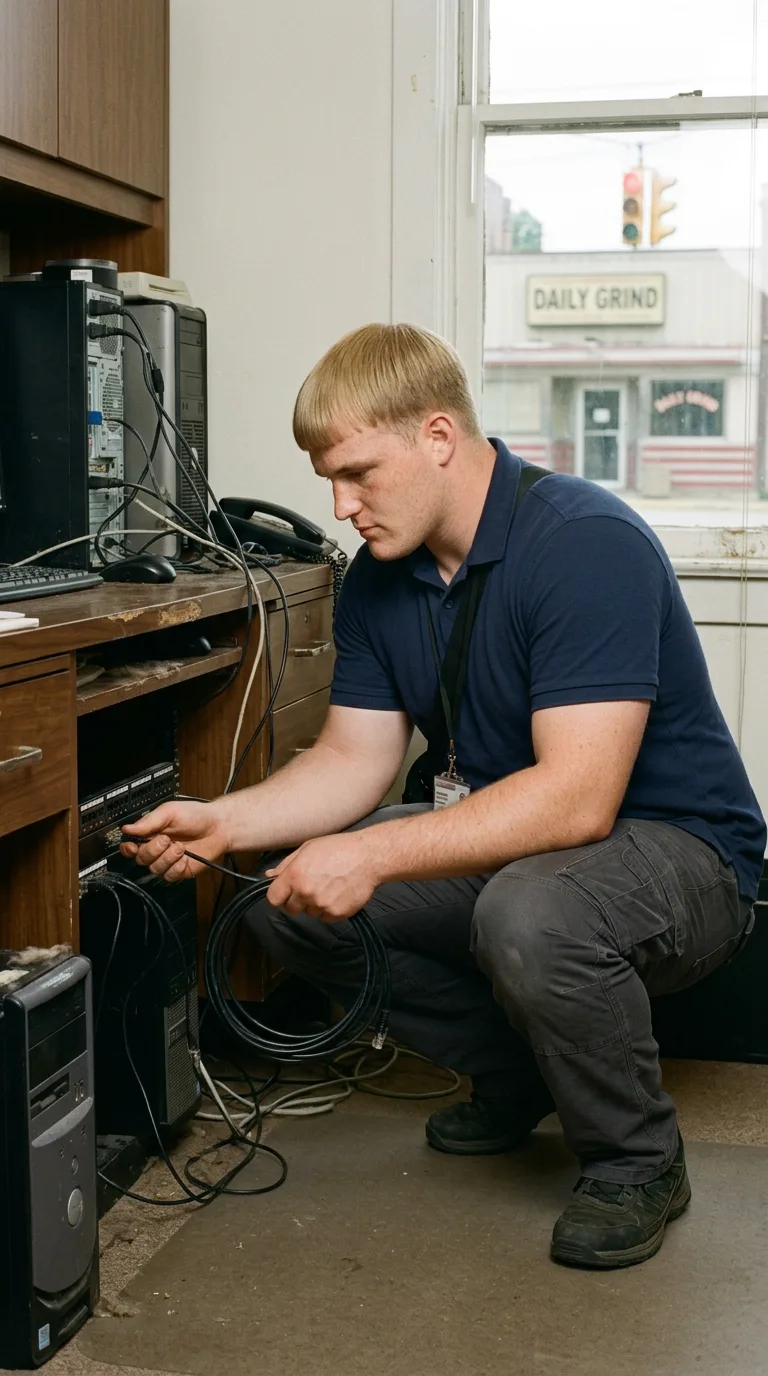
Rarest thing about him: Help desk technician — common, 1 in 175
Season 1seed 1919717559 · engine v11
Character card
lineage 2NZHHJ
His body-swap story
@colin.hasbrook, wearing Charles Liu, rolled the wheel on and woke up as Dalton Braswell, spent 5 minutes in him, then spun the wheel and woke up as Marcus Reddick
Chaplain Charles Liu has been sitting in the hospital break room for forty seconds, and he is already boring you.
You feel it as his own hands feel it: the paper cup of vending machine coffee going lukewarm between his palms, the laminate badge with his face on it, the pager clipped at his hip that has not gone off in an hour. Somewhere down the hall a family is waiting for you to come tell them something gentle. You know exactly how that conversation goes. You have done it 787 times in one shape or another, in one body or another, and Charles Liu's shape is a good one — kind eyes, broad shoulders, a voice that lands soft — but good is not the thing you spun for today.
The thing you spun for is sitting under a desk two states and one time zone over, half past a shift that started before dawn, in a town with one stoplight and a diner that closed years ago.
You know him. That's the whole of it, the itch you can't scratch sitting here in scrubs-adjacent khakis with a dead man's — no, not dead, never dead, just emptied — pager on your hip. Twenty-one minutes ago you were his brother. Six minutes you spent as Colton Braswell, freight handler, Rural Texas, 5'4" and built like a fireplug, and in those six minutes his hands told you things his mouth never would. A phone call neither brother answers anymore. A name said only once, at Thanksgiving, and never again. Money that came from somewhere Colton doesn't ask about and won't touch. You left Colton on his loading dock, leg bouncing against a pallet jack, and you thought that was that.
It wasn't. You want the other one now. You want to know what it looks like from the taller side of that silence.
You set the coffee down. Charles Liu's chaplain badge catches the light. You are already gone before your thumb finds the site again — vessel.cards, the wheel spinning up cheerful and lazy on a screen that isn't really there anymore, not to you, not once the wheel starts turning.
—
The screwdriver is between two fingers, still turning, and it turns wrong — quarter-inch too far, cross-threading a screw that has gone into this exact panel a thousand times without a fuss — and then it turns again, right, slow, deliberate, like someone learning the motion for the first time from an old memory of it.
You are crouched. Your knees complain about it in a way Charles Liu's never did. There's a desk above you, computer towers stacked like cinderblocks, a phone cord looped over your shoulder, and daylight coming through a window somewhere behind you at an angle that says late morning, though something in the joints of this body is arguing for two in the morning, for a night shift stumbling toward its end. You do not know yet which one is true. You only know your hands — his hands — are thick-fingered and sure, and the cable in your left palm is already coiled the way a man coils it who has done it ten thousand times.
You check the next connection. And the next. Ten in a row, each one checked twice, on a job that stopped needing checking years before you arrived in it.
—
The polo shirt is what opens first — navy, damp at the small of the back, the lanyard's strap sitting in the same groove it always sits in, worn soft there — and it comes with the smell of the break room microwave two floors up and the particular ache of a body that carries itself heavy and calls it strength. Dalton Braswell. The name arrives with the shirt like it was stitched into the collar. Twenty-four years old. Freckles that were never anything but a joke to him — his mother called them cinnamon, once, and it stuck, and it still needles some soft, private nerve every time a coworker says it too.
The lanyard gives you the office: four desks, one closed diner across the street called the Daily Grind that hasn't ground anything in three years, a boss who calls him "the Wire Whisperer" without irony. You like this man. You liked his brother too, in the ten-thousand-dollar way you like all of them for exactly as long as you're wearing them, but this is different — this is the one who stayed. Who didn't leave for the freight yards, who didn't leave for anything. Who still lives forty minutes from where he grew up and drives past the house sometimes without meaning to.
The cargo pants give you the money — not his, technically, not on paper, but there, humming under the whole of his life like a second electrical system nobody talks about at Thanksgiving. An inheritance neither brother wanted to explain to anyone in town, so neither of them spends it where anyone can see. Dalton's version of not spending it is this: the same off-brand boots for three years running, the same three polo shirts on rotation, a coffee mug with a chip in it he refuses to replace. Colton's version, you remember now, wearing this man's memory of that man, was a truck he never drives anywhere interesting. Two brothers holding a small fortune like it might go off.
This morning — his morning, hours behind or ahead of the one you left, you can't tell which and his body won't say — he pulled this shirt over his head standing in a kitchen that still has his mother's curtains in it, and he did not think about any of that. He thought about the "server" that is really just three desktop towers duct-taped into a shelf, about whether Denise at the front desk was going to ask again about her printer, about nothing, about the specific static-hush peace of a mind that has made room in itself for repetition and lets the repetition hold it up.
You feel the leg starting before you understand it's happening — a bounce, heel drumming lightly against the carpet, a motor that runs under him whether or not there's anything to be nervous about. It has run under him since he was nine. Nobody in his family calls it nerves. They just call it Dalton being Dalton.
There is no drink in this memory anywhere, no cigarette ever lit, just clean mornings and quiet nights and church on the occasional Sunday that he stopped attending years ago without deciding to, the belief still there, just unhoused now, floating loose in him the way it floats loose in a lot of men his age in a lot of towns like this one.
And under the diner sign in the window, under the stoplight cycling red for no one, there is Colton — six minutes of him still fresh in your borrowed memory, a brother two states south with the same jaw held tighter, the same money held the same silent way, the two of them a matched pair who never talk about what they're sitting on.
—
The screwdriver is still in your hand when you finally look at it.
You turn the hand over slow, freckled knuckles, a fresh-shaved jaw you didn't earn tilting down to watch it happen, and for one full second it is the strangest object in the world — a tool built for a task you now know backward, in a hand that has done nothing else for years and never once stopped to notice.
You lift your eyes off it into the window glass, into your own reflected face, blond fringe cut dead straight across the brow, and you say, quiet, to no one in the empty office:
"Hey, Colton. Bet you didn't see this one coming."