Wesley Tannehill
Fictional. Generated by AI — not a real person, and no likeness of one is intended.
27, forklift driver in Nashville · rolled by @colin.hasbrook · card — no film
History
who has worn him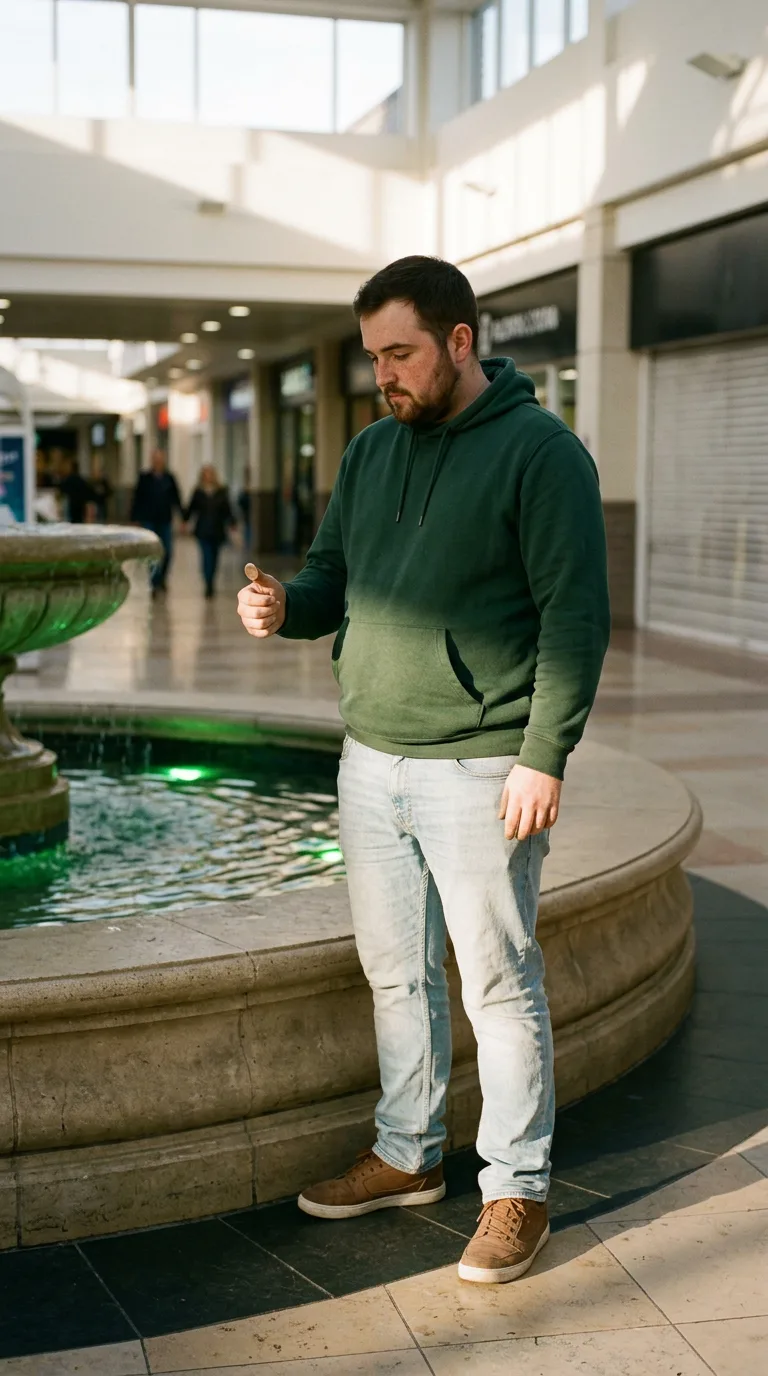
Rarest thing about him: Making a wish — common, 1 in 65
Season 1seed 1505158498 · engine v11
Character card
lineage 2NZHHJ
His body-swap story
@colin.hasbrook, wearing Isaac Cordero, rolled the wheel on and woke up as Wesley Tannehill, spent under a minute in him, then spun the wheel and woke up as David Choe
The hedge trimmer is dead in Isaac Cordero's hands, and the last of the light is going orange over a Rural Texas fence line, and you are twenty, athletic, gap-toothed, one minute into a body that already bores you. That's the thing nobody warns you about the wheel: it's not the men who are bad, it's the *waiting inside them* once the newness burns off, which for you now takes about sixty seconds flat. You wipe your palm — his palm — on his jeans. You think about the mortgage-sized hole this kid is in, the truck payment, the mother who calls twice a day, and you think: no. Not tonight. You want something with less debt breathing down its neck and more hands that know a real machine, something with weight to it, a life with some meat on the bone instead of a boy still growing into his own wrists. You take out your phone — his phone — and you go to vessel.cards, and you spin, because the correct amount of a person to be is always the next one.
The wheel doesn't ask why. It never does.
You are standing at the lip of a fountain and the coin has already left your thumb.
It goes down without turning, not once, end over end the way a flipped coin should, just a flat little vertical drop, and the splash it makes folds backward into itself, inward, wrong, like the water flinched. You feel that wrongness arrive a half-second before you feel anything else — a dad-bod weight settling into a stance that was built for someone shorter through the torso, greener through the eyes, and the green isn't just his eyes, it's the fountain-light climbing the underside of your — his — jaw. Beard. Short, close to the line of it. Freckles you can't see but can feel, somehow, the way you can feel a scar on skin that isn't yours yet, a scatter of small warm points across the nose that this face has always had and always will.
The hoodie is against your back and that's the first door.
Green cotton, worn thin at the elbows, a smell of fabric softener and the particular cold of a warehouse that never fully leaves clothes even after the wash — and Wesley Tannehill comes up through it in pieces. Not his name yet. Not his face. Just: *this morning*, pulling the hood on over wet hair in a one-bedroom off Nolensville Road, the dryer buzzer going off two rooms away because he'd forgotten it, the particular ache low in his shoulders that comes from eight hours steering a forklift mast up and down in a warehouse kept forty degrees for the sake of pallets that don't feel the cold. He'd stood in front of the mirror in this exact hoodie and thought, not for the first time, that he looked like his father did at thirty-five, and hadn't minded it as much as he used to.
The jeans give you the drive over — windows down even though it wasn't warm enough for that, radio on a station that plays the same forty songs, his knee bouncing at a red light on Charlotte Pike. The sneakers give you the walk in, past the Auntie Anne's with its shutter half down, past a couple holding hands he didn't look at twice, though something in his chest tightened a little anyway, an old reflex from being the one who used to hold somebody's hand in a mall on a Wednesday and doesn't anymore.
That's when she comes, sideways, through no object at all — just a feeling attached to the coin itself, the weight of it on his thumb, a habit from a woman he hasn't called in fourteen months and still thinks about on the forklift sometimes, in the cold, between pallets, when the radio in his headset plays the wrong song. She used to make him throw a coin in every fountain they passed, said it was bad luck not to, and he'd rolled his eyes and done it every time because it made her laugh, and now he does it alone and doesn't examine why. He isn't wishing for her tonight. He tells himself that. He isn't sure it's true.
The gloves aren't on him now — they're in the jacket pocket of the vest he wore to work today, hung over a chair at home, and touching the memory of *them* instead of the gloves themselves gives you the job clean: the mast lever worn smooth under his palm, the cold that gets into the meat of his hands by hour three no matter what he wears, the particular satisfaction of a pallet set down square on the first try, no adjustment needed, a small workmanlike pride that has never once needed anyone else to notice it. He is good at a thing that nobody applauds. He has made peace with that, mostly, the way you make peace with a body that carries more of you around the middle than it used to and still gets the job done every single day without complaint.
None of it — not the money he owes, not the girl who isn't calling, not the cold he carries home in his shoulders — has weight against the water going still in front of you now, closing back over where the coin went down.
You lift your hand off your own thumb and look at it in the green light — thicker fingers than you had a minute ago, a callus riding the base of each one, dirt worked so far into the creases that no amount of washing has ever fully lifted it out — and you turn it over slowly, like it might not be attached.
"There it is," you say, to nobody, to the water, to the mall closing down around you in its long fluorescent hush — and you don't look away from your own palm until you remember to lift your eyes at all.