Wesley Begay
Fictional. Generated by AI — not a real person, and no likeness of one is intended.
47, soldier in Philadelphia · rolled by @colin.tarwater · card — no film
History
who has worn him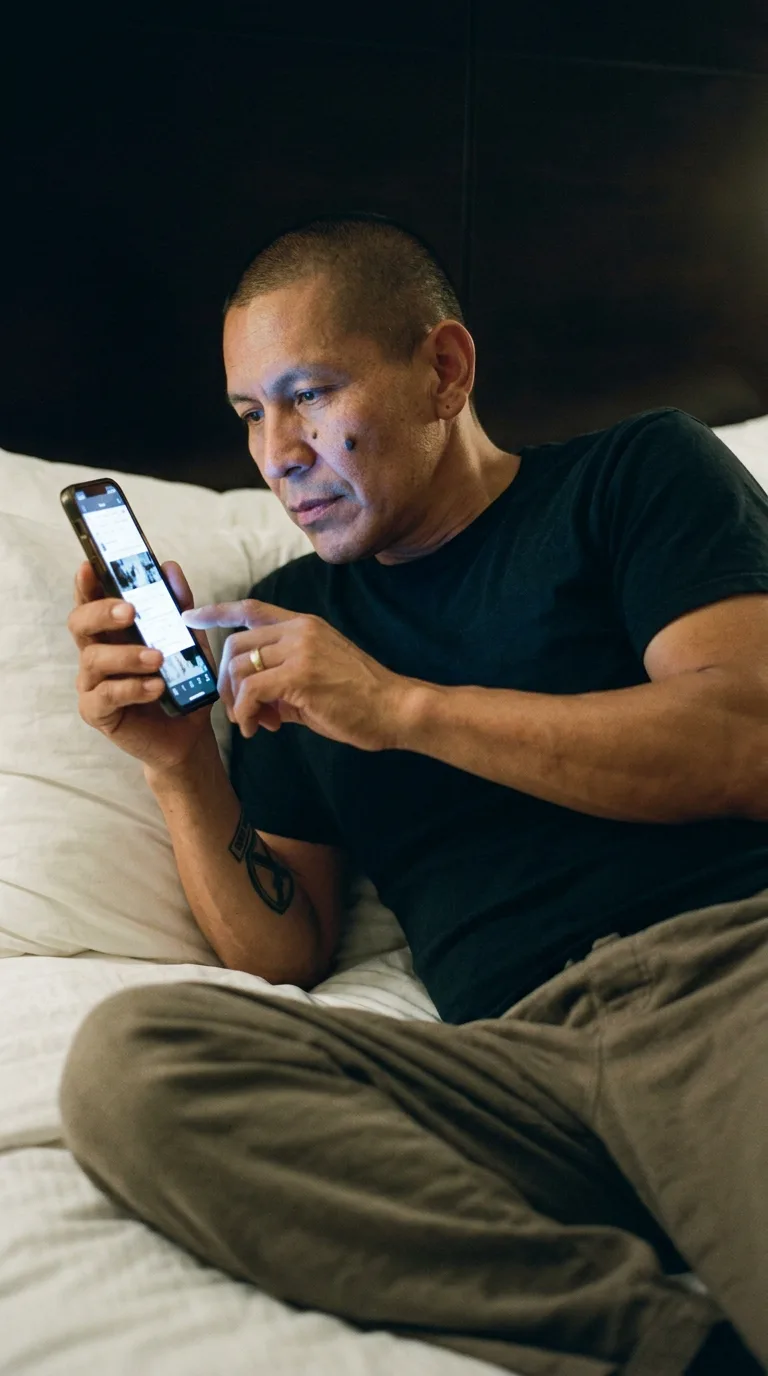
Rarest thing about him: Cancer, in remission — epic, 1 in 110
Season 0seed 1601225634 · engine v10
Character card
lineage COEU7T
His body-swap story
@colin.tarwater, wearing Alan Oshiro, rolled the wheel on and woke up as Wesley Begay, spent under a minute in him, then spun the wheel and woke up as Grant Pellicane
Alan Oshiro's kitchen is quiet in the way a house is quiet at four in the morning when nobody in it needs to be awake. You stand at his counter in his boxers, the tile cold under his feet, coffee going stale in his hand, and you feel forty-nine spins deep in a body that used to belong to a cop who liked being a cop. That's the trouble. He liked it. Liked the freckles, the silver coming in at his temples, the easy weight of him. Liked it too much, maybe — the second night in, you caught yourself thinking about keeping this one for real, and that thought is exactly the one that always sends you back to the site. Not boredom. The opposite of it. You spin again because staying anywhere too long feels like something closing.
The site loads the way it always loads, patient and gray and asking for nothing but money, and you pay and put your thumb — his thumb, the one with the faint white scar from some call you never heard the story of — on the wheel, and let go.
Your thumb is already moving when you arrive, faster than the man in this body was moving it, flicking through photos of somebody's kids at a barbecue, a strip mall, a dog. Weight settles differently — shorter, denser, a body used to carrying itself at attention even lying down. The room is dim, a headboard dark as a confessional behind you, legs crossed under a thin blanket, a phone six inches from a face that has stopped blinking on its own schedule. Middle of the day outside this room, you'll understand in a second, though the dark says otherwise.
The T-shirt is against your back first, and it comes in like a held breath let go: a locker room smell of detergent and something metallic underneath, the shirt pulled on this morning — his morning — in a room with the blinds already down because he'd worked through the night and was going backward into day, sleeping while Philadelphia had its lunch. Night shift. Guard duty, radios, the long grey nothing of 0300 outside a barracks, and this — sleeping through a Saturday afternoon with the blackout curtain doing its best — is what a Saturday off looks like now.
The ring is the loudest thing. Left hand, cold band of it against your palm as your fingers close, and it opens a whole wedding in a rush: a backyard in Tucson, folding chairs, his mother's rosary wound around her knuckles though she never said the word Catholic once around him, Elena in a dress the color of wet sand, laughing at something his brother said into the mic. Fifteen years gone by since, three kids loud enough to fill a house that's never quite big enough, and a fourth chair that used to be at that table and isn't anymore because grief doesn't always announce which kind it is.
The forearm tattoo comes next, the insignia raised faintly under two fingers — this arm has done pull-ups until it shook, has carried packs that would flatten most men, has also, on a Tuesday eight years back, had a needle in it for six hours straight while chemo went in slow and Elena sat in a chair that wasn't built for sitting eight-hour shifts and read to him from a paperback neither of them can now remember the title of. Remission tastes like nothing, like the absence of a taste, and it's there anyway, under everything, the way a held breath is still technically breathing.
His hands, when you're not asking them to do anything, go straight for the cuticles of the other hand — worrying at the edge of a thumbnail, an old habit that predates the Army, that predates Elena, that goes back to a boy waiting outside a principal's office wondering how much trouble he was in. Church is somewhere under all of it too, a plain building with folding chairs and a pastor who shakes every hand at the door, Sunday mornings that have to be traded for sleep more often than either he or God would probably prefer.
The phone is still warm from his palm. You feel the exact shape of his thumb's stopped scroll — a picture of his daughter's soccer team, cut off mid-look — before your own hand takes it faster, colder, past everything he cared about toward nothing at all.
You look at the hand holding the phone. Not yours. Blunt-fingered, a nail bitten close on the thumb, the band catching the phone's light.
"Wes?" — you say it out loud, testing the name the dog tags gave you, tasting how strange it is in a mouth that isn't asking permission to be here — and you don't know yet if that's a question to the empty dark room or an answer to it, and you don't know how long you'll be the one giving it.