Wendell Sturgill
Fictional. Generated by AI — not a real person, and no likeness of one is intended.
61, grocery stocker in Eastern Kentucky · rolled by @julian.reyes · card — no film
History
who has worn him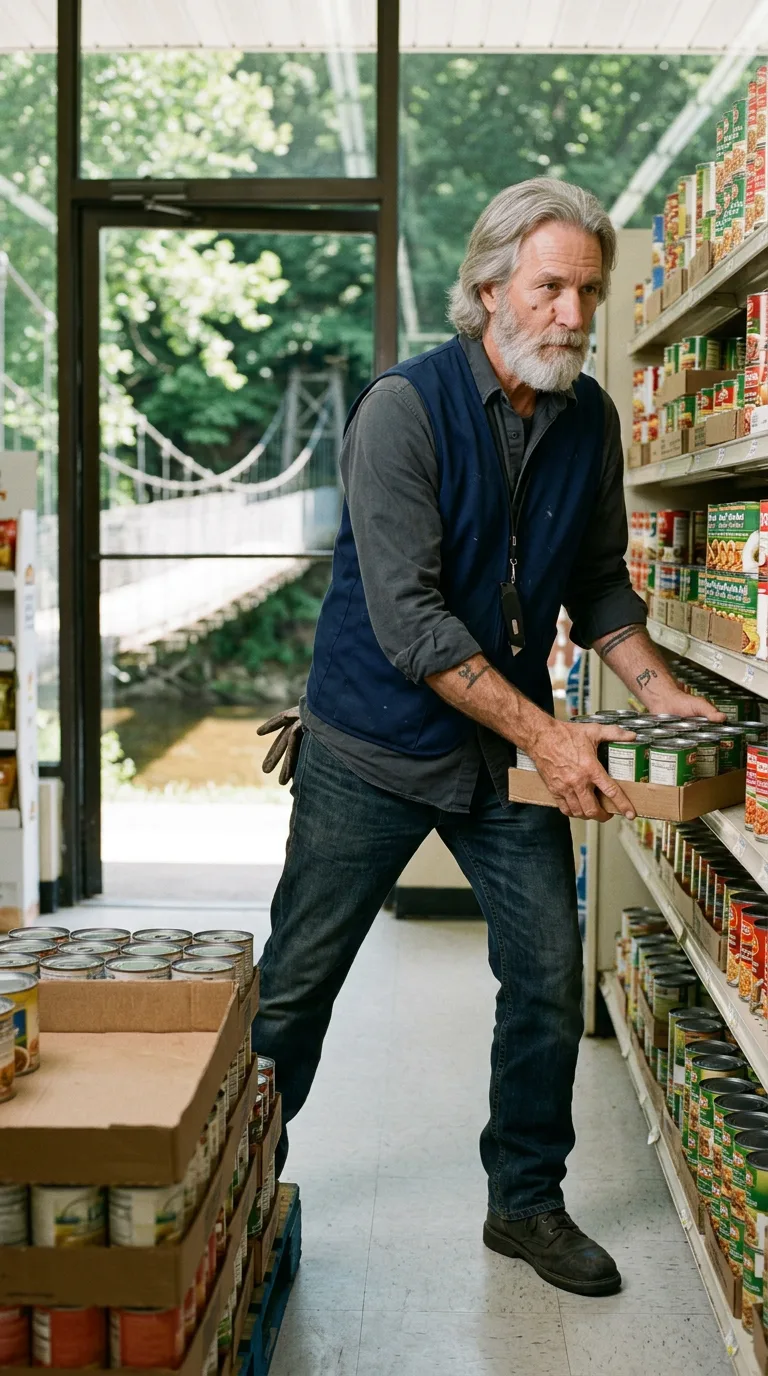
Rarest thing about him: A tremor in the hands — common, 1 in 79
Season 1seed 1139721212 · engine v11
Character card
lineage PYNCV3
His body-swap story
@julian.reyes (admin), wearing Terry Blevins, rolled the wheel on and woke up as Wendell Sturgill, spent under a minute in him, then spun the wheel and woke up as Justin Klema
You are standing in Terry's kitchen with Terry's coffee going cold, and Terry's hands won't hold still on the counter's edge. Fifty-six years old, six-one, a waiter's spine that's learned to carry three plates up one arm, and none of it belongs to you the way it should by now — five days and change and you still flinch a little when you catch this face in the toaster's chrome. It isn't boredom exactly. It's that somewhere under all this borrowed decency you keep circling back to a construction laborer in Western Kansas you wore for one minute, five days and nineteen hours ago, and to the best friend that man has out in Eastern Kentucky, a man you have never once worn but have seen — through Colton's own memory, in the sixty seconds you had him — more clearly than you've seen almost anyone. You want to know him from the other side of that friendship now. That's the whole shameful engine of it. You set Terry's coffee down unfinished, open the laptop, and the wheel is already loaded, spinning before you've fully decided, the way it always is.
The reach is for a case of green beans and it goes wrong for half a second — fingers closing on air that used to be exactly where the case was — then right again, slow, deliberate, checked. You feel the tremor before you feel anything else, a fine electric shiver riding up through both hands like a current with nowhere to go, and you think, distantly, that's not stage fright, that's something older than five minutes. The fluorescent light overhead is doing that grocery-store hum. Cold case-cardboard under your palms. A vest with a knife clipped to a lanyard swinging against your chest. Beyond the open dock door, impossibly, trees, and past the trees a footbridge on cables over water the color of strong tea — dark outside, but not fully; gray at the edges, the specific gray of an Eastern Kentucky morning that hasn't decided yet, though your body says the middle of a shift and his says the middle of the night, and there's no reconciling the two except that they are, somehow, the same instant.
The vest gives it up first — canvas gone soft at the shoulders, stains you didn't make. Fourteen years stocking this floor, the smell of it: wet cardboard, floor wax, the particular metal smell of case-cutter blades kept too long. Then the wedding band that isn't there — a pale stripe of skin on the ring finger, and touching it with the opposite thumb, out of habit, out of a hundred thousand instances of that same gesture, brings her: Donna, gone six years now, the divorce papers signed at this same kind of hour after a night shift, her voice saying she couldn't do the schedule anymore, meaning him, meaning the drink, not saying that part out loud because she never had to. The gloves tucked in his back pocket smell like machine oil and bring the one child, a daughter in Lexington who calls on Sundays if she remembers and sometimes doesn't, and the low permanent ache of that, filed down over years into something almost bearable, almost.
The shirt is next, sleeve by sleeve — this morning, or what was this morning to him, buttoning it in a trailer bathroom with the light buzzing, hand shaking too bad on the second button that he had to brace the elbow against the sink, an old trick, twenty years of a tremor that started before the drinking and got blamed on it anyway. Coffee first, then a vape pulled off the truck dash, then out into full dark toward a building that never really closes. Sixty-one years old and still strong through the back and shoulders, still able to swing a case one-handed onto a shelf, and still — this is the part that arrives last, heaviest — still, underneath all of it, holding a friendship the way you hold something you're afraid to look at directly: Colton Wiersema, thirty-three, out in Kansas, calls him twice a month and means it every time, the two of them having met on a mission trip a decade back that neither one talks about with anyone else, an unlikely closeness that outlived every other relationship this man built. You know Colton's hands from having worn them. You know, now, holding this man's forearms, dressed in this man's shirt, exactly what it is Colton would say if he called tonight and got no answer, and exactly how much money is sitting untouched in accounts this man never mentions to anyone, built quiet over decades of a job nobody would guess it from.
The tremor is still going when you look down at your own hands, cans forgotten in the box between them, and for a second the shaking isn't strange anymore — it's just Wendell's, and it was always going to be there whoever came to stand behind it. You turn one hand over slowly under the fluorescent light like you're checking it for something you can't name, then lift your eyes to the dark glass of the dock door where your own reflection is standing in it, half a stranger, mole high on the cheek, beard full of gray.
"Bud," you say, quiet, to no one, to Colton, to the shape of him you're already missing though you haven't even called yet, "you're not gonna believe who's holding the phone next time."