Justin Klema
Fictional. Generated by AI — not a real person, and no likeness of one is intended.
27, power lineman in New York · rolled by @julian.reyes · card — no film
History
who has worn him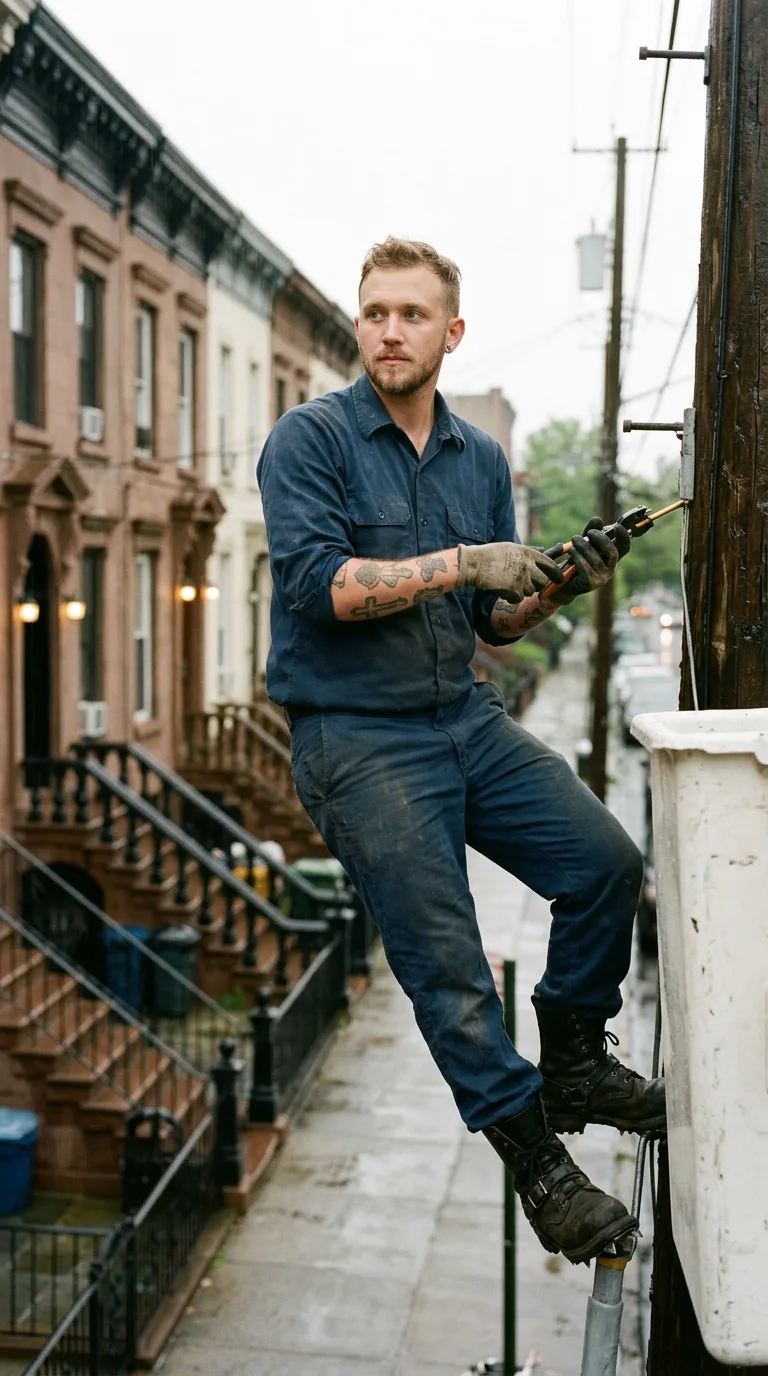
Rarest thing about him: Pagan, Wiccan or New Age — rare, 1 in 185
Season 1seed 814726423 · engine v11
Character card
lineage PYNCV3
His body-swap story
@julian.reyes (admin), wearing Wendell Sturgill, rolled the wheel on and woke up as Justin Klema
---
The beard itches. That's the first thing you notice, sixty seconds into being Wendell Sturgill again, standing in the dairy aisle of a grocery store in Eastern Kentucky with a box cutter in your hand and a pallet of yogurt half-unloaded at your feet. Sixty-one years old, gray-bearded, and your knees already ache from a life you didn't live, and something in the ache makes you impatient in a way you can't name yet. The fluorescent light hums. Somebody's radio in the back room is playing a song you have never once liked, in this body or any other. You set the box cutter down on the shelf edge, slow and deliberate, the way you've learned to do things now, since you are always leaving them for somebody else to find mid-task. You feel Wendell's minute of life like a coat that doesn't fit, and you think: not this one, not today, and you don't examine it further than that, because you never do. You go to the break room, you take out your phone, and Wendell's thick, silver-ringed fingers open the site he does not remember bookmarking. The wheel is already spinning before you've decided anything. That's the trick of it. You decide by doing.
The wheel lands.
You are bent at the waist over a service line on a wet pole, and the crimping tool is already in your grip, jaws closed on a splice you have made a thousand times, and for half a second your hand does it wrong — clamps at the wrong angle, has to walk back — and then it does it again slow, and correct, joint by joint, as though someone new were operating machinery built for a different pilot. Rain comes down in that fine Brooklyn mist that isn't quite rain, needling the yellow hard hat, and below you the street is brownstones and stoops and a sodium lamp still lit even though it's day, buzzing weak against the gray sky. Your boot is hooked over a step-bolt. Your other leg is wedged against the pole, spikes biting into old wood grain. Twenty feet down, a Con Ed van idles. Somewhere a dog is barking at nothing.
The gloves are the first thing that gives him to you. Leather, stiffened with old sweat, one seam gone soft at the thumb where he's worried it with his teeth in the truck between jobs — a nervous habit he doesn't know he still has, going back to a father who did the same thing chewing a toothpick. Through the glove's give you get a flash: his hands at nineteen, raw and blistered, an apprentice lineman crying quietly in a bathroom stall because a foreman screamed at him for a wrong tie-off, and how he never told anyone that, not even her. Especially not her.
Her is the shirt. Chambray, gone soft at the collar, and you feel — not remember, feel, the way he'd feel it — the morning eight months ago when she was still folding his laundry, still leaving it on the chair instead of the floor, humming something with her back to him while he buttoned this exact shirt sleeve by sleeve, cuffs first the way his mother taught him, and thinking, we're fine, we're fine, right up until the week they weren't. Her name comes without asking for it: Danielle. A tarot deck on the windowsill that was hers, that he kept because throwing it out felt like a small murder. He isn't over it. He tells people he is.
The pole under your palm gives you weather — decades of weather, other men's hands, creosote, and under that his own two years climbing this exact circuit, this exact street, knowing which brownstone has the loose gutter, which one has the old woman who brings coffee out in September and complains about the noise in July. The wood is a diary written in splinters.
His body settles into you the way work settles — not story so much as knowledge. Twenty-seven and built soft everywhere it isn't built hard: forearms ropy from grip work, gut a little give under the shirt from beer he only drinks with company and cigarettes he has every hour on the hour, a pack a day, the last one this morning tasting like it always does, like a small ugly comfort. Your knees — his knees — don't hurt yet the way Wendell's did; they're young, though the left one clicks faintly on the climb, an old sprain from a fall that wasn't a fall, just a wet spike and bad luck, three years back. His fingers, when they're not gripping tool or wire, want to drum — on a steering wheel, on a table edge, on his own thigh at a red light, some restlessness that lives under the calm face he shows strangers. The studs in his ears are cold today in the rain. The cross tattoo on his forearm, the praying hands beside it, were his grandmother's idea more than his — she took him to get them the week she died, some arrangement made in advance that he never fully explained to anyone, a woman who read cards at her kitchen table and told him the church was fine but the church didn't know everything. He believes her more than he believed anyone in a pew. He has never said this out loud to a living soul either.
The crimping tool in your hand knows its own weight, knows the particular resistance of copper against jaw, knows the small satisfaction of a splice seated right. His hands have done this ten thousand times without his mind in the room. Today his mind wasn't in the room for a different reason.
You feel the shape of an ordinary Tuesday closing around you — the van waiting, a thermos of coffee going cold on the seat, a text from Danielle three days unanswered because what is there left to say, and under all of it the small persistent decision he made this morning buttoning this shirt: that today would be a day like other days, unremarkable, survivable, his.
You look down at your hand on the crimping tool. Turn it over. The rain sits on the glove's leather in beads too fine to be called drops. Twenty feet below, someone in the van honks once, cheerful, no idea.
You lift your eyes to the wet street, to the brownstones, to nothing in particular, and you say, to no one who's listening, "Almost done up here" — and you don't know yet if that's true, or how long it will stay true, or whether you'll be the one who finishes the job.