Wendell Argenbright
Fictional. Generated by AI — not a real person, and no likeness of one is intended.
57, bartender in Eastern Kentucky · rolled by @colin.hasbrook · card — no film
History
who has worn him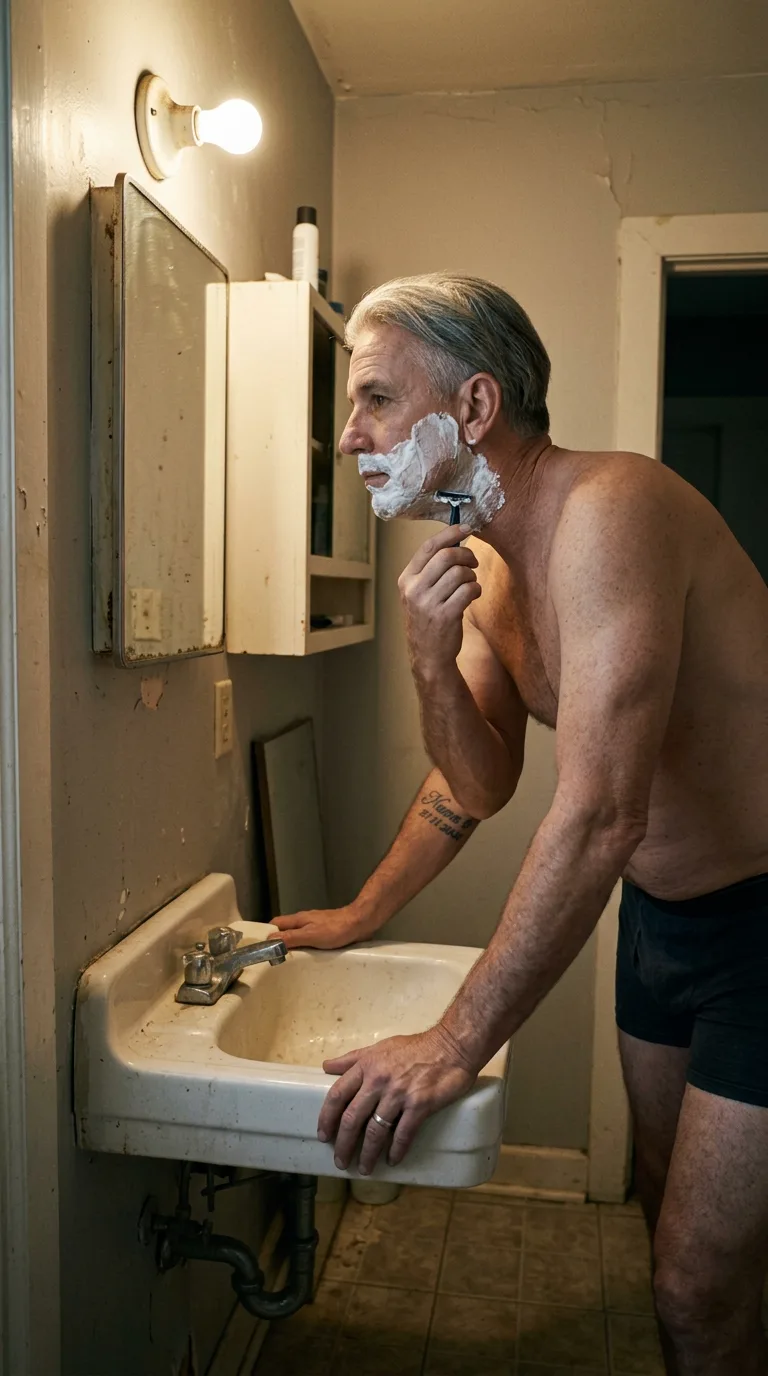
Rarest thing about him: Jehovah's Witness — epic, 1 in 132
Season 0seed 746234237 · engine v10
Character card
lineage 2NZHHJ
His body-swap story
@colin.hasbrook, wearing Russell Dembinski, rolled the wheel on and woke up as Wendell Argenbright, spent under a minute in him, then spun the wheel and woke up as Nathan Zaccardi
You have been Brendan Hoyer for one minute, and already it is a coat that does not fit.
You feel it in the joints first — the wide soft heaviness of him, the way his knees ache faintly just standing, the phone still warm in his hand from whatever he was scrolling before you landed here and made him yours. You know this house because you have never seen it before and also because you lived here for sixty seconds: the smell of a candle burning somewhere down the hall, a glass of water sweating a ring onto a nightstand, a Bible pamphlet face-down on the comforter. Somewhere in him is a mother who calls too often and a class he is failing and a body that flares up on him without warning, joints hot and swollen for no reason he can control. None of it is worth exploring. You did not come back here to live in a boy's unfinished life. You came back because the wheel is still open on the laptop screen across the room, log-in still warm, and because six spins ago you were a man in Detroit who is, right now, somewhere in the city, waking up into a life with no one inside it, and that thought itches at you the way it always does — the used-up husk, the empty room you left the light on in.
Comfortable is not enough. It never has been. Two hundred and five men and you still spin like it might finally be the one that quiets it.
You reach over, in his hand, and hit the wheel again.
The room does not change so much as insist on being a different room. Fluorescent light off a bare bulb, not this soft lamp glow — a bulb on a cracked ceiling, cheap and too warm and too close. Water running. Your own weight drops half again, your shoulders narrow, and there is foam on half a face that used to be Brendan's and is now someone thinner, older, gray at the temples, leaning into a chipped mirror with a razor stopped dead against his jaw.
The hand finishes the stroke before you have caught up to it. Up the jaw, against the grain, no hesitation where the mouth pulls the skin tight at the corner — the second half of the shave goes faster than the first ever does, like the body already knew you were coming and hurried to get done with itself.
You are standing in tile-floor cold on the soles of feet that ache a little in the arch, an old man's ache, a bartender's ache, the kind that comes from twelve years of standing on mats behind a rail. The mirror is spotted with age at its corners. A single bulb over the sink throws yellow light down one side of your face and leaves the door behind you in shadow, and past that door, faint, the sound of water somewhere outside — not a tap, something running low and steady, a creek maybe, close enough to hear through a screen.
The razor is what starts it. Just the weight of it, its handle worn smooth in one particular groove where a thumb has pressed for years. It comes with a flash — this same sink, a younger jaw, the mirror not yet cracked at the corner, his mother's voice from a kitchen he can't see, calling him down before school. Then it's gone and the sink is just the sink again, older, this same water pipe knocking once in the wall the way it always does when the hot side opens too fast.
The waistband of his boxers, elastic gone soft with washing, brings back the shape of a body he has lived in for fifty-seven years and never once resented: strong enough still, thick through the forearm from years of hauling cases, a low ache low in the back that comes some mornings and not others, and today is not one of the bad ones. His left hand, resting on the porcelain lip of the sink to steady him, carries the band on it — plain, unadorned, worn into a groove of its own — and with it comes an entire marriage in a single unbidden gust: her voice teasing him for taking too long in the bathroom, twenty-some years of it, the two kids grown and mostly gone now, one a voice on the phone twice a month, one closer, in and out of the house like weather. And under that, quieter, an old ex-girlfriend's face from decades back, the kind of memory that surfaces without asking permission and doesn't mean what it used to.
The tattoo on his upper arm, half-covered now by a sleeve that isn't there yet — bare-armed at the sink, foam drying at his collarbone — gives up its ink without him even touching it, just the sun-warmth of skin remembering itself: a name in script, a date under it, one of the two kids, the day they were born, inked in a shop that smelled like antiseptic and cheap coffee while she waited outside with the other one on her hip.
He'll dress after this the way he dresses every day he opens: the black shirt off the hook on the bathroom door, sleeves already gone soft at the cuff from rolling, buttoned from the bottom because his fingers learned it that way tending bar years back — fast hands, hands that know a pour without looking, that crack their own knuckles absently at the rail while waiting on a ticket. A towel over one shoulder without thinking about it. Jeans that have held his weight at this exact size for a decade. None of it church clothes — that's a different morning, a different closet — this is a work morning, ordinary, the creek loud outside because the window's cracked for the heat, green light coming up off the trees the way it does this time of evening back home, though he does not think of it as evening. He thinks of it as time to open.
Your hand — his hand — is still on the razor. You lift it away from the jaw, foam only on the near side now, the far cheek already clean and pink from a stroke you don't remember choosing.
You look at the hand instead. Turn it. Not his to you — an ordinary hand, thick-veined, a white line of a scar you didn't put there across one knuckle, the ring catching the bulb's yellow light.
You lift your eyes into the mirror, into the both of you.
"There you are," you say, to no one who's listening anymore.