Warren Renshaw
Fictional. Generated by AI — not a real person, and no likeness of one is intended.
40, tow truck driver in Detroit · rolled by @colin.hasbrook · card — no film
History
who has worn him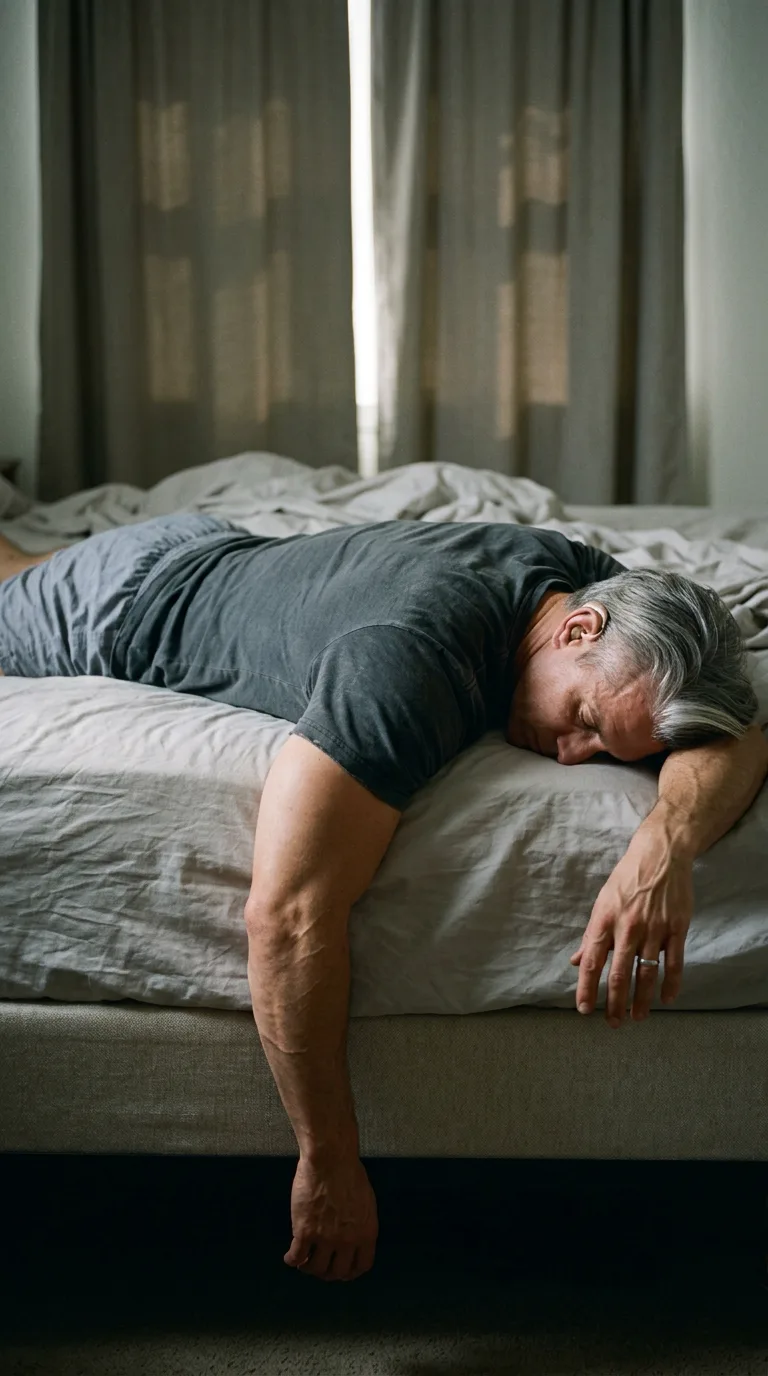
Rarest thing about him: Hearing loss, wears aids — epic, 1 in 165
Season 0seed 1525633759 · engine v10
Character card
lineage 2NZHHJ
His body-swap story
@colin.hasbrook, wearing Gerald Ostrowski, rolled the wheel on and woke up as Warren Renshaw, spent under a minute in him, then spun the wheel and woke up as Dale Furbish
---
You are Gerald Ostrowski for three more minutes, standing in a chimney with soot to your elbows, and the reason you're leaving him has nothing to do with the soot. It's that you keep thinking about the kid. Colby. Twenty-two, blond, dimples, some kid's apartment in El Paso that smelled like protein powder and cheap candles — you were him for thirty-two minutes eleven spins back, and it was good, easy, a body that still believed things were going to work out. You gave him back. You always give them back. But something's been nagging at you since, some unfinished curiosity, the kind that doesn't have a name until you're already reaching for the toothpick — no, wrong body, that's not yours yet — until you're already reaching for your phone. You want to know what made him. You want to stand in the house the kid grew up leaving.
So you spin.
The brush is still in your hand and then it isn't, because the hand is different — broader, older, a wedding band biting into the base of the finger — and you are lying face down in sheets that don't smell like soot, they smell like fabric softener and someone else's sweat, and your right arm is hanging off the edge of a mattress into cool air. Streetlight is coming through a gap in the curtains that shouldn't be there because it should be daytime, and some far-off part of you understands before you do: night shift. He sleeps when the sun's up. The breath that was ragged going in comes out even, and the arm that hung off the bed draws itself back up without you quite choosing it, folding at the chest with the other one, a posture this body has never once made in its sleep, and you feel it not-fit like a shirt buttoned wrong.
The pillow is under your cheek and that's the first thing that gives you anything — a smell, detergent and something underneath it, and a flash: a woman's voice saying *you're tracking grease on the good pillowcase, Warren* — laughing, not really mad. Then it's gone, and you're just lying there being him, four kids' worth of noise somewhere distant in a house that isn't loud right now, gray Detroit light instead of streetlight, low sky pressing on brick.
The hearing aids are still in — he sleeps with them in sometimes, too tired to bother, and touching the shell of your ear with the back of a knuckle gets you a memory whole and sudden: a chain, cold and greasy, going hand over hand under a jackknifed semi on I-94 at three in the morning, someone yelling something you couldn't catch over the wind and the traffic and the ringing in your ears that never really goes away anymore, and you'd just nodded like you'd heard it, the way you always do, because admitting you hadn't felt like admitting something bigger.
The ring. Left hand, plain band, and it opens like a door: a courthouse wedding nobody remembers to call cheap because nobody there thought of it as anything but right — her in a green dress she'd had for years, him in the only jacket that fit over these shoulders, and after, sitting in the truck eating gas station sandwiches because neither of them had thought to plan dinner. Twenty-some years of it since. Three kids at least, maybe more — a boy's face flickers, laughing at something, too young to be Colby, too old to be the youngest — this house, these brick walls, the low gray sky that never quite lifts in this city, all of it arriving in pieces too fast to sort.
And under it, quieter, guiltier: a woman who isn't the wife, a name that comes with a particular kind of tiredness, an ending that hadn't finished ending when it ended — texts he didn't answer, a voicemail he listened to twice and deleted. Recent. It sits in the chest like a stone he'd learned to carry without noticing the weight, until right now, when you're noticing everything.
The shirt against your back — gray, cotton, worn thin at the shoulder blades — gives you the morning he put it on, except it wasn't morning, it was evening, dusk bleeding out of that same gray sky, him standing in front of a dresser with a toothpick already going in the corner of his mouth out of habit before his brain had caught up, pulling this shirt over a chest that still works, still lifts chain and tows dead trucks off shoulders at 2 a.m., forty years old and stronger than men fifteen years younger, knees a little shot, a permanent low hum in both ears under the aids. He'd looked at himself in the mirror a half-second too long that evening. You don't know why yet. Maybe the ex. Maybe just tired.
You feel his hands, thick-knuckled, a mechanic's callus across the palm, wanting a toothpick that isn't there.
You open your eyes.
You lift the hand that was hanging off the bed and turn it over in front of your face — his hand, not the last one, not the one before that, six hundred and thirteen hands now and this one still manages to feel like news — and you look up, past the gap in the curtain, into the gray light standing in for a camera that isn't there yet, and you say, in his voice, rough with a sleep he didn't ask to fall into right:
"Whose house is this."