Warren Latchford
Fictional. Generated by AI — not a real person, and no likeness of one is intended.
55, lawyer in Eastern Kentucky · rolled by @colin.tarwater · card — no film
History
who has worn him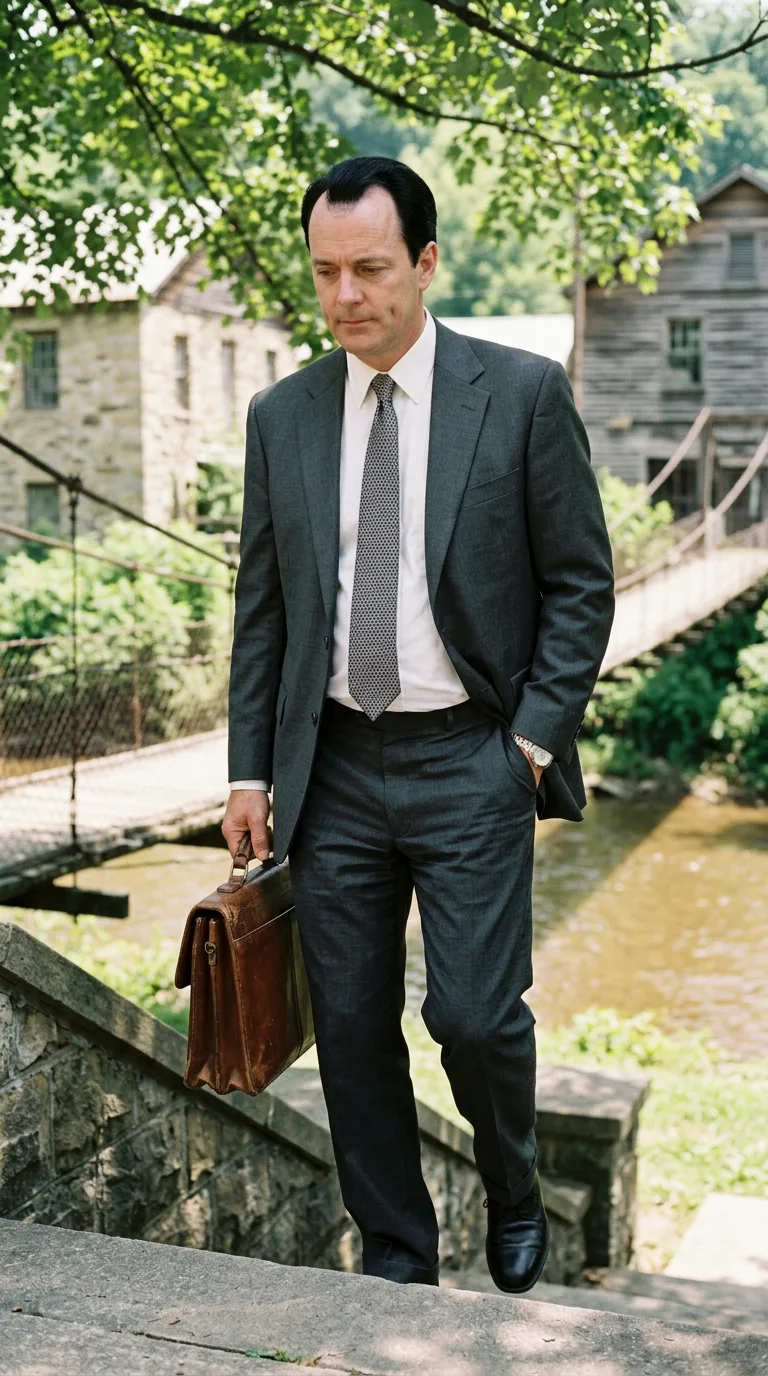
Rarest thing about him: Dyed black — uncommon, 1 in 109
Season 1seed 1489483844 · engine v11
Character card
lineage COEU7T
His body-swap story
@colin.tarwater, wearing Douglas Prentice, rolled the wheel on and woke up as Warren Latchford, spent under a minute in him, then spun the wheel and woke up as Bryan Kessler
Douglas Prentice's hands are shaking, and they have only been Douglas Prentice's hands for forty seconds.
You knew this the moment you landed in him: skinny fat, going gray, a beauty mark on the cheek like a mistake somebody made once and never bothered fixing. A mechanical engineer standing in his own kitchen in Chicago in the middle of a Tuesday, the tap running for no reason you set it running, some habit of his you inherited along with the rest of him. Fifty-three years old and his knees already announce themselves when he shifts weight. You spent less than a minute deciding, and the decision was this: not this. Not the tap, not the beauty mark, not the softness under the shirt that isn't fat exactly, just a body that quit fighting gravity sometime around forty-five. You did not hate him. You simply remembered, standing there, that you did not have to be anyone in particular, and that the wheel does not care how long you've owned a thing before you throw it back.
So you go to the site on his phone, the one already logged in, and you spin, because that is what the wheel is for and what you are for now, eighty-five men deep into a habit that stopped needing a reason a long time ago. The reason, if pressed, is only that Douglas's hands were shaking and you didn't want to watch them do it any longer.
The wheel spins somewhere behind your eyes that are not your eyes and were never going to be for long.
—
The creek smells like green rot and cold stone before you know you have a nose to smell it with. Your hand — his hand — is closed around a leather handle, old, cracked soft at the seam, and your feet are two steps down a set of stairs that lead onto a swaying cable footbridge, planks gray and sun-warmed. Trees lean in close on both banks. Somewhere behind you a stone building holds the afternoon heat in its walls.
The motion breaks. One foot comes down wrong, catches the edge of a plank at an angle a man who's walked this bridge a thousand times would never allow, and then — slow, deliberate, correct — you set it right, and take the next ten steps like a man reading an instruction manual for his own legs. Briefcase. Tie. A wedding band catching the light. Nobody watching would think anything except: he paused.
—
The handle is what opens first, worn smooth by twenty-two years of one hand, and it comes back to you the way water finds a crack: fast, then everywhere. Warren Latchford bought this briefcase in Lexington the year he made partner, paid too much for it on purpose, wanting a thing that would look old before he did. It has held motions, held photographs of a daughter at four different ages, held a flask once, in the years before he stopped, tucked behind the legal pads like a shameful clause in a contract with himself.
The shirt gives you the morning — his morning, hours behind you and yet the one that just happened, because his clock is not yours and the gap between them is a small vertigo you don't examine. He'd stood in the bedroom with the blinds already up, Linda's side already made, and buttoned this shirt from the bottom because his mother taught him that, sixty years dead and still bossing him from the grave about buttons. He'd looked at the collar in the mirror too long. He does that most mornings now — not vanity, just checking, the way you'd check a fence line, to see if anything had moved overnight. The hair is dyed and he knows everyone knows and nobody says anything because he's Warren Latchford and the money says what it needs to.
The band on the left hand brings Linda, and Linda brings twenty-six years compressed into a single kitchen argument that wasn't really an argument, more a low tide, both of them just tired in the same room at the same time. And underneath Linda, quieter, not gone: Renee. Nineteen years old on this same bridge, before it had cable and before he had a career, her laugh doing something to the water that the water still seems to remember. He has never told anyone he still thinks of her crossing this bridge specifically, every single time, for thirty years. Nobody's asked. His daughter's face flickers in too — grown now, a voice on the phone more than a person in a room, but his, entirely his, the one unarguable good thing he ever helped build.
The dimples are already there, resting, doing nothing, the thing people remark on and he's stopped hearing. His knees are fine. His shoulders are fine. He's fit in the unbothered way of a man who never had to try, and his mouth still tastes like nothing, like a man who quit drinking so long ago the wanting doesn't even announce itself anymore, just an old room he doesn't go into. His right hand, free of the briefcase, wants to go to his mouth — the nails already too short, a habit thirty years old, worn into the muscle memory before any memory you're borrowing bothered to explain why.
He was three million dollars deep in a life nobody would call unhappy from outside it, walking home from something ordinary at an hour his body still hasn't fully agreed to, mid-shift, mid-thought, mid-step.
—
You stop on the bridge. The planks give slightly under Douglas's old weight, which is not the weight in these legs anymore.
You look down at the hand not holding the briefcase — the wedding band, the bitten nails, the clean unhurried lines of a hand that has held depositions and a daughter's small fingers and, once, briefly, thirty years ago, another girl's hand on this exact bridge — and you turn it over like it might have writing on the underside.
You lift your eyes to the water, then past it, toward wherever the lens of the world happens to be pointed.
"Well," you say, in his voice, testing the dimples with it, "that's new."