Douglas Prentice
Fictional. Generated by AI — not a real person, and no likeness of one is intended.
53, mechanical engineer in Chicago · rolled by @colin.tarwater · card — no film
History
who has worn him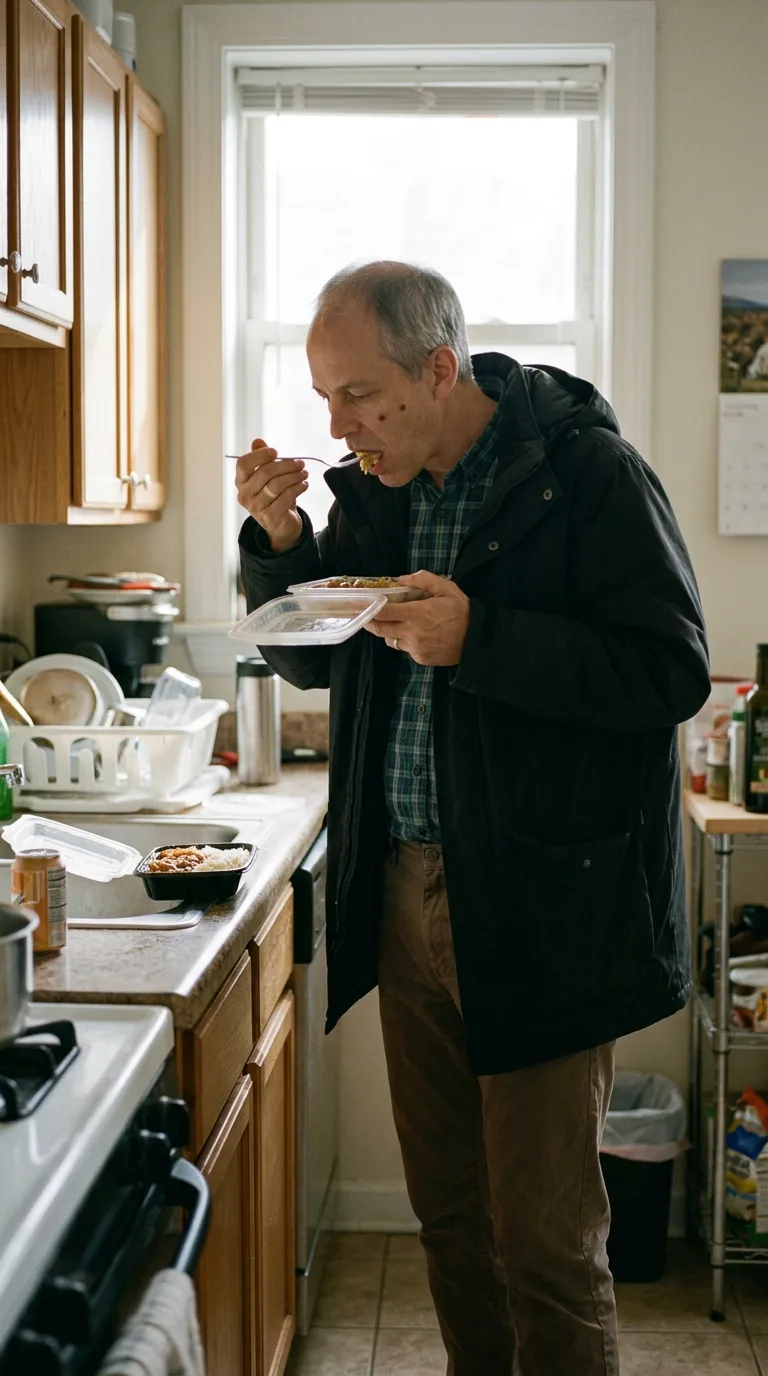
Rarest thing about him: Flips a lighter — common, 1 in 37
Season 1seed 1801514889 · engine v11
Character card
lineage COEU7T
His body-swap story
@colin.tarwater, wearing Terrence Okafor-Boyd, rolled the wheel on and woke up as Douglas Prentice, spent 1 minute in him, then spun the wheel and woke up as Warren Latchford
The plant floor smells like cutting oil and Terrence Okafor-Boyd's coffee, and you are standing in the middle of a line that will not run right no matter what you do to it. His foreman is talking about a bearing tolerance out of spec on Cell 4, and you are nodding along in his broken-nosed, gray-goateed face, and you are thinking: not this again. Fifty-two years old, athletic, a good jaw, a corner office he actually earned — and none of it is yours, and none of it ever gets easier to leave. You spun this one only a minute ago, barely long enough to feel the goatee under his own palm, and already the itch is back, that specific hunger that has nothing to do with hunger. It never lasted with any of them. Eighty-three men and the feeling is always the same by the second minute: this is not the one, spin again, there is always a better fit somewhere in that wheel. You tell the foreman you'll call it in from your desk. You don't go to your desk. You go to your phone, to the site, to the wheel sitting there patient as a slot machine that never says no, and Terrence's thumb — no, your thumb, in his hand — presses spin before the guilt even finishes arriving.
The fork is between the container and your mouth and then it is not moving, and you are not moving, and for a half-second there is nothing behind this face at all — then you are behind it, and the fork comes back down onto the counter with a small definite click. You are 5'10" now instead of 5'6". Fifty-three instead of fifty-two. The coat is heavy and unfamiliar on shoulders that slope more than Terrence's did, softer through the middle, a stranger's stomach already half full of something with curry in it. Steam is fogging a dark window in front of you. Somewhere under the floor a train goes by loud enough to feel in the glass, and you understand before you understand anything else that this is not Los Angeles.
You shrug the coat off — his coat, black, heavier than it looks — and the flash comes with it: an L platform in a wind that goes straight through wool, a hood pulled up, a bus that never comes on time in January. You sit at the little kitchen table because your body wants to, not because you decided to, and that is its own small unease, riding a man whose habits move before you do. The container is warm-ish plastic in your palm and it gives you nothing at first, just curry and rice, and then — a coworker's name, Priya, handing it across a break room table, saying you look like hell, Doug, go home. Doug. Douglas. The name arrives the way all of it arrives, sideways, through the object and not through the air.
The fork is the real key. It's been in this hand for thirty years in one form or another, and the moment your fingers close on the handle you get the whole rest of him at once, in pieces, the way a dropped drawer gives you everything at the same time. A ring that isn't on your finger anymore — you feel the tan line before you see it, a paler stripe of skin that means something has been taken off and never put back. A courthouse hallway, fluorescent, a woman's voice saying she's tired, not angry, just tired, and that being somehow worse. A kid — one kid — a boy, now grown, who calls twice a year and means it both times, and the ache of that is old enough that it doesn't hurt so much as sit there, familiar as furniture.
The shirt against your back gives you a Tuesday morning: buttoning it in a bathroom with bad light, top button skipped because you never do that one, the vest zipped over it after because the lab is always cold no matter what the thermostat claims, the safety glasses shoved up into hair that is thinner every year and you've stopped pretending otherwise. Boots that have logged a decade of concrete floors. A prototype half-assembled on a bench under fluorescent tubes, calipers in your palm measuring a tolerance that has to be right the third time because it wasn't the first two. You are good at this — the body knows it in its wrists, in the specific patience of hands that have learned to trust a number over a guess. Skinny fat, unremarkable, hair gone at the crown, a mole high on the cheek that you've stopped noticing in mirrors and other people never stop noticing at all — a girlfriend once, years back, before the divorce, told him it made him look distinguished, and he'd laughed like he didn't believe her and believed her completely.
Nicotine wants a lighter that isn't in this pocket; you feel your thumb twitch for the flick-and-catch of it anyway, an old motion with nowhere to land, ten years quit and the hand still hasn't heard. Evangelical, a church three blocks from here he goes to less than he used to since the divorce, since it started feeling like everyone's marriage but his. Money that doesn't show anywhere in this kitchen, this counter, this dish rack — seven figures sitting quiet in accounts nobody who saw this apartment would guess at, because he never learned to spend it, only to earn it and let it sit, the way some men hoard patience.
You finish the container in even mouthfuls you didn't choose to make even, looking at nothing in a window gone dark with early winter, a body's habit outlasting the person driving it.
You look down at your hand — his hand, wide-knuckled, a little soft, the tan line on the ring finger pale as a scar that healed wrong. You turn it over once, like it might be somebody else's, because for one more second you're not entirely sure it isn't.
"Okay," you say, out loud, to the empty kitchen, to the window, to no one. "Okay. Let's see what you've got, Doug."
Somewhere out past this window a train goes by and doesn't slow down, and neither do you, not yet — not today, maybe not tomorrow — but the wheel is still out there being patient, the way it always is.