Warren Kaczmarek
Fictional. Generated by AI — not a real person, and no likeness of one is intended.
38, beekeeper in Pittsburgh · rolled by @colin.hasbrook · card — no film
History
who has worn him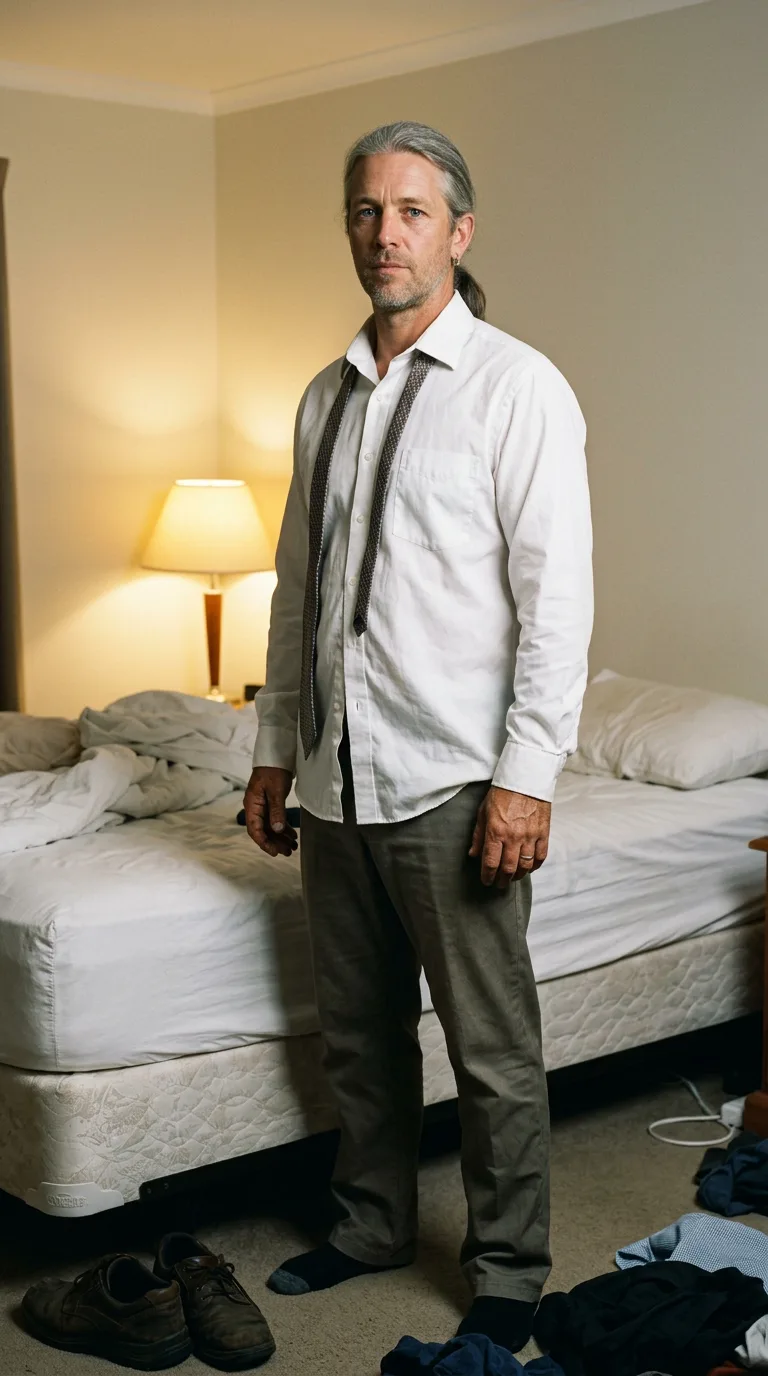
Rarest thing about him: One earlobe — epic, 1 in 28
Season 0seed 1169758453 · engine v10
Character card
lineage 2NZHHJ
His body-swap story
@colin.hasbrook, wearing Paul Ferretti, rolled the wheel on and woke up as Warren Kaczmarek, spent under a minute in him, then spun the wheel and woke up as Marcus Aldridge
The rectory room smells like votive smoke and the cheap coffee going cold on the sill, and you are Paul Ferretti's hands folding and unfolding on your knees, twenty-six years old, heavy in the shoulders, a scar through the eyebrow that some kid's fist put there before any of this. Less than a minute you've had him. Less than a minute and already the collar is too tight, and there is a woman in the front pew of your memory — his memory, now yours to carry, since the wheel gives you that too — waiting on a confession you have no intention of hearing, because you are not going to be him past tonight. It was never about him. It's never about any of them, past the first hour. The laptop is already open on the desk, the site loaded, the wheel sitting there mid-spin from last time like it's been waiting on you specifically. You did not come back for Paul. You came back because the wanting came back, plain as that, the way it always does once the newness goes thin as a coat in March. You put two fingers on the trackpad. You spin.
And then you are short.
That's the first thing, before anything else has a name — the ceiling is closer, the doorframe you can see past the lamp is lower relative to you, and your hand is flat on your own chest, feeling ribs that are narrower and drier than the ones you just left, a chest with less padding and more give. Your fingers are on shirt buttons, mid-button, and you feel the wrongness before you understand it — one hole down, one shift over — and without your intending it the hands finish the correction themselves, fast, certain, the way a man's hands do something they've done four thousand mornings running. A tie hangs against your collarbone. Somewhere behind you a bed, unmade, and a lamp throwing yellow into a room that is not Boston, not evening the same way — this light is later, tireder, a different clock entirely, though you have no way yet to know by how many hours.
The shirt is what opens him.
It comes in on the fabric first — cotton gone soft at the collar from a hundred washes — and you get a flash of a bathroom mirror, fluorescent, him at some earlier version of this same hour buttoning this same shirt with his glasses pushed up into gray hair not yet pulled back, and underneath it, unbidden, the smell of smoke on a jacket he hasn't worn in eleven years, the last cigarette he ever finished, out behind the extension office parking lot with a man who is dead now and whom he still misses on Tuesdays for no reason he's ever named to Diane. That's her name. It comes with the wedding band, plain, worn thin on the inside curve where it's turned against his finger ten thousand times — Diane, twenty years in, her voice in a kitchen he can see now with the particular fondness of a man who complains about being married and would not survive not being. Two kids. A boy's height marked in pencil on a doorframe that this shirt, somehow, remembers being measured against, tall, taller than you'd think, gone off to State this fall, and a girl still home who leaves cereal bowls in the sink and calls him Wozzy as a joke from when she was four and couldn't say his name.
His name comes slower, the way your own name never has to. Warren. Warren Kaczmarek. It arrives with the tie — not from the tie itself, which is unfamiliar in your hands, a knot shape this closet has genuinely never held before, but from the reaching for it, the automatic assumption of a Windsor that gets undone somewhere in the making and redone into something else, something your hands know and he apparently does not, and that mismatch sits strange in him for half a second like a word on the tip of a tongue.
The hive smell is under everything, though there's no hive here — it's in the muscle, in forearms more corded than they look, in a lower back that carries a specific permanent ache from bending into boxes forty pounds at a time since March, and in fingers that know without asking how to move slow around something that can hurt you. Thirty-eight years old and the knees already talk to him on cold mornings. A small hoop of silver in the left ear that he got on a dare he'd deny giving in to, twenty years back, at a lake with friends whose faces have gone soft at the edges in memory but whose laughter hasn't. He doesn't drink — hasn't in a long time, wasn't ever the reason he quit smoking, that was Diane, first pregnancy, cold turkey out of pure terror — and his jaw is already working at a piece of gum he doesn't remember putting in, the same unthinking chew that's been going since he set the coffee down twenty minutes ago.
He believes in something larger than the bees and it isn't the state agriculture board. Sunday mornings, a particular pew, hands raised sometimes when the song asks for it and nobody minds him for it here. Doing well for himself, quietly — nobody at church would guess the number, and he wouldn't tell them if they asked, because what he's worth was never the story he wanted told about himself; the story he wants told is the one where he shows his daughter how to hold her hand steady near a frame of them, unafraid, the smoker in his other hand going gray and patient.
Getting dressed tonight — for a meeting, a viewing, a dinner, something that made him put on a real shirt instead of the ruined jacket in the first picture, mud-caked, that other version of himself who stands in bee yards all day — he'd been thinking about nothing, really, the specific nothing of a man doing a small task at the end of a long one, and that is the last true thing that was his: the nothing.
You look at your hands. They are weathered in a way Paul Ferretti's soft hands never were, nicked along one knuckle by a hive tool he doesn't remember reaching for tonight, the wedding band catching the lamp. You turn the right one over, study the calluses like they're a language you're only now being handed the alphabet for.
You lift your eyes to find the mirror isn't there, only the room, only whatever is watching — and you say, quiet, testing the new voice in the new throat: "There you are."
Somewhere behind that, unspoken, is the wheel, still open on a laptop in a rectory a state and a haze of miles east, waiting on nobody knows when.