Marcus Aldridge
Fictional. Generated by AI — not a real person, and no likeness of one is intended.
58, retired in New York · rolled by @colin.hasbrook · card — no film
History
who has worn him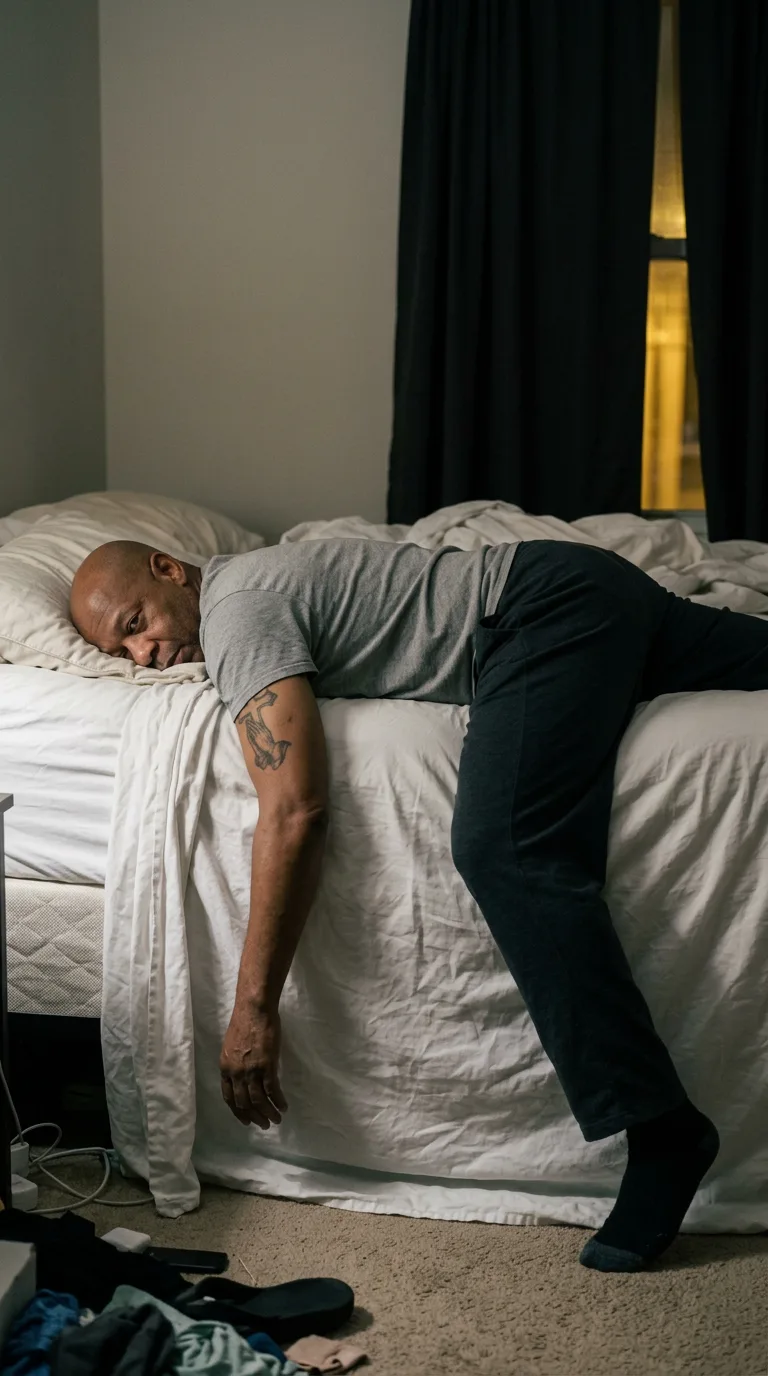
Rarest thing about him: A lazy eye — rare, 1 in 66
Season 0seed 1197786837 · engine v10
Character card
lineage 2NZHHJ
His body-swap story
@colin.hasbrook, wearing Warren Kaczmarek, rolled the wheel on and woke up as Marcus Aldridge, spent under a minute in him, then spun the wheel and woke up as Gene Loftin
Warren Kaczmarek's hands smell like smoke and wax even after washing, and you have been sitting with them folded on his stomach for eleven minutes, on his porch, in his dark, listening to his neighbor's dog lose its mind at nothing. You have been him less than a day and already you know the whole shape of tonight and tomorrow and the one after that: the supers to check, the sugar water, the mite counts, a Tuesday like every other Tuesday he has ever lived, stacked up ahead of you like empty boxes. He is a good body. He is not enough. You spun for Warren because the last one bled out ugly and you wanted something quiet, and quiet turned out to be its own kind of hunger. You go inside, you open the laptop still logged into vessel.cards from last time, and Warren Kaczmarek's finger — gray-haired, blunt, a little sticky at the knuckle — taps the wheel before you've finished deciding to let it.
The porch is gone. There is a mattress under you and a smell of somebody else's fabric softener and your arm is dead asleep, pinned under a weight that is suddenly, entirely, all wrong — heavier, longer, a stranger's ounces. The breath that was ragged going in comes out even. The arm lifts itself off the edge of the bed before you've told it to, some current running the machinery ahead of you, and the body rolls onto its back and folds its hands on its chest like a man laid out for a viewing. You did not do that. It did that. You are only now catching up to being here.
The hands are the first thing. They come to rest against his own chest and through the folded fingers you get a flash — his mother's hands, actually, guiding his four-year-old ones over a rosary, the beads clicking, her voice low and certain in a kitchen that smelled like this room doesn't at all but the memory arrives anyway, stapled to touch and not to place. Then it's gone and you're just lying in a stranger's bed at whatever hour this is for him, streetlight cutting a yellow blade through the curtain gap, and the reflux is the second thing you notice, a low simmer at the base of the throat that isn't pain exactly, just an old tenant that never leaves. Fifty-eight years in this chest and it knows its own ache without being told.
You lift the arm — his arm — and it drags, unfamiliar, and the sleeve of the T-shirt slides against the inside of the elbow and there it is: the tattoo, half-covered, a cross and two praying hands inked crooked by a man in the back of a shop on Nostrand Avenue thirty-some years ago, and for a second you are twenty-six and stupid and proud of it, showing it off to somebody whose face you can't hold onto, already dissolving. The shirt itself — gray, thin, worn a hundred washes soft — gives you the morning he put it on, except it wasn't morning, it was afternoon, because this is a man who sleeps against the grain of the world now: retired, no shift to keep him honest, no reason the sun should mean anything to him anymore. He'd stood in front of the dresser at two in the afternoon in sweatpants and this shirt and thought about nothing in particular, which was the whole luxury of it, thirty years on the MTA maintenance crews bought him exactly this — the right to dress for no one, at no hour, forever.
Under the sheets your bare feet find the carpet's edge and there's a whole marriage in it, gone eleven years now and neither of them ever hating the other for it, just two people who wanted different sizes of quiet; no kids, and some nights that sits in him like a held breath, though tonight — his night — isn't one of them. Your palm finds his scalp on its own, an old unthinking habit, smooth under it, and that single gesture unlocks a barbershop, his father's hand doing the same thing to him at nine, the buzz of clippers, being told sit still. Straight, single, no one who still matters — you get that as an absence more than a memory, a door that opens onto an empty room and swings shut again without complaint.
The body itself declares its age plainly once you're paying attention: the low ache behind the sternum, a knee that clicks when you shift your weight, arms with real strength left in them but no hurry to prove it, the particular loose comfort of a man with money enough that nothing has to be earned twice. Catholic, and it isn't performance, it's structural — somewhere under all this there's a rosary in a drawer and a Sunday habit that survived the marriage's end when nothing else did.
You sit up. The room resolves — brownstone bedroom, someone else's ordinary disorder, a Tuesday that for him started this morning with coffee on the stoop and is ending, unfairly, asleep before midnight came anywhere close, some rhythm retirement rearranged without his permission. You look down at the hands on your knees, dark-skinned, broad, a stranger's hands wearing your want now like a glove that fits better than it should.
You say, to the empty room, in his voice, testing the weight of it: "Okay."
Nothing after that. Just the sound of it settling, and the wheel somewhere behind you, patient, unspun, waiting for whenever you get bored of being good at this.