Warren Iwata
Fictional. Generated by AI — not a real person, and no likeness of one is intended.
63, stagehand in New York · rolled by @colin.hasbrook · card — no film
History
who has worn him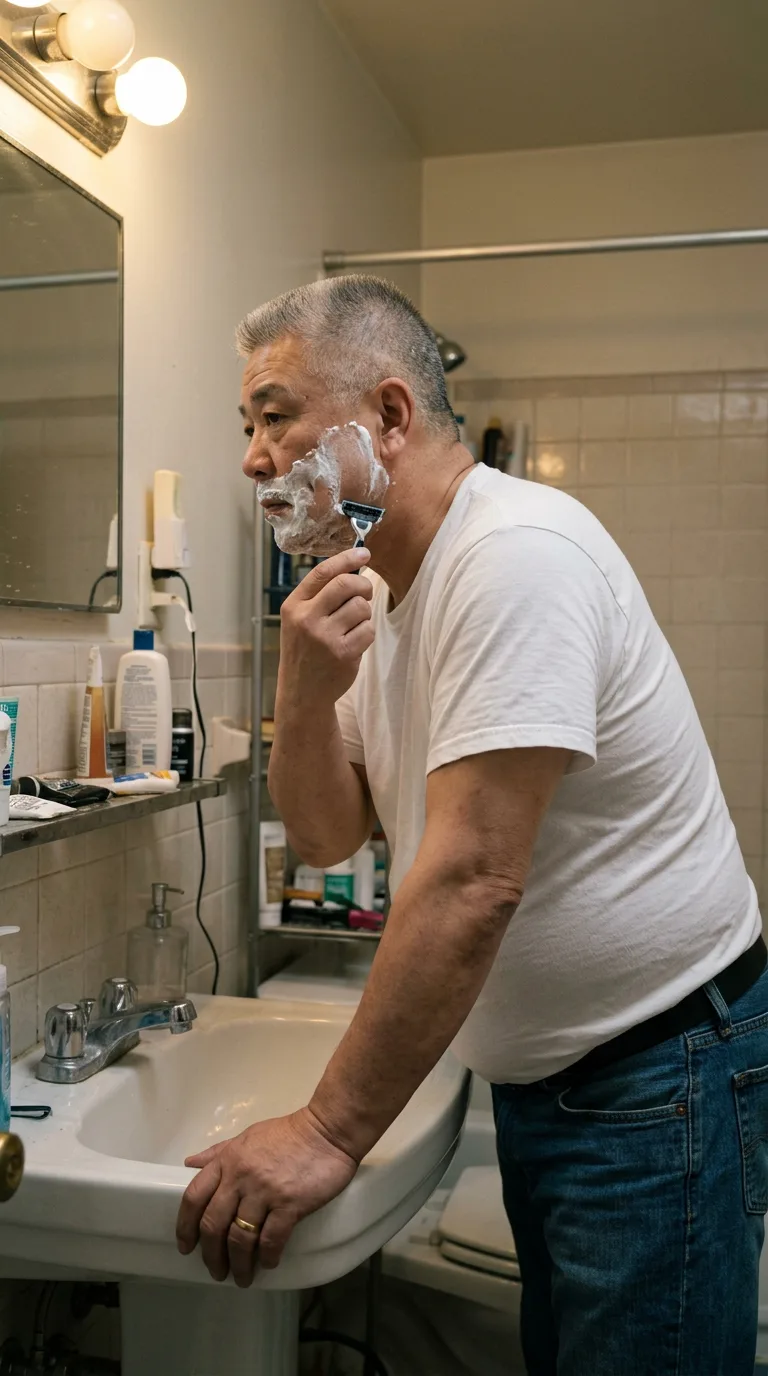
Rarest thing about him: Stagehand — rare, 1 in 158
Season 0seed 1877018765 · engine v10
Character card
lineage 2NZHHJ
His body-swap story
@colin.hasbrook, wearing Dustin Yellowhawk, rolled the wheel on and woke up as Warren Iwata, spent under a minute in him, then spun the wheel and woke up as Douglas Prentiss
The mop closet at the Bellagio smells like bleach no matter how many years pass, and you are standing in it at noon holding a mop handle that is not going to get any wetter because Dustin Yellowhawk's arms don't want to work anymore. Not his arms. Yours, for the last eleven days, since spin 457 put you into a thirty-eight-year-old janitor with a shaved head and dimples that show up even when he's furious, which — you have learned — is often, because the shift supervisor is a child and the tips of his fingers ache from a cart wheel that's been squeaking since before you got here. He's fine. He's strong and bored, and that's the whole problem: fine is not what you spin for. You spin because fine runs out. You feel it start around day nine, a kind of hunger that has nothing to do with this body's stomach, and by day eleven you're standing in a mop closet at noon on a Friday thinking about the wheel the way some men think about a bar they know is still open. You set the mop against the wall. You don't clock out. You just stop being the kind of thing that has a shift.
The site loads the same as always, the wheel indifferent and pretty, and you spin, and three thousand miles away and three hours ahead of you a razor that had stopped moving starts again.
It goes up the jaw against the grain, no hesitation where he always hesitates, right at the corner of the mouth, and the second half of his face gets done faster than the first ever does. You feel that wrongness before you feel anything else — a rhythm broken from outside — and then you feel everything else at once: the give of a soft belly under a white undershirt, foam cooling on one cheek, a low persistent ache low in the back like a hinge that never quite closes right, and a weight to the whole body that Dustin's frame never had, something settled into itself over sixty-three years instead of muscled through thirty-eight. The bathroom light is yellow and too bright, two bare bulbs over a mirror gone soft at the corners. Somewhere under the smell of foam there's cigarettes, old ones, in the walls.
The razor is the first thing that talks to you. Cheap, three-blade, the kind you buy in a six-pack, and it comes with a full year attached to it — standing at this exact sink, this exact light, telling his wife through the door that yes, he heard her, yes, he's hurrying, the matinee call is at one and the subway from here to the theater takes longer on Fridays than any other day for reasons the MTA has never explained to anyone's satisfaction. Forty-one years he's been shaving in bathrooms that get smaller as the rent gets more absurd. He likes this one. Pedestal sink, ugly tile, his.
The undershirt gives you the morning whole: pulling it over his head an hour ago, the little grunt he makes now when his arms go up because something in the left shoulder doesn't love that anymore, the way he checked the mirror sideways first, out of habit, before he ever looked himself full in the face — a stagehand's habit, checking the wings before you check center stage. The jeans on the shelf edge, still warm from the radiator, going on one leg and then a pause to press two fingers into his lower back where thirty-eight years of counterweight rigging and sixty-pound sandbags and one bad fall off a ladder in 1994 have left something that never fully forgave him. He works through it. He has always worked through it. Tonight there's a two-show day and he already knows by four o'clock he'll be standing at the fly rail under the blue running light chewing an aspirin dry, and he'll do it anyway because the union local he's been in since he was twenty-six doesn't run on men who complain.
The wedding band gives you more than the razor does. Thirty-four years married to a woman named Carol who still, after all this time, leaves the cap off the toothpaste in a way that undoes him a little every single morning. Two kids, grown, out of the house — a son in Albany doing something with insurance that Warren has stopped pretending to understand, a daughter who calls on Sundays without fail and whom he loves so plainly it embarrasses him. He turns the ring when he's not thinking, has for years, a groove worn into the pad of his thumb from doing it during long tech rehearsals in the dark, waiting for a cue. It isn't nerves. It's just where his hand goes when the rest of him is somewhere else — up in the grid, watching a batten come in, counting.
The dimples are there in the mirror even now, at rest, doing nothing, foam on one side, clean skin on the other, and you feel — not your feeling, his, arriving sideways through the tile and the light and the smell of drugstore shaving cream — a small persistent gladness about his own face that has survived sixty-three years and a hairline gone silver and a body gone soft in the middle: he has always liked that about himself, the dimples, the one vanity he'll admit to Carol and to nobody else. A pack of cigarettes waits on the shelf by the aftershave, half gone, guilt already loaded into it before he's touched one today. He drinks maybe four times a year, weddings and one funeral he can still see clearly, and otherwise keeps his vices singular and his hands busy, and his hands, right now, know exactly how to finish a shave they didn't start, because forty-one years is forty-one years, and the body does this without him.
You rinse the razor under the tap. Water spots collect on the ugly tile. In the mirror your own — his — face looks back, plain, tired around the eyes in the particular way of a man with a two-show Friday ahead of him, dimples visible even now, even doing nothing.
You lift your hand and turn it, foam still clinging to two knuckles, the ring loose enough to spin with your thumb, the way it apparently always spins.
"There you are," you say to the mirror, not sure yet if you mean him or you, and you hold there, looking at your own hand like it might still decide to be someone else's.