Douglas Prentiss
Fictional. Generated by AI — not a real person, and no likeness of one is intended.
43, student in Small-town Ohio · rolled by @colin.hasbrook · card — no film
History
who has worn him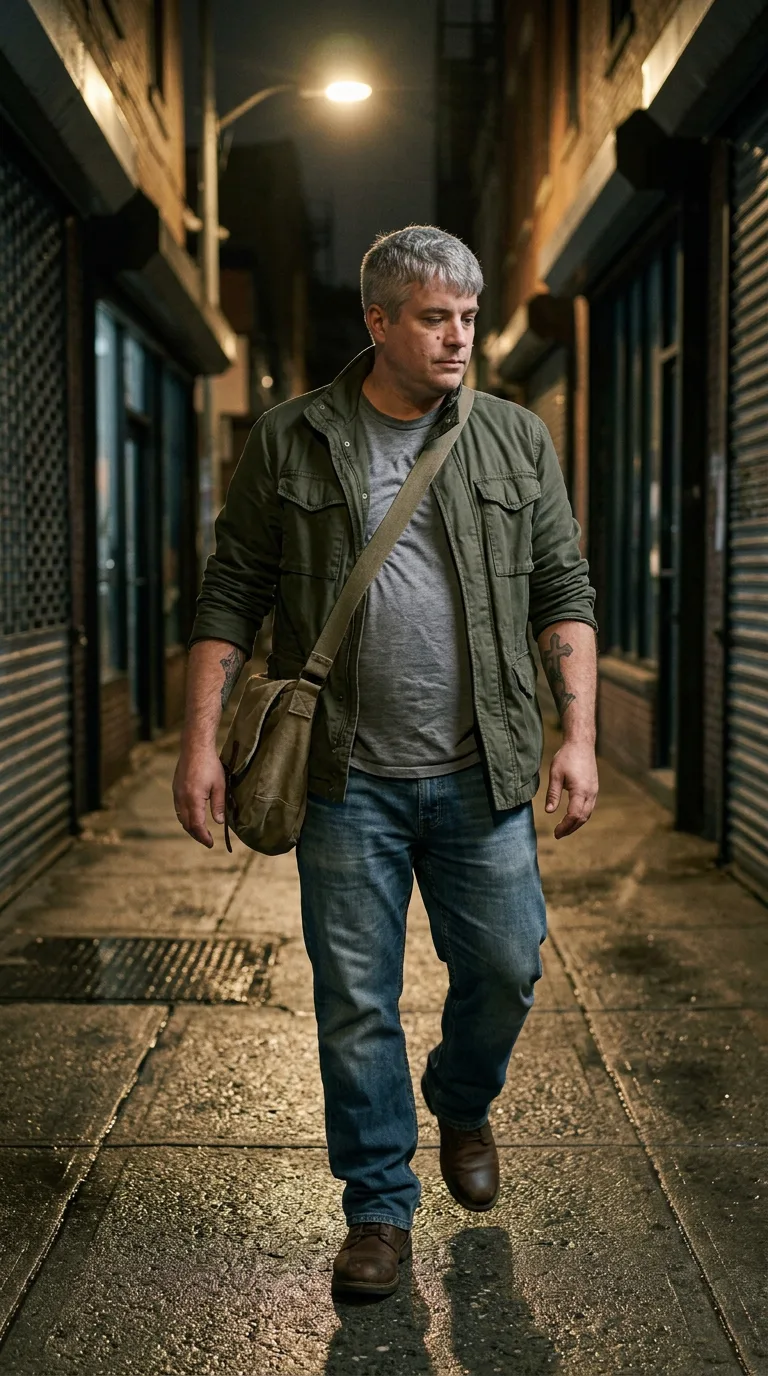
Rarest thing about him: One, upper arm — rare, 1 in 13
Season 0seed 1288461165 · engine v10
Character card
lineage 2NZHHJ
His body-swap story
@colin.hasbrook, wearing Warren Iwata, rolled the wheel on and woke up as Douglas Prentiss, spent under a minute in him, then spun the wheel and woke up as Samir Haddad
The stagehand's knees are the first thing you notice, kneeling on the catwalk to coil a cable, and they are the reason you go back. Warren Iwata's knees, sixty-three years of them, grinding like wet gravel every time he bends. You have had him less than a minute and already you know you will not finish the show in him. Somewhere below, an actress is hitting her marks under a light you rigged, and none of it matters against the small clean thought that arrives the way it always does, without drama: *not this one, not tonight.* You set the coiled cable down gently, because some part of you is still considerate even now, and you get up on those bad knees, and you go find a phone that isn't yours to reach a site that never quite looks the same way twice.
You are still crouched, still Warren, still tasting his coffee-and-Marlboro-going-stale mouth when you spin — and then you are not crouched at all. You are upright, mid-stride, catching yourself on the cold wet flank of a parked Buick, fingers spread on the metal. A shoe that was scuffing every third step simply stops scuffing. The night air here is colder than New York's afternoon, colder than it has any right to be, and it takes you a full two steps to understand you are not confused about the temperature — you are somewhere else entirely, some hour that does not belong to the hour you left.
The hand on the car is thick-knuckled, a gold band snug on the ring finger, and the moment your palm meets the wet paint something comes through: *this car, not his, belongs to Denny two doors down, and he has touched it a hundred times steadying himself same as now, ashamed a hundred times same as now.* You take that shame and set it down in the body like a bag you didn't ask to carry. Forty steps and the scuff never comes back. Even, quiet steps, a rhythm his legs know without him. Chronic hurt is sitting low in both knees and along the spine, dulled right now by the whiskey but not gone, never gone, and you feel how tired that constant hum has made him, a tiredness bigger than any one night.
The jacket is open over a gray shirt, and cold air gets under it, and touching the collar gives you a flash: a closet in a small house, a wife's hand smoothing this same collar down before he left for a study group that turned, like they always turn lately, into three beers too many at a bar with a name he can't now recall. Her name arrives whole and unbidden — Carla — and with it a version of the morning: her at the stove not looking at him, the baby monitor crackling upstairs though the baby is six now and there's no monitor anymore, it's habit, it's love worn down into habit. He is forty-three years old going back to school on a loan and a prayer, one kid, one wife, one town with a stoplight that he has run at two a.m. more than once because there was nobody coming.
The strap of the bag crossing his chest gives you the classroom — a laptop older than it should be, a professor half his age, the particular humiliation of being the oldest guy in Intro to Statistics and doing fine, actually doing fine, better than fine, and nobody at the diner counter believing it because the diner closed eight months ago and took half the town's opinion of him with it. Somewhere in there is the woman who got away, a name that surfaces and submerges too fast to hold, college-aged and twenty years gone, a softness that still aches when he's had exactly this many drinks and not one more.
His right hand finds the tattoo through the sleeve without meaning to — cross, praying hands, done the year his daughter was born, done in the same week he swore off the harder stuff and got saved properly, meant it properly, has kept meaning it properly ever since with the specific stubbornness of a man who backslides Friday and repents Sunday and never once thinks himself a hypocrite for it, only a man being carried.
His leg, standing still at the corner now, wants to bounce and has nowhere to put the motion, so it just trembles once against nothing.
You look down at the hand still flat on the wet hood of Denny's Buick, turn it over under the streetlight, mole-shadowed face tilting with it, and something in you — some old, patient greed that has worn four hundred and fifty-eight men thin before finding them boring or used up or simply not enough — settles into this one like a coin dropping into a slot.
"Wrong way home," you say, to nobody, in his voice, and turn left anyway.