Wade Youngblood
Fictional. Generated by AI — not a real person, and no likeness of one is intended.
56, roofer in New York · rolled by @brian.okafor.lynch · card — no film
History
who has worn him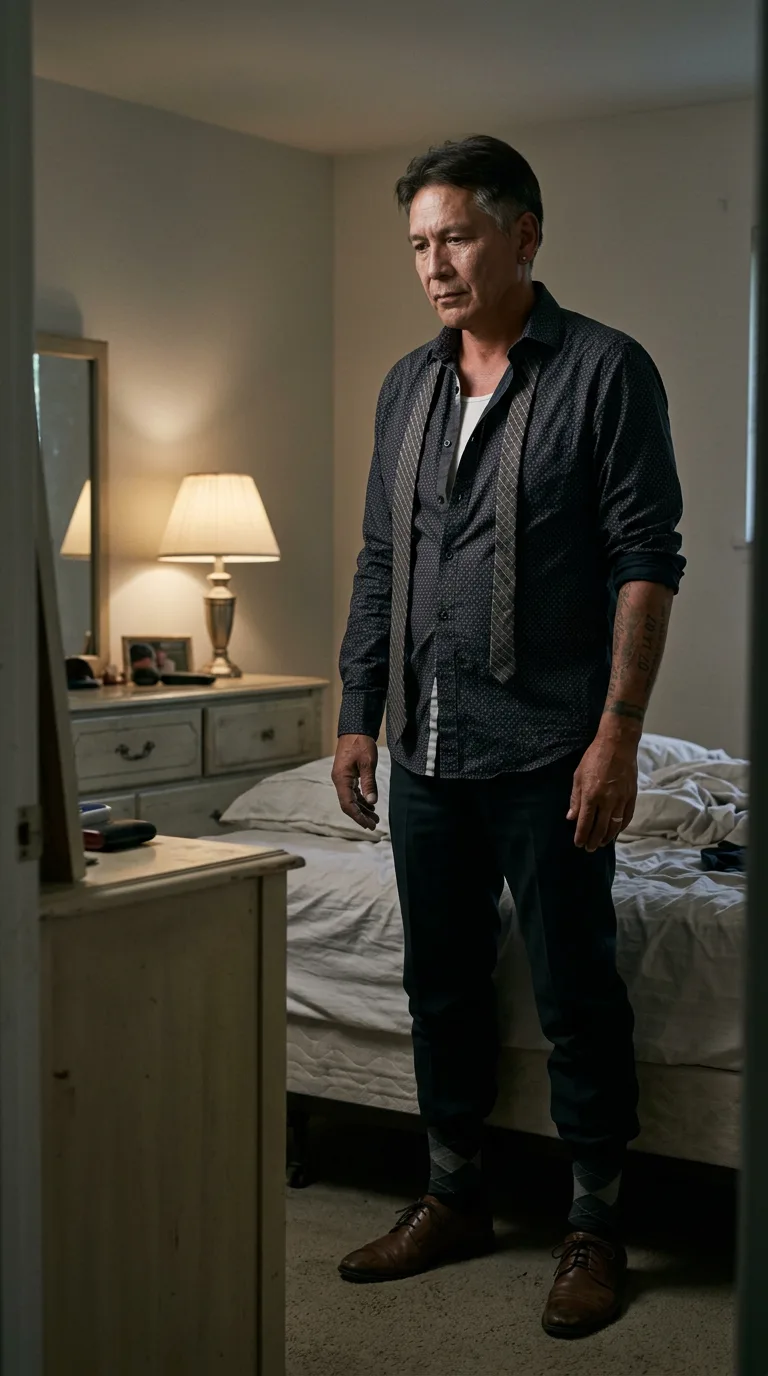
Rarest thing about him: Both earlobes — epic, 1 in 80
Season 0seed 989936805 · engine v10
Character card
lineage 79CGDV
His body-swap story
@brian.okafor.lynch, wearing Ruben Castellanos, rolled the wheel on and woke up as Wade Youngblood, spent under a minute in him, then spun the wheel and woke up as Jamal Everson
---
Ruben Castellanos is sitting on the edge of somebody else's carpet at eleven in the morning, in a Nashville duplex that smells like the casserole he microwaved and didn't eat, and he has the phone number of a fifteen-year-old boy's mother memorized wrong for the third time this month. Less than a minute of being Ruben Castellanos and already the case file is open on his knee, already the boy's intake photo is looking up at him with a face that isn't scared enough for what's in the notes, and already the weight of it is sitting on him like it's been there fifty years instead of forty seconds. It is not the case. It is not even really the tiredness, though the tiredness is real, it came pre-loaded, a body that carries other people's Mondays for a living. It's that the wanting was already there before he finished landing — some low hum under the sternum that says *not this one, not yet, give me something with a horizon on it* — and the laptop is right there on the coffee table, vessel.cards still open in a tab from last night like he knew.
He doesn't decide so much as notice his own hand has already opened it.
The wheel spins.
—
Your hand is flat on your chest and there are ribs under it that have never been Ruben's ribs, wider apart, a cage built for a taller man, and the shirt is open to the sternum with one button in the wrong hole so the collar sits crooked. You are standing. You are barefoot on carpet that is thinner and colder than the one you just left. Somewhere behind you a lamp is burning yellow against a window that's still charcoal-blue, too early for real light, and there's a tie hanging loose and unknotted around a neck that is not the neck you had four seconds ago.
You undo the buttons. You do them up again, in order, without being told how, your fingers already knowing it the way a habit knows a doorknob. The tie goes up and over and through itself into a knot your hands have apparently tied a thousand mornings that were never yours until right now.
He does not wake up somewhere else, confused, calling for someone. There is no him left in here to be confused. There is only the shirt, and the tie, and the room, starting to talk.
—
The shirt first — the cotton against your back gives it up in a rush, sleeve by sleeve, the way it always goes when you take a man mid-dressing: *left arm first, always left arm first, ever since the shoulder started catching.* The shoulder. It's there now, a dull permanent ember low in the joint, and lower down a matching one in the lumbar, the specific ache of a man who has spent thirty years bent over other people's roofs in weather nobody sane works in. Fifty-six years in this frame and the frame remembers every one of them in the knees.
The tie is a rented memory too — not his, exactly, borrowed off a dead father-in-law forty years back, *Sunday, learn it once, you'll thank me* — and it comes back whole, a kitchen in another decade, a man's hands over younger hands, and under it, unbidden, the fact that this is not a workday knot. This is a good-clothes knot. Which means this isn't a roof morning. Which means — the room finishes the thought before you do — this is a Monday he blocked off for something else, and the roofing crew already knows he isn't coming, and the tie is for later, for whatever's after.
The half-sleeve on the right forearm is next, just from your own arm brushing your side — script and a date, and it comes up hot and whole: a woman's name, *Carol Ann*, and the day they married, inked the week the divorce was final, which nobody who's seen it has ever understood and he has never once explained. It isn't grief exactly. It's more like a man keeping the receipt.
The dresser gives you the rest when your eyes land on it rather than your hands — a photograph face-down that used to face-up, a wallet, a ring that isn't on his finger anymore but has worn a pale ghost of itself into the skin all the same, fourteen years of tan lines outlasting the marriage that made them. Carol left on a Tuesday in March with the good dishes and the cat and didn't take the framed photo off the dresser, just turned it face down, which he has never once turned back up and never once thrown away.
The room's smell does the rest — coffee not yet made, drywall dust that never fully leaves a workman's house no matter how many showers, the particular mothball hush of a good shirt kept for the two or three times a year it's needed. You feel, distantly, why this Monday: a hearing, maybe, or a funeral, or a daughter of somebody he used to work beside getting married, the kind of thing that pulls the good shirt out and puts an ache behind the sternum that has nothing to do with the shoulder.
His body underneath all of it is honest in the way a tool is honest: sixty-one inches of shoulder to hip that has thrown bundles of shingles for three decades, average weight sitting well on a long frame, hands that are steady and a little swollen at the knuckle in the cold mornings, feet that know a pitched roof's angle without looking. Fifty-six and strong in the specific ways that get asked of him and worn thin in exactly those places. No cigarette in twenty years, but the want for one still visits at coffee time, quiet, unfed. No drink at all now, and the body seems almost grateful for that, steadier for it.
Your hand — his hand — finds a pen off the dresser without you asking it to, clicks it twice, sets it down. That's not memory. That's just what these hands do when nobody's steering.
—
You look at your hands. Wide-knuckled, sun-marked to the wrist and pale above it where sleeves usually sit, a faint white band circling the base of the ring finger like the ghost of something that used to matter enough to leave a mark and not enough to stay. You turn them over once, both sides, the way you always do, checking the fit.
You lift your eyes to the mirror over the dresser, and the face in it is not asking you anything, because it doesn't know there's anything to ask.
"Late for my own wedding," you say to it, low, almost a laugh, "and it's not even mine."
Somewhere south of here, in a duplex that doesn't know it's been abandoned yet, a laptop is still open to a wheel that has already stopped spinning.