Vikram Suresh
Fictional. Generated by AI — not a real person, and no likeness of one is intended.
37, factory foreman in Eastern Kentucky · rolled by @colin.hasbrook · card — no film
History
who has worn him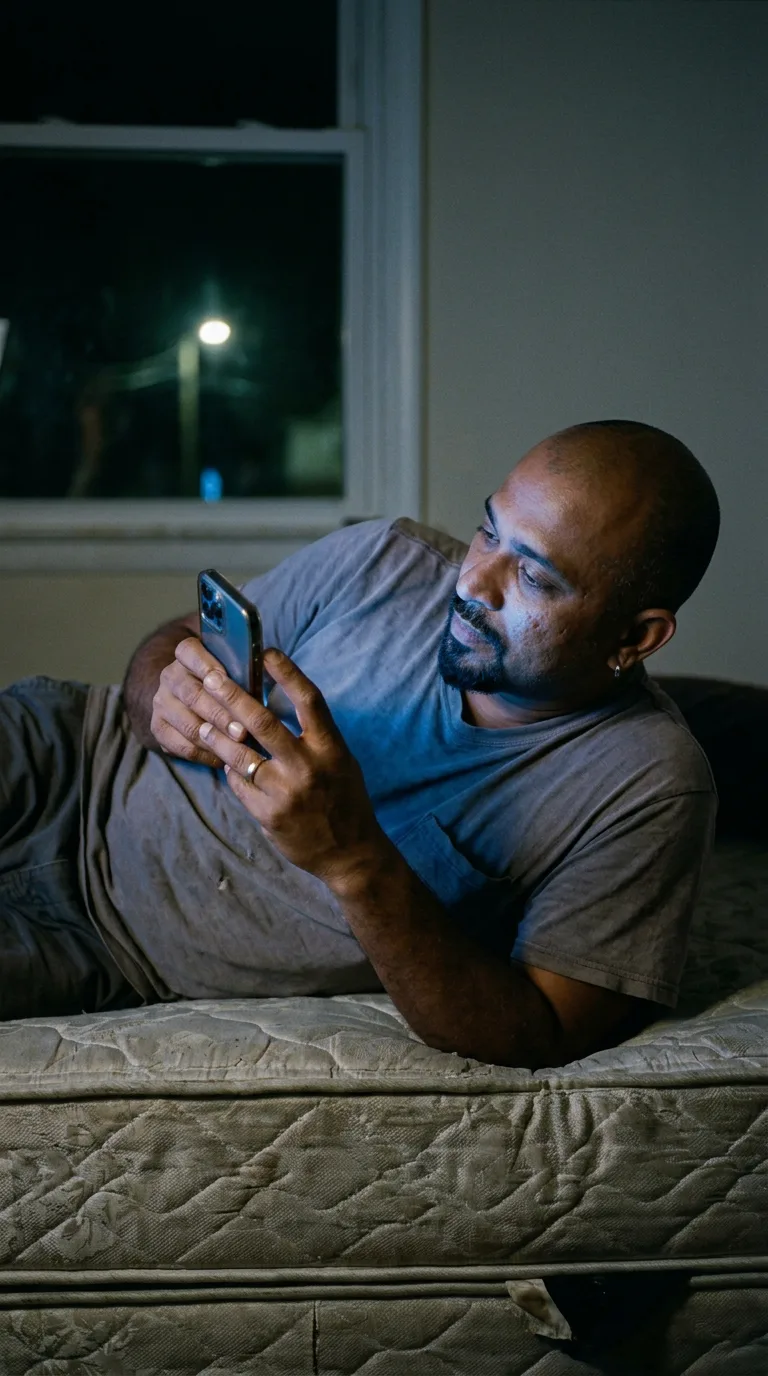
Rarest thing about him: Jehovah's Witness — rare, 1 in 222
Season 1seed 1517644044 · engine v11
Character card
lineage 2NZHHJ
His body-swap story
@colin.hasbrook, wearing Marcus Ridgeway, rolled the wheel on and woke up as Vikram Suresh, spent under a minute in him, then spun the wheel and woke up as Osvaldo Reyes
The stack of essays on Marcus Ridgeway's kitchen table is thirty-one deep and none of them are good, and that is the whole of it, really — not despair, nothing so grand, just a Thursday going gray at the edges the way Thursdays do when you have graded for two hours and the light outside the window has gone from gold to ash and you realize you have circled the word "irregardless" four times tonight already. You've been him less than a minute. You know this because you can still feel the newness of his knees under the table, the borrowed ache of a lower back that has stood in front of whiteboards for two decades, and none of it is interesting yet, and that is the whole problem with a body: the first minute is the only minute it's new. Everything after that is just living in it. You set the red pen down. You are not tired of Marcus. You are tired of the feeling that you have already spent the best part of him, the arrival, and what's left is Thursday. So you open the laptop instead of the gradebook, and there's the wheel, the way you left it, spinning lazy and gold under your cursor, patient as a slot machine that never has to ask twice.
You pay. You spin. You do not close your eyes, because after eight hundred and sixty-eight times there is no ceremony left in it, only appetite.
The light is blue and it is six inches from a face that has stopped blinking on schedule, and the thumb under it — this thumb, these knuckles, dark and a little callused at the first joint — picks up speed before you have even finished arriving, flicking past a video of a truck, a meme, a woman laughing at something off-screen, faster now, steadier, the scroll of a man who has somewhere better to be and doesn't. You are on your side. There is a mattress with no frame under it, bare ticking gone yellow-gray at one corner, and a shirt against your back that is not on your back at all — you are in a plain gray T-shirt gone soft with washing, and it is the shirt that gives you the first flash, unbidden: not this shirt, an older one, denim-blue, sleeves rolled twice, the particular give of a collar that's been ironed by the same hand for eleven years.
The room is dark except for the window, where a streetlamp burns white-orange behind a young maple, and somewhere below the window a creek you cannot see is running the way it always runs, this time of year swollen brown and quiet. That, too, comes to you sideways, from nowhere you're touching: the smell of green shade and the particular tin note of a footbridge's cable rail warming under June sun, a memory that belongs to daylight and has no business being here except that touch has already started opening drawers it shouldn't, and this is how it always goes, the body giving up its life to you in no order at all.
The wedding band is the loudest thing on you. Plain, gold, worn thin on the underside the way rings get when a man works with his hands, and when your thumb — his thumb, already, faster than you — brushes it mid-scroll, you get her. Not her face first. Her voice, saying his name the way she says it when she's teasing, two syllables drawn into three: *Vi-kraam.* Priya. Nineteen years married this October. You get the wedding itself in pieces, garlands and his mother crying the good kind of crying, and then nothing about the wedding at all, just an ordinary Tuesday four years ago, her handing him a mug of tea gone lukewarm because she forgot it on the counter while yelling at the middle one about homework, and him drinking it anyway, lukewarm, because it was hers.
Three children, at least — the memory won't hand you a number cleanly, only weight: a girl's laugh through a bathroom door, a boy's cleats by the mudroom step, a smaller one's hand fisted in his shirt collar at some gathering, sticky, and him not caring. The small silver hoop in his left ear itches faintly with its own history — nineteen, a dare from a cousin, his mother's disapproval that softened into fondness inside a year. You are aware of your own height before you're aware of anything else physical: short, compact, the ceiling further from you than it should be if you were Marcus, gone. Thirty-seven-year-old shoulders, average build gone a little soft at the middle from desk work that isn't desk work at all — a foreman's job, standing shift-length hours on concrete, knees that complain on the third flight of stairs and never before.
The T-shirt against your back keeps giving. This morning — his morning, hours behind wherever Marcus's Thursday was ending — pulling the navy work shirt off its hanger, the same navy shirt from the picture you'll never see but his hands remember buttoning: three buttons before the phone rang, his shift supervisor already complaining about a jammed conveyor before Vikram had his boots on, and the small flare of irritation followed immediately, always immediately, by the swallowed patience that thirty-seven years and a faith that asks patience of you have worn into a groove. He does not raise his voice at work. He has not raised his voice at work in four years, since the incident with the temp who nearly lost two fingers and Vikram walked him outside instead of writing him up, sat with him on the loading dock steps while the ambulance that didn't end up needing to come, didn't come. That's the one thing nobody at the plant knows he still thinks about on nights he can't sleep — not guilt, exactly. Relief with teeth in it.
He does not drink except at his brother-in-law's on holidays, one beer, warm by the time he finishes it. He has never smoked; the one time at nineteen, the same year as the ear, he coughed so hard his cousin laughed for a week. He goes to meeting on Sundays and sometimes Tuesdays, and the peace of it isn't in your hands to feel fully, only its outline: a folding chair, a hall that smells like carpet cleaner, Priya's shoulder warm against his.
The phone is still in your hand, his hand, screen gone dim now under a thumb that has finally slowed to nothing. Six inches away. You feel the specific fatigue of the body under you — the good kind, the kind that comes from eleven hours on a floor with the line running, checking guarding, checking headcount, a foreman's fatigue, honestly earned, nothing like the chalk-dust tiredness of the man you left mid-word at a kitchen table three thousand miles and one time zone away, grading essays that will still be ungraded whenever anyone thinks to look for Marcus Ridgeway again, which may be never, because there is no Marcus Ridgeway anymore, only the last thing he was doing when you stopped being him.
You bring the hand up in front of your face — his hand, brown, a white ring-line, a nail bed with a permanent gray-black bruise under the index nail from something heavy dropped on it two years back that never grew out right. You turn it over slowly, watching the hoop light catch on gold.
"Priya?" you say into the dark room, quiet, testing the shape of her name in his mouth, though there's no one there to answer, and you don't know yet if you'll call for her again or just lie here a while wearing the quiet, the creek running somewhere below the window, the wheel still open on a phone you no longer feel the need to hold.