Osvaldo Reyes
Fictional. Generated by AI — not a real person, and no likeness of one is intended.
56, construction laborer in Chicago · rolled by @colin.hasbrook · card — no film
History
who has worn him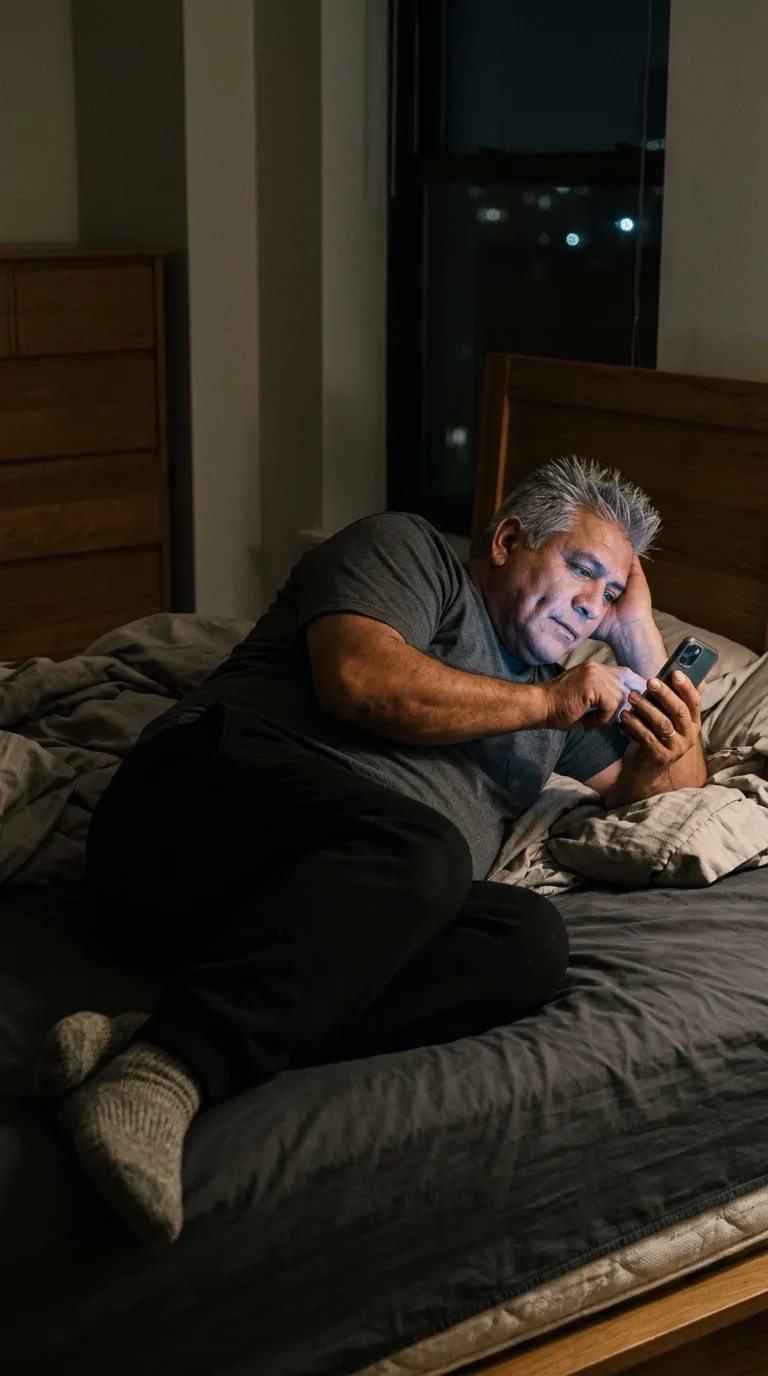
Rarest thing about him: Short and spiked up — common, 1 in 56
Season 1seed 1661644930 · engine v11
Character card
lineage 2NZHHJ
His body-swap story
@colin.hasbrook, wearing Vikram Suresh, rolled the wheel on and woke up as Osvaldo Reyes, spent under a minute in him, then spun the wheel and woke up as Adam Sikorski
Vikram Suresh has been sitting on the edge of this bed for forty seconds, and forty seconds is long enough.
You know this body's tells by now — you've had it less than a minute, but a minute is plenty when you've done this eight hundred and seventy times. The goatee itches where sweat dried under it. The shift ended two hours ago and this is his house, his actual house, his wife somewhere downstairs running water, and already the walls of him are pressing in the way they always do, fast, the way a rental car feels wrong before you've left the lot. You didn't take him for anything. You took him because the spin before him ran dry — a locksmith in Tulsa, six days, forgettable — and Vikram Suresh was just what came up next, foreman, goatee, tired eyes, a life already half-lived by somebody who is no longer anybody. You don't even dislike him. You just don't want to be a man who manages a floor of stamping machines and eats dinner at the same hour every night for the rest of whatever this is. That itch is the only reason you need. It has never needed to be a good one.
You reach for the phone on the nightstand — his phone, muscle memory not yours, code already remembered — and you go to the site the way you always go to it, the way an addict's hand knows a doorknob in the dark. Vessel dot cards. The wheel loads. You pay what he has, which is not much, and that stopped mattering to you spins ago. You spin.
The room does not fade. There is no room, and then there is a different one entirely, and you are already inside it, mid-motion, a thumb moving on glass that isn't the same glass.
You are lying on your side. There is a weight to this body that Vikram's never had — heavier through the middle, a low ache low in the back that has opinions about the mattress. Blue light sits on one cheek. The thumb — his thumb, gone quiet under you the second before, stopped mid-scroll on something he'd been looking at too long — picks back up on its own, faster now, flicking through a feed with a rhythm that isn't his and was never going to be. Somewhere behind these eyes there had been a whole man reading a comment thread about the Bears' offensive line, and now there is only you, wearing his stillness like a coat still warm from him.
The window behind you shows lit windows across an alley and the dark bulk of an L platform, empty this hour. It's late enough where he is that a decent man is asleep already. It should be later, if you think about it, but there's a rhythm to bodies like this you already half know without having to be told: an early call, a four a.m. alarm, a trench waiting for him in the cold before the sun's up. He's not up late. He's up early, in his own tomorrow, stealing an hour of nothing before it starts.
The phone is warm from his hand and that's the first door. Not memory exactly — a hum, a groove worn into the pad of the thumb, thousands of nights just like this, lying on his side scrolling because sleep doesn't come easy anymore and never really did, not since the knee started keeping time with the weather. Osvaldo. The name arrives with the hum, sourceless and certain, the way his own name always would be. Osvaldo Reyes.
You let your hand fall flat against the comforter and the comforter gives you the rest of it, slow, the way the site always does it — cloth first, then a life.
The gray T-shirt against your back: you put it on this morning after a shower that didn't take the concrete dust out from under your nails, not really, not ever, and Marisol didn't say anything about it because she stopped saying anything about the dust twenty years ago. You remember — no, he remembers, and it comes to you sideways, in his feeling and not yours — pulling that shirt over his head at five-forty this morning in a bathroom with the fan broken, elbow catching the door frame the way it always does because this apartment was built for someone smaller. The T-shirt is soft in the way of something washed four hundred times. It smells like the same detergent it's smelled like for a decade. There's a comfort in it that isn't yours and that you feel anyway, secondhand, like standing near somebody else's fire.
The wedding band is next, and it's heavier than it looks, worn thin on the underside where it's rubbed against a shovel handle for thirty years. Marisol. Her name comes with a wedding in a rented hall on the South Side, her sister crying louder than anyone, and years and years after that, ordinary years, dishes and orthodontist bills and one bad winter where the union hall had no work and they ate rice for six weeks and never told the kids there'd been a problem at all. Two kids. A daughter who calls on Sundays now from Milwaukee, a son who doesn't call enough and Osvaldo doesn't say anything about that either, because that's not how his father did it and he's spent his whole life either being like his father or fighting not to be, and some days he can't tell which one he's doing.
There's an ex in there too, distant, sanded down by thirty years — Teresa, a girl from before Marisol, a name that still has a small ache riding under it whenever it surfaces, the kind you keep because it doesn't cost anything anymore. You don't chase it further. It isn't yours to chase.
The mattress under you gives you the knee — the left one, that's the bad one, that's the one that makes the ladder into the trench a small negotiation every morning now — and the jaw gives you something else entirely: a tightness that's been there since before you arrived, an old habit of clenching down on nothing, a man who doesn't drink anymore and never smoked and has had exactly one place to put the pressure of thirty years of load-bearing work and a mortgage and a body that is starting, quietly, to send him bills. The dimples are there even now, even held tight like this, a face built by something that laughs easy sitting on top of a jaw that's learned to grind.
He was a good hand once, is still a good hand, knows a trench line by looking at it, knows the exact weight a shovel should carry before the wrist starts to complain, knows all of it without thinking, the way you know how to spell your own name. None of that is available to you yet except as an ache in a shoulder and a callus on a palm that you can feel from the inside like a stranger feeling somebody else's scar.
The phone is still moving in your hand, thumb doing his old motion at your new speed, and you finally let it slow, and stop.
You turn the hand over. Study it — thick fingers, dirt worked so deep into the creases that no shower touches it, the band catching the last of the phone's light.
You say, quiet, to no one, into a dark bedroom under the L tracks in Chicago:
"Wrong hands."
Then you set the phone down on the nightstand, face up, still glowing, and you don't know yet how long the dimples are yours to wear.