Trent Boskovich
Fictional. Generated by AI — not a real person, and no likeness of one is intended.
42, security guard in Phoenix · rolled by @colin.hasbrook · card — no film
History
who has worn him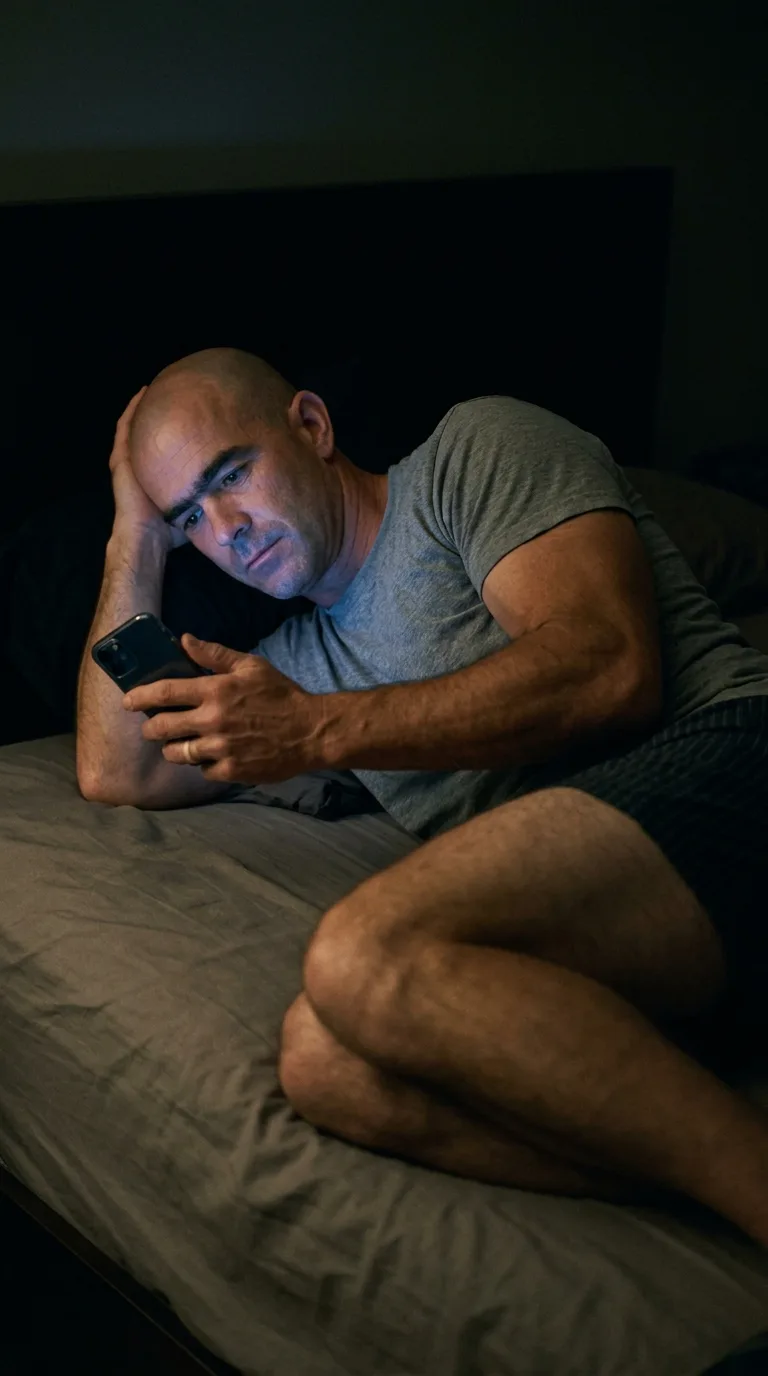
Rarest thing about him: A unibrow — rare, 1 in 48
Season 0seed 628037168 · engine v10
Character card
lineage 2NZHHJ
His body-swap story
@colin.hasbrook, wearing Curtis Abernathy, rolled the wheel on and woke up as Trent Boskovich, spent under a minute in him, then spun the wheel and woke up as Gerald Novotny
The stall in the Los Angeles shop smells like hoof and hot iron, and Curtis Abernathy's knees are already screaming from fifty-one years of crouching. You have been him less than a minute — you feel the burn scar on his forearm pull tight when he flexes it, feel the ache riding low in his back like it's always been there, feel a horse's flank breathing against his shoulder, patient, waiting for the next nail. It is a good body. Capable. The kind of hands that know a trade. But you did not come back for him. You came back because there is a phone in his coverall pocket, and it just lit up with a name you'd rather not read twice, and Curtis Abernathy's whole tired, aching, fifty-one-year-old life suddenly feels like standing still. So you don't set the hoof down gently. You let it drop, straighten up too fast for that back, and open the wheel on a screen already smudged with someone else's day.
You spin.
You are on your side in the dark, and the room is not a room you know — no farrier's shop smell, no horse breath, no iron. A phone six inches from your face throws blue up onto one cheek. A shirt or nothing at all against your back, cool sheets, an air conditioner somewhere clicking through its cycle against a heat that hasn't broken outside yet. Your thumb, mid-scroll, keeps moving — faster now, steadier, a rhythm that isn't the rhythm it was a half-second ago. You do not blink when the body wants to blink. You are aware of the shape of him around you before you are aware of anything else: shorter than Curtis, tighter through the shoulders, a compact, coiled kind of strength, and a smooth dome of scalp against the pillow where your own hair should be and isn't.
The phone is the first thing you're touching, so the phone is the first thing that opens.
A scroll through a dating app, thumbnails of women who all look a little like the one who left. That's not a thought you have — it's a thought that arrives already shaped, already sour, already his: *four years and she still owns which faces catch my eye.* You feel, distantly and then not distantly at all, the particular hollow of lying awake in the wrong hour of the day with nobody to call about it. His shift ended before dawn. He came home to a lobby-quiet apartment, blackout curtains, a body that runs on a clock nobody keeps with him, and instead of sleeping he opened the phone the way he always does now, like checking a wound.
The mattress under you gives him next — cheap but new, bought alone, a receipt he kept out of some grim, private accounting of what a marriage costs to leave. A ring that isn't there anymore. You feel the tan line on your finger like a phantom weight, and with it a wedding — a courthouse one, small, her in blue because she said white felt like a lie — and years after it that thinned out into two people passing a remote back and forth without looking at each other. No kids. He'd wanted them. She hadn't, not with him, not by the end. That fact sits in him like a stone worn smooth from being turned over so often it doesn't cut anymore, just weighs.
The shirt — no, there's no shirt, just his own skin against the sheet, and that gives you the gym instead: a body he built on purpose after she left, like strength was something he could still control when nothing else had held. Four in the afternoon, most days, before the overnight desk. Free weights, mirrors, the specific satisfaction of a heavy bag taking a hit clean. His hands know that. His hands also know, without him ever deciding to teach them, how to run themselves over his scalp when a thought gets too loud — and one does, now, half-formed, something about a therapist's office and a prescription bottle by the bathroom sink and how much better this year is than three years ago, quietly, without anyone throwing him a parade for it.
Under your back, the dark of the bedroom gives you the shift itself — the lobby desk downtown, fluorescent hum, the long stretch between two and five when the building holds its breath, a Bible with a cracked spine in the bottom drawer he reads on slow nights, not performing it for anyone, just needing it. Church on Sundays he can make it to, when the schedule allows. A beer with the other guard sometimes after, nothing more — no reason to chase a buzz he doesn't need. Getting dressed for tonight's shift, hours from now on his clock: the black uniform shirt, sleeves rolled precisely once, buttoned steady because his hands don't shake anymore, not since the second year of the medication; the belt with its flashlight and its weight settled onto hips that have gotten used to carrying it; boots that have walked the same marble floor eleven hundred times. All of it still hanging in the closet six feet from where you're lying now, waiting for a body that thinks it has hours left before it has to be that man again.
The unibrow — you feel it more than see it, a single line of tension over both eyes, the thing people notice first and he's stopped minding. Divorced eighteen months. No nicotine, ever, some old promise to a father with a bad lung. A little money saved, unglamorously, the way a person saves who has learned nobody else is coming to catch him.
Your thumb stops scrolling. You lift the hand off the phone and hold it in front of your face — his hand, blunt-fingered, a pale stripe where gold used to sit — and turn it once in the blue light like you're checking it's real.
You sit up into the dark, into the hum of an AC unit fighting Phoenix through a wall, and say, to no one, in a voice still finding its new floor: "Okay. Okay, let's see what you've got."