Gerald Novotny
Fictional. Generated by AI — not a real person, and no likeness of one is intended.
62, paramedic in Los Angeles · rolled by @colin.hasbrook · card — no film
History
who has worn him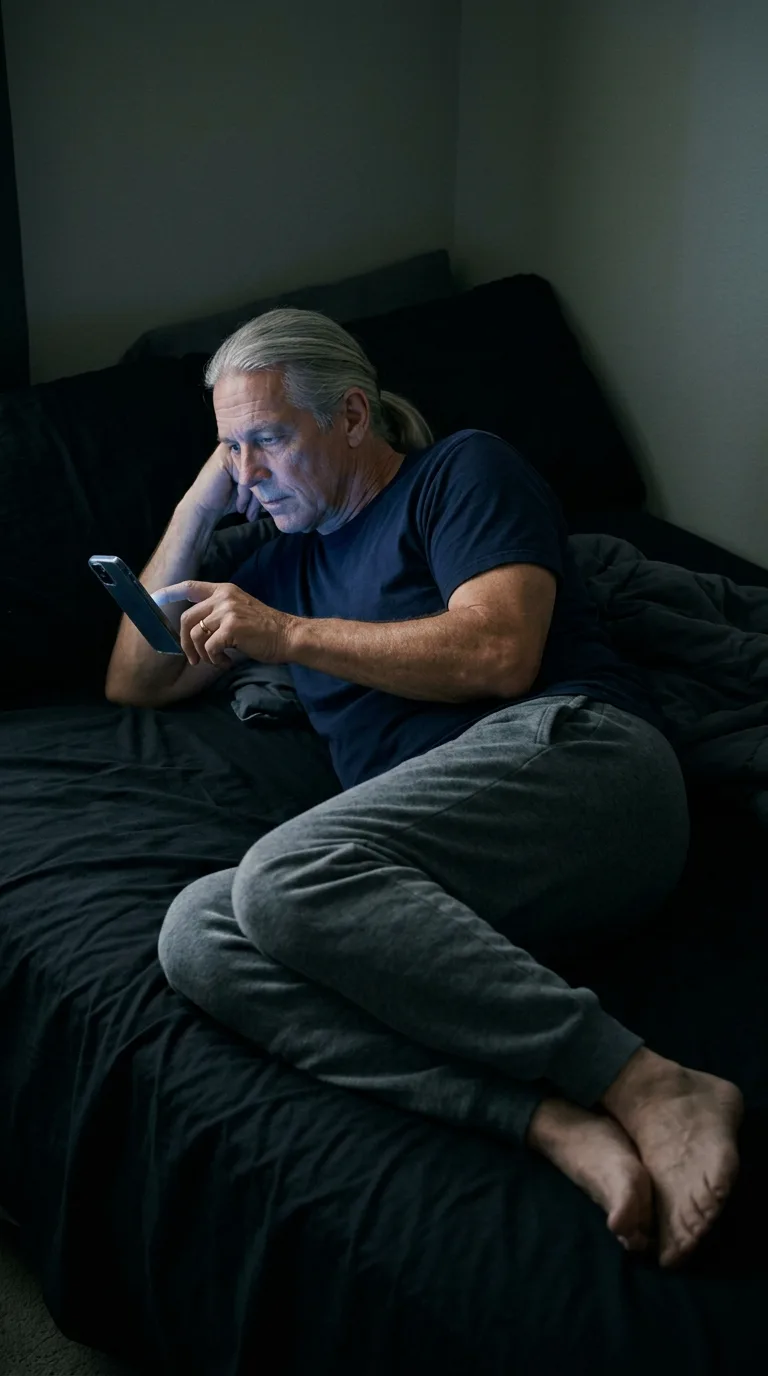
Rarest thing about him: A ponytail — rare, 1 in 167
Season 0seed 265231928 · engine v10
Character card
lineage 2NZHHJ
His body-swap story
@colin.hasbrook, wearing Trent Boskovich, rolled the wheel on and woke up as Gerald Novotny, spent under a minute in him, then spun the wheel and woke up as Otis Prather
You are standing in a Phoenix parking lot at two in the afternoon, wearing a bald head and a unibrow you have worn for less than a minute, and already it is not enough.
The uniform is stiff at the collar. The radio on the shoulder crackles with somebody else's call, some strip mall alarm, not yours to answer. You feel Trent's shift stretching out in front of you — six more hours of standing near doors, nodding at people who don't see you, the particular boredom of a body built for a fight nobody starts. He is strong. He is thirty years younger than what you're about to trade him for. None of that is the thing you want. You spun for him last time thinking strength would be enough for a while, and it lasted less than sixty seconds before the flatness of him set in, the sense of a life with no weather in it. You want weather. You want a life that has already had its storm and is standing in what's left.
You don't decide so much as notice your thumb is already moving toward the phone in your borrowed pocket. You open the site. The wheel is the only bright thing on the screen. You spin it the way you've spun it four hundred and seventy-seven times before, without ceremony, the way another man might reach for a second beer he didn't need and wouldn't remember wanting.
—
The room is dark and the only light is blue and it is coming off a phone six inches from your face. Your thumb is already moving before you understand it is your thumb — flicking, flicking, faster than the rhythm it was in a half-second ago, some ad, someone's kitchen, gone, gone, gone. You feel the weight of a body settle onto you all at once: heavier through the middle than the last one, softer, older, lying on its side with one arm dead asleep beneath a pillow. A ring is warm and tight around the base of your fourth finger. Your knees are drawn up. Your feet, bare, hang off the edge of a bed that smells like fabric softener and, underneath that, like nothing — like a place where nobody else has slept in some time.
The phone dims when your thumb finally stops. You are looking at a face you have not chosen and do not recognize on the screen — a face you were apparently looking at before, mid-scroll, a woman maybe, a listing, a memory not yet yours — and it doesn't matter yet, because you have not blinked correctly in several seconds and something in the body knows it and has no way to say so.
—
The shirt you're not wearing yet — because this is bed, this is boxers and an old academy T-shirt gone soft gray at the collar — still holds something. It's folded over a chair across the room, a uniform shirt, navy, the mic clip still on the shoulder, and just the sight of it through the dark gives you a hand memory: buttoning it top to bottom this morning, the fourth button always a half-second slower because the thread's going, a pen already clipped into the breast pocket before he even puts the shirt on, because he loses pens if he doesn't do it first thing. Gerald Novotny. The name arrives with the gesture, not before it — the way his own hand knows the order of his morning better than his mind does. Twenty-two years on the rigs. Boyle Heights, Highland Park, now mostly the west side, mostly stable people having the worst day of somebody's life.
The ring is the deepest thing your finger touches. It has been there so long the skin has grown a little around it, and touching it — just resting your thumb against the band the way his thumb does without thinking — brings back a kitchen with yellow light and someone laughing with her back to the stove, brings back a hospital room eleven years later that smelled like the underside of everything a paramedic knows and cannot stop, brings back him standing at the foot of a different bed than this one, professionally useless for the first time in his life, holding a hand he had held ten thousand times before, watching a monitor he understood too well. Carol. He never took the ring off. It was never a decision, just a thing that never came up, the way not drinking anymore never came up, the way he drifted so far from needing a cigarette that he forgot there was ever a version of him that had. Two kids, grown, calling on Sundays out of love and a little out of guilt, and he lets them off easy both ways because he remembers being that age and thinking his father would always be exactly this steady.
Under your palm, the mattress remembers itself too — nights when this was a bed for two and now is a bed with a phone in it, blue light, a man forty minutes past a twelve-hour shift, scrolling nothing in particular because the apartment is quiet in the specific way apartments get once everyone who used to be loud in them has either grown up or died. Your body — his body, sixty-two years in it, the low ache behind the left knee that's been there since a call in '09 gone wrong on a curb, the strength still in the forearms from two decades of lifting people who couldn't lift themselves, the particular ease of hands that have found pulses in the dark without needing to look — carries no complaint in it. It is tired in the ordinary way. It is, underneath the tired, still working.
His hands, when they are not doing anything else, click a pen. You feel the ghost of that now, the phantom motion in the tendon, even with no pen in reach — a habit worn so deep into him it survives the man who owned it.
—
You lift the hand off the mattress and look at it in the last of the phone's light — spotted at the knuckle, the band gone dull with age, the tendons standing up thin under skin that has thirty more years of weather on it than the hand you had an hour ago in a Phoenix parking lot. You turn it over once, slowly, like you're checking it's really attached.
Then you lift your eyes to where the phone's camera would be if it were pointed at you, and you say, quiet, to no one:
"Okay. Okay — who are you."
The room stays dark. The ring stays warm. Nobody answers, and there is no telling, tonight or any night after it, how long you intend to be the one who's asked.