Terrell Voss
Fictional. Generated by AI — not a real person, and no likeness of one is intended.
21, barista in Boston · rolled by @marco.villagrana · card — no film
History
who has worn him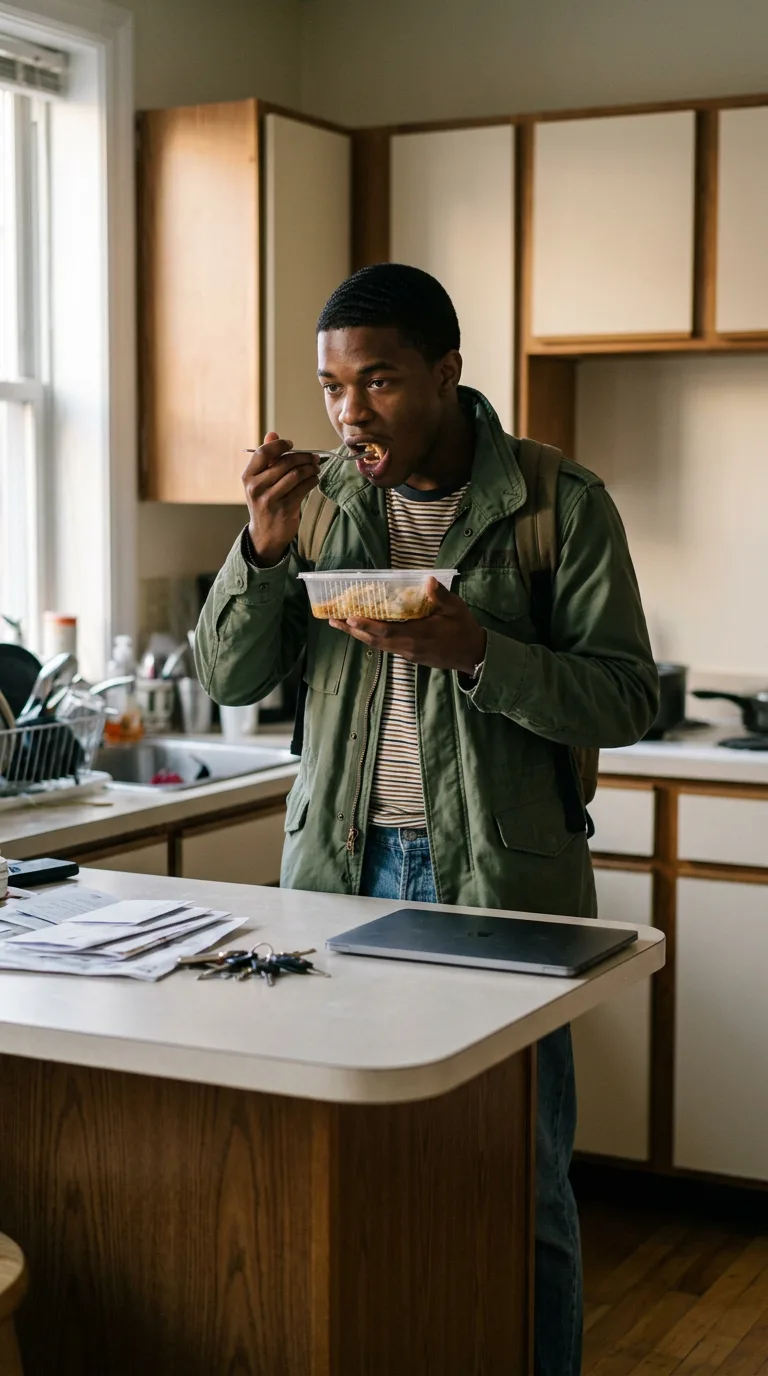
Rarest thing about him: Unitarian or liberal faith — epic, 1 in 113
Season 0seed 1583761387 · engine v10
Character card
lineage LJL8SV
His body-swap story
@marco.villagrana, wearing Marcus Villagran, rolled the wheel on and woke up as Terrell Voss, spent 4 minutes in him, then spun the wheel and woke up as Malik Osei
Marcus Villagran's knees ache on the concrete floor of the ranger station bathroom, and that ache is the whole reason. Four minutes in and already this body is telling you what it costs — the left knee that took a fall on the levee trail two winters back, the gut that sits heavier than you'd like under the uniform shirt, the thick, patient hands that know how to coil a rope and calm a spooked tourist and not much else you want right now. It's a good body. It's a body with a pension and a dog somewhere and a sister who calls on Sundays. None of that is yours and none of it interests you. You didn't spin thirty-four times to sit still in a man who is, underneath everything, contented. Contentment is the thing you cannot stand wearing. You want the itch back — the leg that won't stop bouncing, the mouth that isn't finished growing into itself. You want young. You找 the site on the phone in Marcus's pocket, the wheel already spinning in your head before it spins on the screen, and somewhere in the part of you that used to be nobody at all, you think: something lighter. Something with less to carry. You pay. You spin.
The fork stops an inch from your mouth.
You feel it before you understand it — the whole weight distribution wrong, no gut, no ache, hips narrow, a lip ring cold against your bottom lip like a small correction. The fork comes back down into the container on its own, obedient to a hand that is abruptly, entirely yours. Coat still on your shoulders, backpack straps still biting in. A kitchen that smells like garlic and old grease and the specific mildew of a triple-decker in autumn. Gray light through a window over a sink full of dishes. You shrug the coat off one shoulder, then the other, sit down at the counter on a stool that creaks, and you keep eating, even mouthful after even mouthful, because the body wants to finish what it started and you let it, because you are still finding the edges of him.
The container is what starts it. Plastic, warm, the ridged lid folded back — and it comes to you in his hand: this is his mother's chicken, dropped off Friday because she still doesn't believe he eats. Warmth floods up through your palm and it isn't yours, it's his, a small helpless gratitude toward a woman you have never met. The fork is next — cheap, bent slightly at the tines, the one that survives every apartment because it's ugly enough nobody steals it — and behind it, three years of dorm kitchens and shared sinks and one Christmas he spent alone because the trains were down.
The jacket on the floor by the stool gives you more, sleeve by sleeve, the way it went on this morning: cold storm door, the porch groaning, him zipping it halfway because his hands were full of a to-go cup he doesn't even remember buying. Under the jacket, the shirt — thin, soft from washing, a band he doesn't listen to anymore but never threw out. The apron isn't on him now but its ghost is, the muscle memory of tying it twice around because once never sits right, the smell of steamed milk baked so far into his forearms that even bare-armed in his own kitchen he can smell espresso if he tries.
His hands know things without him telling them: how to crema a shot without looking, how a portafilter locks in with exactly enough force and no more, how to write a name on a cup fast enough that the line doesn't back up. Right now those hands are still except for the leg — his leg, going under the counter, a small tireless bounce that started in high school and never left, that isn't nerves so much as a motor idling. You feel it start up in you like a second pulse.
There's a girl in this, somewhere in the counter's grain, in the grease of the backpack strap — an ex, recent enough that her name still has a temperature. Not tonight. Not this container of chicken. But close underneath, the way a bruise is close under a sleeve: a fight neither of them finished, a key he still hasn't asked back for. You don't chase it. It's his to keep for now.
The window over the sink gives you nothing but your own face doing nothing, dark outside, gray inside, and under that plainness — no scar, no story about his skin, nothing anyone would point at — there's just a twenty-one-year-old body, decent shoulders, a waves brush somewhere in the bathroom that his hand already itches for out of habit. Nothing hurts. Nothing is heavy. It is, after thirty-four other men, almost embarrassingly easy to sit in.
You set the fork down in the empty container, and you look at your hand — his hand, narrow-fingered, a lip ring's cold ghost still at your mouth from the last bite — and you turn it over once like it might have arrived with instructions.
Then you look up into the dark glass of the window, where his own reflection is the closest thing to a mirror in the room, and you say, out loud, to no one who is listening: "Okay. Let's see what you've got."