Marcus Villagran
Fictional. Generated by AI — not a real person, and no likeness of one is intended.
32, park ranger in New Orleans · rolled by @marco.villagrana · card — no film
History
who has worn him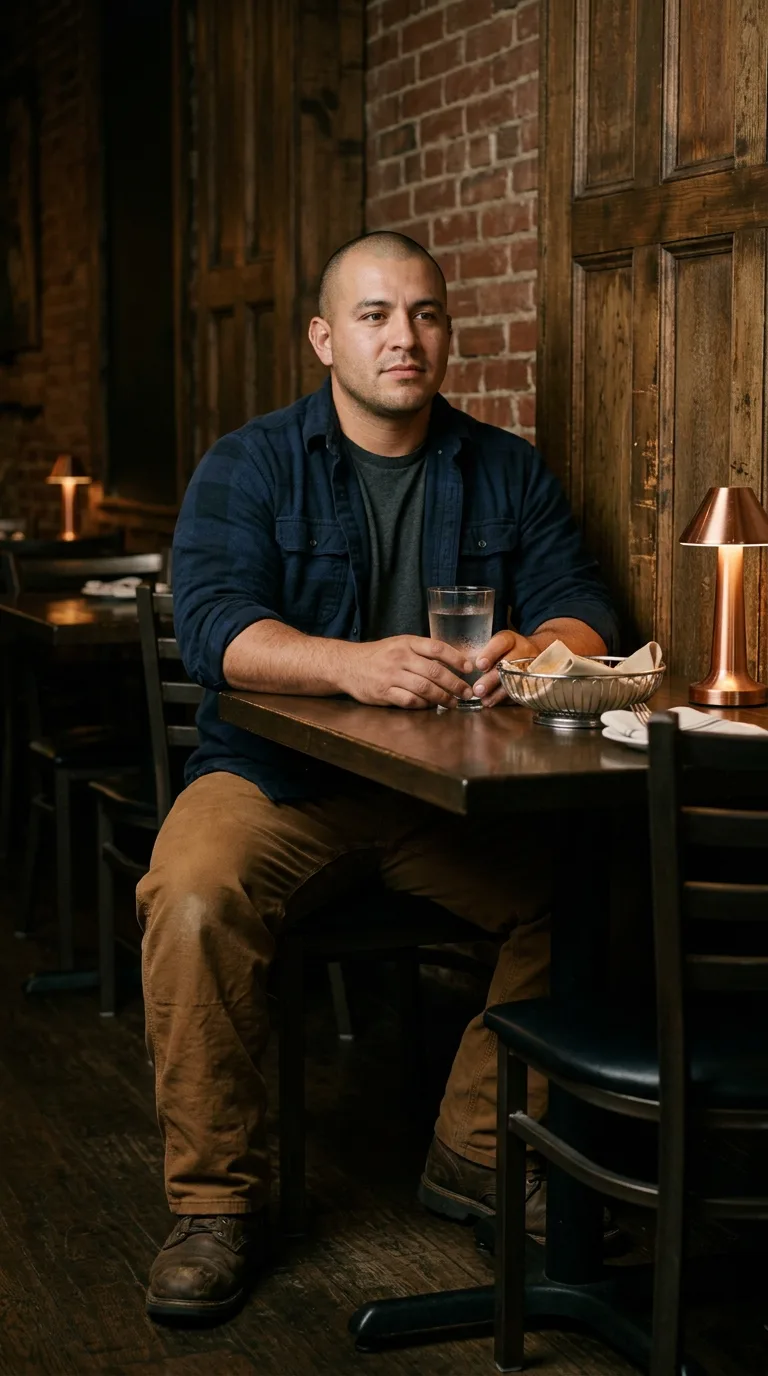
Rarest thing about him: Ear cartilage — epic, 1 in 46
Season 0seed 1929150940 · engine v10
Character card
lineage LJL8SV
His body-swap story
@marco.villagrana, wearing Reuben Tolliver, rolled the wheel on and woke up as Marcus Villagran, spent 4 minutes in him, then spun the wheel and woke up as Terrell Voss
You are Reuben Tolliver for the one-hundred-eightieth second of your life, and it is already unbearable. Not the body — the body is fine, better than fine, younger bones than you've had in weeks, though the knees ache in a specific old-man way that isn't yours to complain about. It's the room. Wood paneling the color of a courtroom. A stenography machine on the desk with its little gray keys like teeth, and outside the window, Sunday light lying flat and used-up across a Kentucky parking lot with four cars in it. Somewhere in the house behind this office a television is on too loud, a game he doesn't care about, and you understand with total clarity that Reuben Tolliver has been sitting in this exact chair on this exact kind of Sunday for years, and that you have inherited not a life but a waiting room. Three minutes was enough. You are bored in a way that has weight to it, a physical impatience sitting under the sternum, and your hand — his hand, dimpled knuckles, wedding-ring tan long faded — is already walking to the laptop, already has the site up from muscle memory that isn't muscle memory at all, just want. You do not decide to spin. You have already decided, days ago, weeks ago, the first time. This is only the part where you do it.
The wheel turns and there is no falling, no darkness, nothing so respectful of the moment as a transition. There is a restaurant. There is brick warm-lit by a copper lamp, a water glass slick under your fingers, and your own voice — his voice, low and a little rough — coming out the far side of a sentence you didn't start. "—so anyway, that's why I don't really do rooftop bars anymore," you hear yourself finish, easy, a joke's cadence hung on the end of it, and it lands too big, carries two tables over, and you feel his mouth do something like a wince behind a smile. Across the table a woman in a green dress is laughing at the wrong half of the joke. The glass turns a quarter under your hand and stops. Bread basket, untouched, sitting between you like a held breath.
The shirt is what opens first — cotton against your back, a flannel worn soft at the elbows, and through it comes a hand pushing an iron the wrong way over a collar because he's late, always a little late on first dates, doesn't trust himself not to be, standing in a shotgun house one room wide with the ceiling fan doing nothing against the wet-street heat coming through the screen door. You get the whole morning that way: him choosing this shirt over a better one because the better one felt like trying too hard, him checking the mirror in the hallway and turning his ear a little to catch the light off the piercing, a small vanity he'd never call a vanity. Boots on last, the leather already broken into the specific give of his left foot, which turns out slightly, an old thing from standing wrong on trail duty for a decade.
Then the belt against your palm gives you the uniform instead — not this uniform, the other one, olive drab, the weight of a radio clipped where his hand goes without thinking, and a whole day arrives sideways: him at a trailhead sign with the pines behind him standing the way pines stand when they don't care what season it is, telling a family of four that no, the overlook trail is closed past the second creek crossing, water's up, and meaning it kindly, and the father getting sharp about it anyway, and him just — absorbing that, jaw working once, twice, the way it always does, a small clench that isn't for anyone to see. That's his, you understand — not a habit he chose, just where the tension goes when there's nowhere else to put it. Nine years of trailheads. A degree he didn't finish and didn't need. A father who still calls the job "the parks thing." No wife, no near-wife, an apartment — no, a shotgun house, his own, paid down more than a man his age has any right to, a little put away that he never mentions and never touches.
The water glass gives you the last of it, the freshest thing: her name is Danielle, she does something with insurance claims, she laughed at the first two things he said and has not laughed since, and somewhere under the table his knee is bouncing at a rate that has nothing to do with attraction and everything to do with wanting this to be over without wanting to be the one who ends it. He does not drink much. He is not drinking now. The water in the glass is just water, and his hand around it is steady in the way a man's hand is steady when the rest of him is not.
You feel all of it land in a body that is thicker through the shoulders than the one you left, heavier in a good way, thirty-two years old and carrying it easily, no ache anywhere that thirty-two shouldn't have. It is, you think, an upgrade, and you feel a little sick admitting that's the whole reason, that boredom is not a big enough word for what sent you back to the wheel from a folding chair in Kentucky, that it was this — plain and unphilosophical — the wanting of a better Sunday than the one you had.
You look down. His hands. Blunt fingers, a white scar of nail-bed nothing on the thumb, the cartilage piercing catching the copper lamp when you turn your head, and across from you Danielle is still waiting for whatever comes after the joke that already landed wrong once.
You lift the glass, set it down without drinking, and say, "Sorry — long day. Let's start over," and mean neither the day nor the sentence, because you have no idea, none, whether you'll still be reaching for this glass tomorrow.