Suresh Pillai
Fictional. Generated by AI — not a real person, and no likeness of one is intended.
64, manager (mid-level) in Houston · rolled by @colin.hasbrook · card — no film
History
who has worn him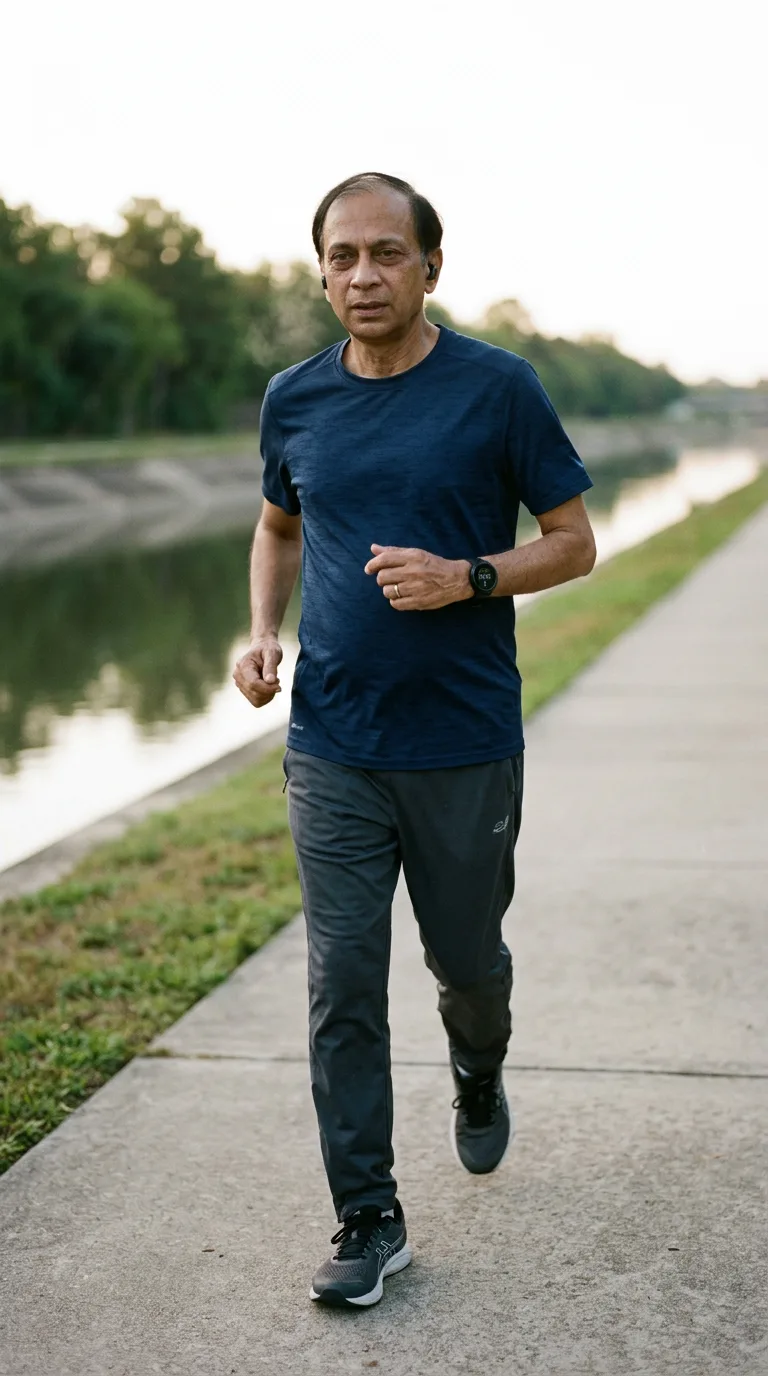
Rarest thing about him: Manager (mid-level) — rare, 1 in 76
Season 0seed 135158951 · engine v10
Character card
lineage 2NZHHJ
His body-swap story
@colin.hasbrook, wearing Bill Farrow, rolled the wheel on and woke up as Suresh Pillai, spent under a minute in him, then spun the wheel and woke up as Owen Takahashi
---
Bill Farrow's knees are the problem. Forty-nine years in a body that has spent thirty of them crouched over trenches in bad light, and the joints announce it every time you stand up from a folding chair, which is what you have just done, in a Los Angeles fieldhouse trailer at the end of a Monday, holding a brush and a fragment of something that will turn out to be a cow bone and not the thing the grant proposal hoped for. It is a fine body. It is a body you have liked, actually, more than most — good eyes, decent hands, the kind of quiet, competent tiredness that feels earned. That is exactly the trouble. You have been him less than a minute and you can already feel the whole shape of the evening ahead of it: the drive home, the reheated dinner, the emails. You did not come back to the site because Bill Farrow's life is bad. You came back because you know, with the flat certainty of four hundred and twenty-one other times, that liking a life is the first sign you have been in it too long, and that the wanting — the specific, low, patient hunger that has nothing to do with comfort — does not care what you like. You set the bone fragment down. You do not say goodbye to him, because there is no him left to hear it. You open the site on your phone with his thumb, and the wheel is already spinning before you have decided anything at all.
The stumble is not a stumble. It is two steps of a man's weight going somewhere his mind isn't, and then it's yours — his weight, low and soft through the middle, a body that carries itself like it has made peace with carrying more than it should. The canal is on your left, flat and pewter under a sky just starting to give up its dark. Earbuds feed you something with a beat under it. A watch on the left wrist buzzes against a split time that belongs to no run you have ever made, because you have never made any run at all, not in this body, not in any of the four hundred and twenty-two. Breath goes out of you in a visible little cloud even though it is Houston, even though it is humid enough at dawn to fog anyway with the right kind of morning. Your foot lands. It knows exactly how to land. You do not.
The shirt is what gives you the first of it — navy, thin, dark with sweat already at the collar, and it comes back sleeve by sleeve the way the site said it would: a hand — his hand, small, thick-fingered, the wedding band catching morning light on the dresser edge — pulling it on in a bedroom in Sugar Land forty minutes ago, over a body already committed to going out and running no matter what the doctor said about the blood pressure, no matter that at sixty-four the doctor says that about everything now. The band around your ring finger warms with a whole marriage: Priya, thirty-one years, a woman who stopped asking why he still runs and started just leaving the coffee on when he gets back. Three children — grown, scattered, one in Austin who calls too little, twins in Dallas who call each other more than they call him — and under that, quieter, older, a face that is not Priya's at all: Meena, a name he has not said out loud in decades, a girl from Coimbatore who married someone else while he was finishing a degree in Ohio, and who still shows up, uninvited, whenever he runs alone at this hour with nothing but his own breath for company. He does not think he loved her more. He thinks he loved her first, and first does something to a man that later never quite undoes.
The shoes on the path give you work — not this work, an office, glass walls, a door he leaves open on purpose because he has had bosses who didn't and he swore he wouldn't be one of them. Spreadsheets. A title that means he is responsible for people without being responsible for anything that matters, not really, not in the way that used to feel like it mattered when he was younger and angrier and better at pretending the anger was ambition. He is a wealthy man now, has been for a while — some of it inherited, some of it thirty years of not spending what he earned — but the money sits apart from him like a coat he keeps meaning to wear. He does not go to temple. He stopped believing in anything organized around the time he stopped drinking, both quietly, both without a story attached, the way a man closes a tab he forgot was even open. His hand, unbidden, rises and runs once over the thinning scalp, over the low comb-over that both of you know is not fooling anyone and both of you have stopped minding. The watch on mile four says his heart rate is fine. It has no idea what just happened to the rest of him.
The high blood pressure sits in the body like weather — not pain exactly, more a pressure behind the ears you'd call a headache in anyone younger. His knees are better than Bill Farrow's. His wind is worse. The skin under the shirt is soft in the way of a man who was athletic once, briefly, decades ago, and has been managing the aftermath ever since — not fat, not fit, something in between that his own doctor has a phrase for and he has stopped listening to. It is, all told, an unremarkable body wearing an unremarkable morning, and that — you understand, standing in it, feeling the cloud of your own breath — is exactly what you spun for. Not a trophy. A rest. A stranger's ordinary weight, carrying a life you did not build and do not owe anything, on a path by a canal at an hour nobody is watching.
You stop running. It is not a decision so much as the absence of one — his legs simply quit asking. You look down at the hand with the ring on it, turning it in the grey light, and it is such a small, unfamiliar thing to belong to you now, this hand that has run this path a thousand mornings before you ever heard of it.
"Okay," you say, to no one, to the canal, to the watch still counting a split it will never explain. "Okay."
Somewhere behind you, thirty-one years and three children and a woman who married someone else keep receding at the pace you've already stopped setting. You do not know how long Suresh Pillai is yours. Nobody does. That has never once stopped you before.