Sipho Ndlovu
Fictional. Generated by AI — not a real person, and no likeness of one is intended.
31, groundskeeper in Johannesburg · rolled by @colin.hasbrook · card — no film
History
who has worn him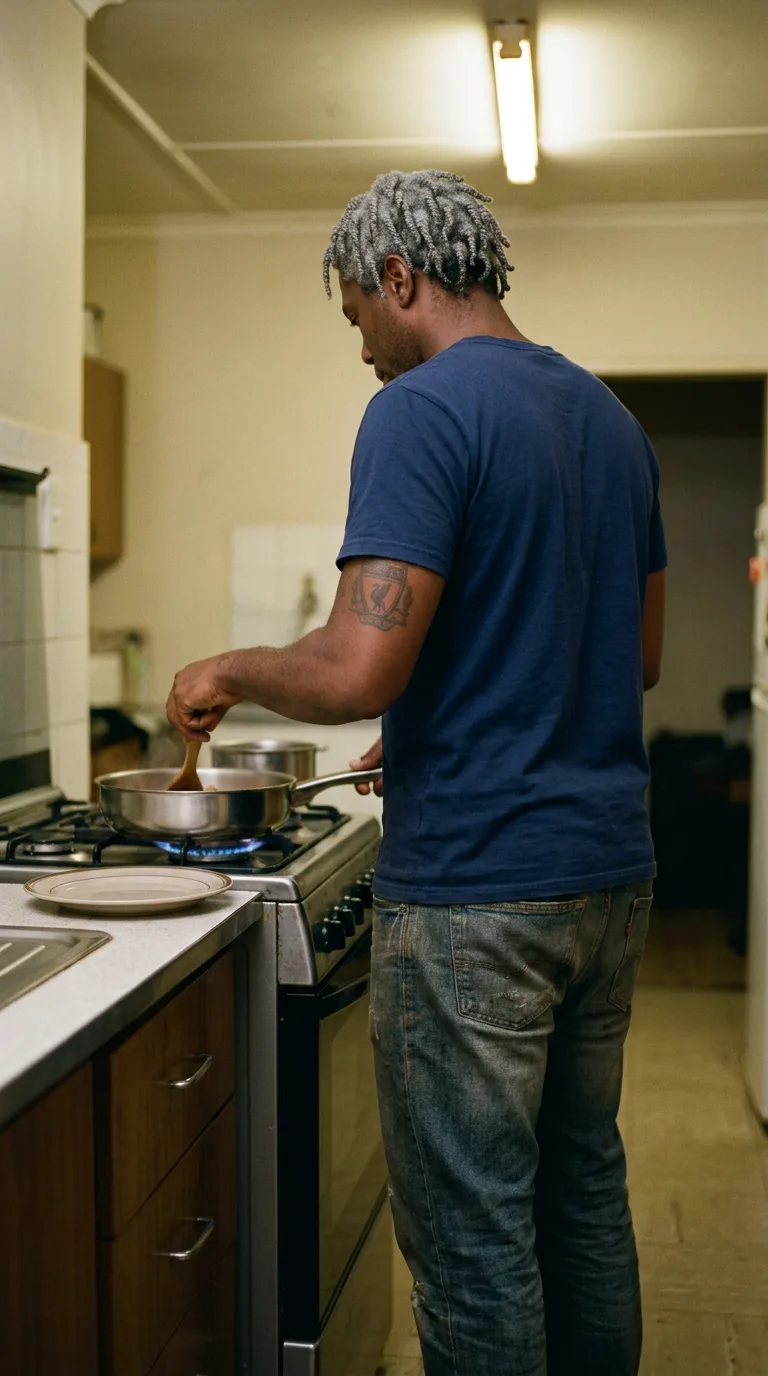
Rarest thing about him: Johannesburg — legendary, 1 in 8,838
Season 0seed 1468226572 · engine v10
Character card
lineage 2NZHHJ
His body-swap story
@colin.hasbrook, wearing Gene Loftin, rolled the wheel on and woke up as Sipho Ndlovu, spent under a minute in him, then spun the wheel and woke up as Ruben Casillas
---
Gene Loftin's hands ache tonight, both of them, the left worse where the arthritis has been chewing at the knuckle for six years, and you are so tired of that ache that it has become the whole reason. Sixty-two years on a body that spent thirty of them lifting stretchers. You are sitting in his recliner with his phone open on his lap, the light of it blue on a face you did not choose and have worn less than a minute, and the ache is what decides it, not the pension he does not have, not the daughter who does not call, just the specific complaint of this one hand around a doorknob this morning that would not fully close. You did not even get up from the chair he sat down in. You open vessel.cards, you pay what it costs, and Gene Loftin, who never asked to be anyone, is gone before the page finishes loading the wheel.
The spin lands on a stove light and a smell of onions and the weight of a wooden spoon in your hand, and you are already stirring — the motion does not stop when you arrive, it stops a half-second later, your hand realizing before you do that something is different, and then it starts again the other way, slow, uncertain, like checking a lock twice. You are tall in this one. That registers before anything else: the counter is lower against your hip than it should be, the ceiling light is closer to your head. You salt the pan out of some reflex that is not yours yet and do not taste it, and then, not deciding to, you reach into the cupboard and take down a second plate and set it beside the first one on the counter, and only once it's sitting there do you understand, distantly, secondhand, that this is wrong, that there is no second person coming, and that the hand that just did it knew that better than you do.
The shirt is what opens him. Chambray, warm from your own back, and the second your shoulders settle into the cut of it you get him buttoning it this morning — Wednesday, five-forty, the room still dark, his girlfriend's voice from the bed telling him to eat something before he goes, and him laughing that he will, he always says he will. Sipho Ndlovu. The name arrives with the shirt, the way a smell arrives with a room. Thirty-one years old, a groundskeeper, and the pride that comes with that word surprises you — not the pay, the field. You get an afternoon: him alone on the diamond at six a.m. before anyone else is awake, the mower going in long green stripes, the light coming up gold and low over the veld beyond the wall, and the particular satisfaction of a line run dead straight to the fence. His hands know a mower the way Gene's knew a stretcher, and you feel that in the calluses along his palm now curled around a wooden spoon, muscle memory sitting patient under skin that has never held anything so light.
The tattoo on his arm gives you a whole year at once, sudden and warm — his brother's voice on a bad phone line from Liverpool, both of them fifteen and pretending they'd been to a match neither of them could afford, and the crest going onto his arm at twenty-two as a promise to go someday, which he still hasn't, which still sits in him like an unpaid debt he's stopped being ashamed of. The floor under your boots gives you the field again, cold mornings, knees soaked through denim, prayer said quietly at the edge of the outfield where nobody's watching, because there's never anybody watching this early and that's exactly why he likes it.
The counter under your forearm gives you her — not his girlfriend, the other one, the one whose photo is still in a drawer he hasn't emptied, whose voice he can still do in his head arguing about nothing, six months gone and somehow still louder in this kitchen than the woman actually sleeping down the hall. You feel the specific shame of that, missing an ex while dating someone kind, a shame he treats the way he treats everything, quietly, with a pill at breakfast and a walk around the field at dusk instead of a drink he was never going to have anyway.
And then the smallest thing undoes you: the plate. Setting down a second plate is not new. He does this — has done this for months, since the divorce papers, since his son's visits became every second weekend instead of every night, an old habit of cooking for two that his hands never unlearned even after the boy stopped being here to eat it. You feel, arriving late and sideways, the ache under that motion, a father's specific loneliness at close to two in the morning in a house gone quiet, cooking anyway because cooking is the only shape the missing knows how to take.
Your hands — his hands, long-fingered, rougher at the palm than Gene's ever were, a thin white scar across one knuckle from a fence wire years back — turn over under the kitchen light, and you watch them like they might do something on their own again.
You look up, into the dark doorway toward the hall where his son isn't sleeping tonight, and you say, quiet, mostly to the empty second plate:
"Not tonight, boy. Not tonight."