Sione Havili
Fictional. Generated by AI — not a real person, and no likeness of one is intended.
61, contractor in Chicago · rolled by @colin.hasbrook · card — no film
History
who has worn him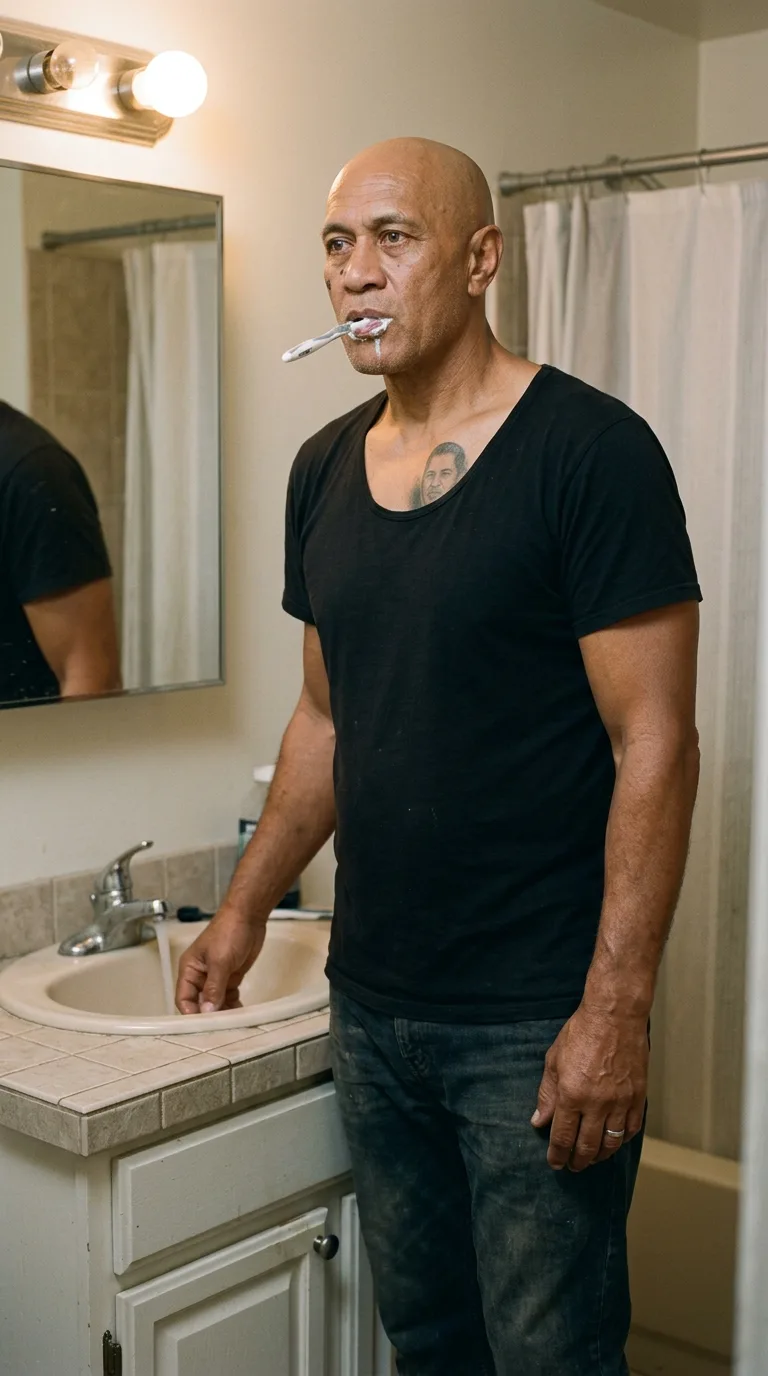
Rarest thing about him: 6'4" — epic, 1 in 220
Season 0seed 1326231048 · engine v10
Character card
lineage 2NZHHJ
His body-swap story
@colin.hasbrook, wearing Rafael Cendejas, rolled the wheel on and woke up as Sione Havili, spent under a minute in him, then spun the wheel and woke up as Patrick Muldowney
You have been Rafael Cendejas for less than a minute, and already you know it was a mistake.
Not the body — the body is fine, better than fine, muscle still holding at sixty-five despite the years off the docks, gray hair combed back and blue eyes that have seen more of the world than you'll ever tell anyone. It's the chair. It's the kitchen. It's the framed photo on the wall of Rafael's grandkids, three of them, gap-toothed, at a birthday party you were never at and never will be at, and something in Rafael's chest — some leftover groove worn into the muscle by forty years of loving them — twinges when your eyes pass over it, unbidden, like a phantom ache in a limb that isn't yours anymore. You didn't come back for this. You never come back for the tenderness. It just keeps arriving anyway, riding in on his rooms, his photographs, and you spin again each time not to escape the men but to escape being reminded there were men, whole men, before you got here. Eighty-three of them now behind you like a hallway of shut doors. You get up from Rafael's chair, walk to Rafael's laptop, open the page with the wheel on it, and pay before the ache can finish arriving.
The spin lands on a bathroom you've never stood in, tile the color of weak coffee, a bulb too warm and too bright over a mirror.
The brushing stops mid-stroke.
You feel the foam first — cool at the corner of a mouth that is not shaped like the one you left, a jaw broader, a neck thick with a strength that has nothing to do with age. The brush starts again, slower now, working the back molars like something in the hand remembers even though you don't, and you let it, because interrupting a motion mid-flight feels riskier than finishing it. Water runs in the sink, needlessly loud. You rinse twice. You stand the brush up bristles-first, out of gray water that has apparently always been gray, in a groove of habit that belongs to somebody else entirely.
The T-shirt is what opens first — plain black cotton, worn thin at the collar, and against your back it gives you a whole morning: him pulling it on two hours ago in a bedroom with the blinds still down, his wife's breathing behind him, slow and even, a Monday like every other Monday except that his head was already tightening behind the left eye, the old warning, the aura creeping in at the edge of the light before the light even got hard. He'd stood in front of the closet a long moment with his hand pressed flat against his cheekbone — that thing his hands do without him — willing it back down before it bloomed. Sione Havili. The name comes with the shirt, the way his own hand would have written it a thousand times on invoices, on permit applications, on the back of a check for the framers who owe him money still. Sixty-one years old and built like he could still hang drywall over his head all day, because he can, because he has, six-four and every inch of it working muscle even now, even with the migraines carved into the backs of his eyes since his forties like a fault line that never quite heals.
The mole is there under your fingers when you touch your own cheek — his gesture, arriving through the motion itself, not chosen but done, the pads of two fingers finding the small dark rise high on the cheekbone the way they must have ten thousand times, checking it's still there, still just a mole, nothing worse, though some frightened decade-old corner of him always half expects otherwise.
The tattoo gives you the most. Collarbone-high, showing at the collar even now: a black-and-gray face, realism work, some artist in Honolulu who took eleven hours over two sessions to get the eyes right. His father. Died the year before the christening of Sione's only child, a daughter, and he'd gone under the needle three weeks after the funeral not to grieve loudly but because grief needed somewhere physical to sit, and this was cheaper than therapy and truer than a eulogy. You feel, distantly and completely against your will, how much he loved the old man, how the tattoo aches sometimes in winter not from the ink but from something underneath it.
The wedding band on the left hand brings a woman's name up out of nowhere attached to twenty-nine years — Melia — and a wedding on a lawn in Laie with rain threatening the whole reception and never quite arriving, which he'd taken, even then, as a sign of something. He hasn't had a drink since before that day; the bishop's talk to him about it stuck when nothing else had. No cigarettes ever, not once — his own father's lungs at the end were argument enough. He is, by any measure that matters on paper, a wealthy man now — three decades of contracts, of buildings that are still standing under the L tracks with his signature on the permits — but none of that comes through the sink or the tile or the shirt. Only the daughter does, faintly, a graduation gown, a hug that lasted too long because he'd had a headache building all through the ceremony and hadn't wanted her to see him wince.
The bathroom floor under your — his — bare feet is cold and ordinary. Somewhere past the door, faint, a radiator knocks. Sawdust smell that never quite leaves a contractor's skin lingers under the toothpaste mint. Winter light through a window you can't see is doing something pale and flat to the wall tile.
You lift your hands out of the sink water and look at them: broad, sixty-one years weathered, a scatter of old white scar-lines across two knuckles from tools that got away from him decades ago, the band catching the bathroom light. Not Rafael's hands. Not the hands of the eighty-two men before that. Yours, now, for however long now turns out to mean.
You look up into the mirror, into eyes that are not the eyes that were looking at nothing a second ago, and you say, to no one, to the fogged glass, to the man who isn't there to hear it anymore:
"Let's see what you've got, Sione."