Sami Haddad-Younes
Fictional. Generated by AI — not a real person, and no likeness of one is intended.
61, sales manager in San Francisco · rolled by @colin.hasbrook · card — no film
History
who has worn him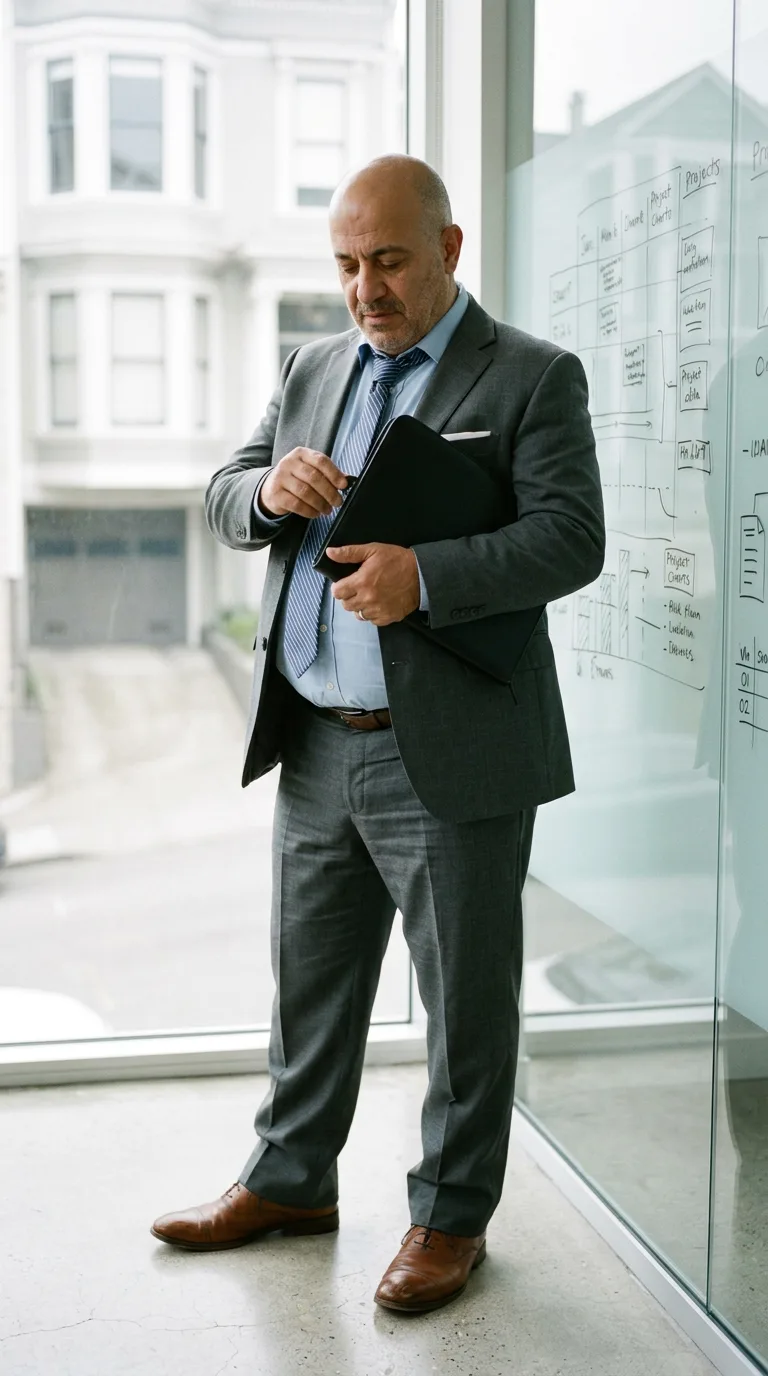
Rarest thing about him: Middle Eastern — common, 1 in 34
Season 1seed 944204435 · engine v11
Character card
lineage 2NZHHJ
His body-swap story
@colin.hasbrook, wearing Otis Marable, rolled the wheel on and woke up as Sami Haddad-Younes, spent under a minute in him, then spun the wheel and woke up as Terry Wickman
Otis Marable's knees hate the ladder before the ladder even happens. You've been him nineteen hours — long enough to know the rebar cuts through his palms like wire through cheese, long enough to know he's got a grandson's birthday Saturday and a lower back that files its complaints on a schedule independent of use. It's a fine body. Strong in the ways that matter on a job site. But it is eleven in the morning in El Paso and the sun is already doing the thing it does, and somewhere in the part of you that is not Otis and never will be, the itch starts. Not boredom exactly. More like standing at the edge of a buffet you've already eaten from eight hundred and twelve times and knowing there's a table behind it you haven't tried. You set down what you're holding — you'll never know if that was rude, mid-task, some foreman's voice about to call your name — and you open the site on a phone that isn't technically yours anymore in any sense that matters.
The wheel spins. It always sounds like it's deciding something, though you know by now it isn't. It's just decided.
You are behind a glass wall in a conference room, and the wall behind you has charts on it, and your hand — his hand — is already moving, tucking a pen into the inside pocket of a suit jacket, and it does the motion wrong, thumb catching the pen at an angle it has never once caught it in forty years of dressing himself, and the hand stops, and does it again, slow, correct, like a man checking his own signature. Then it does the next ten things it needs to do — zip the folder closed, adjust the tie, smooth the lapel — each one checked, each one deliberate, on a body that has done all of it ten thousand times without a single thought spent on any of it.
You are heavier here than you were a minute ago and lighter in the knees. Sixty-one years sits in this back differently than sixty-three did in the other one — less angry, more tired, a low hum instead of a shout. Bald head cool where the window light hits it. A nose that pulls faintly to the left when you breathe through it, an old fact of him you haven't earned yet but that arrives anyway, structural, like a beam.
The folder is what gives you the first of him. Black leather, a little worn at the corner, and the second your palm closes around it you're standing in this same glass room eleven years ago, younger, hair still there in a fringe he was vain about losing, presenting a slide he'd stayed up until two rewriting because Diane on the eighth floor had said "interesting" about the last draft in the tone that meant not interesting. He'd made VP eighteen months after that. The folder still smells, underneath everything, like the good pen he lost and never replaced with one as good.
The tie gives you the wedding. Not the whole thing — just his own fingers, twenty-six years younger, fumbling the knot in a hotel bathroom mirror while his brother laughed at him through the door, while somewhere down the hall a woman named Layla was already dressed and already calm, the way she has been calm about nearly everything since, the way that used to comfort him and now sometimes makes him feel like the only weather in a marriage that has otherwise gone permanently mild. You get, uninvited, the shape of an old ache next to that — a woman before her, Noor, who left when he was thirty-two and who he still, at sixty-one, thinks of on airplanes for no reason he has ever told anyone, not even Layla, especially not Layla.
The shirt, against your back, gives you this morning. Not eleven years ago — this morning, an hour that in this city is still cool enough for the collar to feel good against the throat. Standing at the closet. The blue stripe or the plain — Layla's voice from the hallway, not looking, already knowing which one he'd pick, "the blue, you always pick the blue," and him picking the blue because she was right and it pleased him that she was right. Cufflinks he didn't wear today, changed his mind, plain buttons instead, because his hands felt thick this morning, felt sixty-one in a way they don't always. The belt cinched one notch looser than it used to sit. He noticed that in the mirror and made a joke to himself about it and didn't tell anyone the joke.
The shoes give you a driveway — steep, his own, the garage tucked underneath the bay window, the cold white light this city has in the mornings even in summer, and the specific complaint of these exact shoes on that grade, the small lean backward everyone who lives on that street learns without teaching. Two kids, grown now, one of them still calling every Sunday, one of them not, and he does not let himself think hard about which and why, not now, not in a conference room, not ever really, and the not-thinking comes through as clear as a memory would.
Your — his — hands are still on the folder. Sixty-one years old, dad-bod soft through the middle in the way that a good suit forgives, palms a little dry from an office building's air, a callus gone soft on the right index finger where a pen has lived for four decades. Nothing hurts exactly. Something in the lower back is filing a complaint too, quieter than Otis's, more like a memo than a shout. The wedding band is warm from his own skin, not yours, not yet.
You look down at the hand holding the folder. Turn it over. The palm, the crooked-set weight of the nose you can feel more than see, the ring catching the flat morning light off the glass wall behind you.
"Okay," you say, to the empty conference room, to no one, in a voice that isn't findable as yours or his anymore, "let's see what you've got."