Russell Vandermeer
Fictional. Generated by AI — not a real person, and no likeness of one is intended.
62, nurse in Houston · rolled by @colin.hasbrook · card — no film
History
who has worn him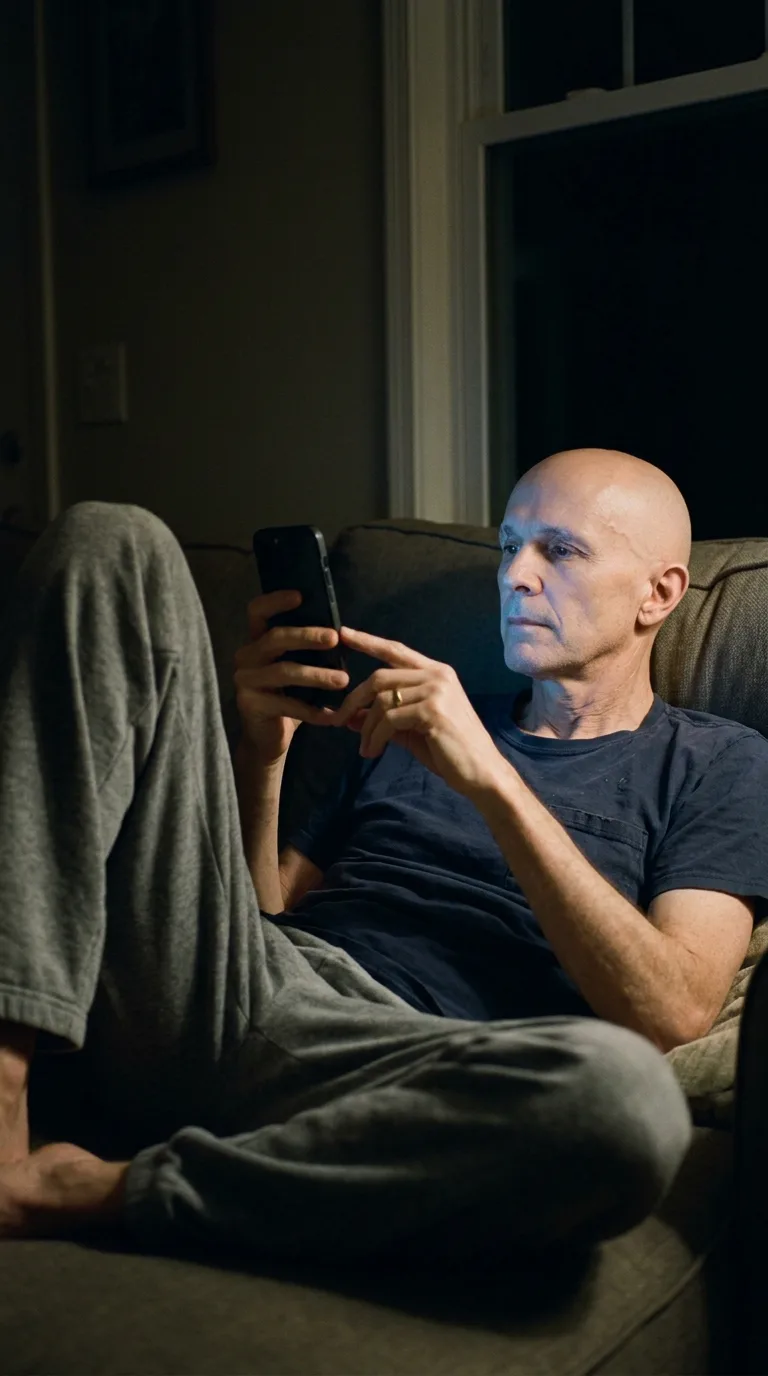
Rarest thing about him: 6'4" — uncommon, 1 in 103
Season 1seed 1840316976 · engine v11
Character card
lineage 2NZHHJ
His body-swap story
@colin.hasbrook, wearing Miguel Osante, rolled the wheel on and woke up as Russell Vandermeer, spent under a minute in him, then spun the wheel and woke up as Óscar Beltrán
---
Eleven fifty-something on a Thursday, and you are twenty, in Ohio, in a body that isn't yours, sitting on a bed that isn't yours either, and none of it fits anymore. Miguel's dorm room smells like Axe body spray and old pizza. His roommate is asleep four feet away, snoring through a fan he runs even in winter. You have been Miguel Osante for seven minutes and already the appeal has drained out of him like water down a tilted glass — he is twenty and small and has a econ exam in nine hours that you feel nothing about, and his phone, when you picked it up off his desk, buzzed with a text from a girl named Ashlyn that made his stomach do something you didn't want to feel secondhand. You didn't spin for this. You spun for the half-second after, the drop, the not-knowing. Miguel was supposed to be a place to stand while you decided. He is not enough of a place. Your thumb is already moving toward the browser, toward the bookmark, before you've admitted to yourself that you're doing it again — 898 has a shape by now, a boredom shaped like hunger, and Miguel's small hands on his own phone are just the last thing they'll do as his.
The wheel spins. It does not ask why. It gives you Houston, evening, a man on his side in the dark.
The thumb under you stutters — his stutter, the last half-inch of his — then steadies. Faster now. Steadier. It flicks past a photo he'd stopped on, past a headline he was three words into, and doesn't slow for either. Blue light lies flat on a cheek that has gone still in a way a face doesn't go on its own. Behind it, a mattress holds a long, thin weight along its side, knees drawn up short of where a taller man might rest them out straight, a phone six inches off a nose that isn't yours yet either. Somewhere behind you, through a wall, water runs and stops. The room smells like fabric softener and something antiseptic underneath it, old habit more than recent use.
The shirt is what opens first — a soft gray t-shirt, worn thin at the collar, and through the cotton against your back comes a memory that isn't a memory yet, just weather: *hot, always hot, the a/c unit in the window working too hard, second shift at Memorial Hermann and coming home at eleven starving and not eating anyway.* Then more. Then all of it, the way water finds the low point in a floor.
Russell Vandermeer, sixty-two, thirty-nine years a nurse, the last eleven of them nights on a med-surg floor where the fluorescent light over the charting station has a flicker nobody's fixed. The scar through his eyebrow comes with its own story, pulled sideways out of 1987 — a bar in Galveston, a pool cue, a friend named Dutch who is dead now of something slower and stupider than a pool cue. His hands remember the weight of a blood pressure cuff, the particular give of a vein under two fingers when you've found it right the first time, forty years of that until it isn't a skill anymore, it's just how his hands are shaped. Right now those hands are long-fingered and thin-wristed, the backs of them ropey with tendon, the left one carrying a plain gold band that has been there twenty-six years and has worn a groove you can feel with your thumb before you know you're looking for it.
Carol. Her name arrives with the ring, unbidden, the way his memories keep arriving — sideways, through contact, never handed over clean. Carol asleep two rooms over on a night shift he isn't working, which is why he's here at all, on his side in the dark at an hour he's usually charting under bad light and a coffee going cold. Carol laughing once, twenty years younger, at a crawfish boil in Pasadena, before either of them had gray in anything. And under her, quieter, someone else — Denise, the one who left in 1994 for a man in Baton Rouge, the one whose name still catches on something in his chest when a certain radio station plays a certain song, the one who got away clean enough that he never had to find out if she'd have stayed. He married Carol two years after. He does not regret it. He thinks about Denise anyway, the way you think about weather in a place you don't live anymore.
There's a son somewhere in the ceiling of this — Daniel, thirty-one now, living in Austin, a phone call overdue by about two weeks, guilt sitting on Russell's chest like something small and warm and easy to ignore. His body under you is skinny in the honest way of a man who's on his feet twelve hours a night and doesn't eat right on the other side of it, six-four and built like something unspooled, and it aches specifically — low back, both knees, a shoulder that clicks when he reaches overhead, the accumulated interest on four decades of turning patients who couldn't turn themselves. He drinks more than Carol knows the number of, never smoked a day, and his cuticles are torn ragged along both thumbs where his fingers go without him when his mind is elsewhere, which it almost always is.
This morning — his morning, hers being backwards from it — he'd stood in front of a mirror in this same gray shirt after his shift and shaved his whole scalp with a careful, unthinking hand, the way he's done three times a week for eleven years, and put on scrubs that are hanging now on the back of a chair four feet from this bed, and driven home through Houston traffic already thinking about sleep. Now he's off the clock and off the clock is when the wanting comes for him too, in a smaller, sadder way than yours — a scroll through nothing, looking for something he couldn't name if Carol asked him, which she wouldn't, because she's asleep, and because after twenty-six years she has learned not to ask what he's looking at when his face goes like that.
You feel all of it land at once, the whole weight of a stranger's ordinary unhappiness, and it is heavier and warmer than anything Miguel Osante ever gave you in seven minutes.
You lift the hand off the phone. Turn it over in the blue light — the scarred eyebrow catching a little of the glow when you tip your head, the ring loose enough to spin with a thumb, cuticles pink and raw at the edges. Not your hand. Not for very long, maybe. Long enough.
"Okay," you say, out loud, to no one, in his flat Houston drawl, and you don't know yet if that's the start of something or the whole sentence.