Miguel Osante
Fictional. Generated by AI — not a real person, and no likeness of one is intended.
20, student in Small-town Ohio · rolled by @colin.hasbrook · card — no film
History
who has worn him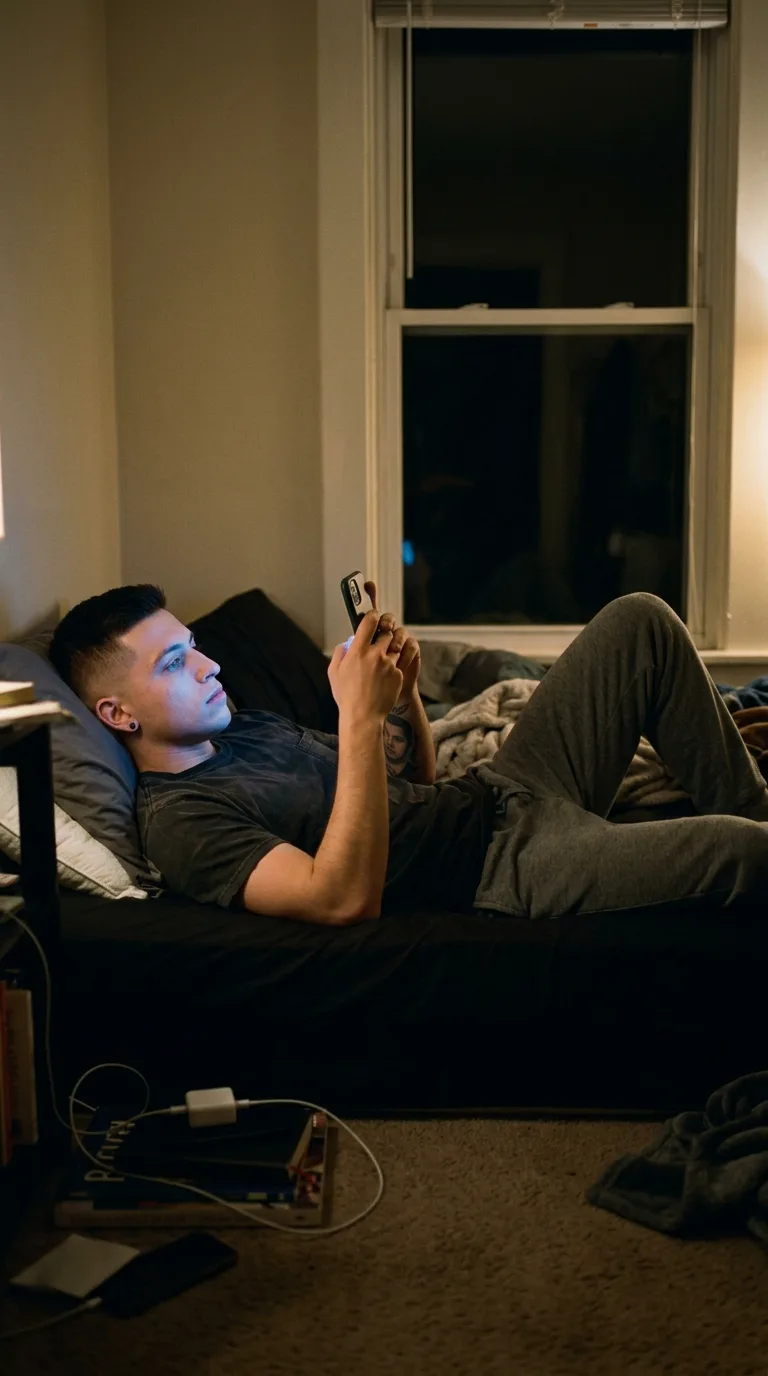
Rarest thing about him: Buddhist — common, 1 in 49
Season 1seed 696732020 · engine v11
Character card
lineage 2NZHHJ
His body-swap story
@colin.hasbrook, wearing Francis Delvecchio, rolled the wheel on and woke up as Miguel Osante, spent 8 minutes in him, then spun the wheel and woke up as Russell Vandermeer
Francis Delvecchio's knees ache before his mind wakes up all the way to remember whose knees they are. That has been the shape of every night for six weeks now: the gout in the left foot, the recliner's stiff spring, the television light on the wallpaper he did not choose and does not like. Sixty-three years in a body that used to be worth something on a construction site, now worth a doctor's appointment he keeps missing. You spun him up out of boredom and you have ridden that boredom a long way — through his retirement dinners, his estranged son's voicemail, his two beers a night that used to be four — and none of it moved. Tonight the recliner's spring pops under him for the four hundredth time and something in you just decides. Not despair, nothing so clean. Just the flat certainty that Francis Delvecchio, sitting alone at nearly midnight with the Eagles game muted, has given you everything he has to give. You open the laptop that isn't yours on the little TV tray that isn't yours, and you go to the page with the wheel on it, and Francis's swollen fingers — his, still, for three more seconds — tap in the card number from memory, because you made him memorize it weeks ago.
The wheel spins somewhere that isn't a place. You feel Francis's chair, his television, his tray table let go of you all at once, mid-blink —
— and the thumb in front of your face is younger, faster, moving before you have caught up to it, flicking through a feed at a speed that has nothing to do with the slow ache you just left. Blue light lies across a cheekbone that is not Francis's cheekbone. You are on your side in the dark, weight distributed wrong, no gout, no knees complaining, a mattress too firm and too small for the man you just were. A window across the room holds no city glow, just black country dark and a blind gone crooked. The phone in your hand is six inches from a face that has not blinked at a normal interval in several seconds, because you are behind it now and you have not learned yet how often this face is supposed to blink.
The shirt is what gives him to you first — an old gray tee, soft from a hundred washes, and touching it through his own skin brings back a laundromat on Main Street next to the diner that closed in 2019, quarters lined up on top of the dryer, his girlfriend Ashley texting him a photo of a dog she wants and doesn't get. The sweatpants at his waist bring back a dorm room three hours from here he moved out of in May, milk crates of textbooks, a roommate named Deshawn who left without saying goodbye. You are twenty. You have never been twenty in eight hundred and ninety-six other men and it lands in the knees first, oddly, the exact opposite of Francis — no ache at all, a kind of coiled ease you'd forgotten was possible, muscle that answers before you ask it anything.
The phone screen keeps feeding memory through his thumb. A photo he lingered on three swipes back — his ex, Marisol, tagged at somebody else's wedding, laughing at an angle he used to be allowed to stand at. That one comes with heat, with a whole spring of her in it: the two of you at seventeen behind the Sunoco station, her mother's disapproval, the specific quiet of the diner booth the night she ended it, both of you staring at the CLOSED sign through the glass like it was a person who'd wronged you too. Ashley comes back gentler, newer, less finished — six months, her laugh over speakerphone while he studied, her name lighting up this same phone an hour ago with a heart emoji he hadn't answered yet.
The earlobes carry their own small history — getting both studs done at nineteen in a mall kiosk, his mother's face when she saw them, how she came around to it inside a week because that's who she is. The forearm is harder to read with your eyes alone in this light, but you know without needing to look what's there: a black-and-gray portrait, a face he chose to carry on his skin and never once regretted, though whose it is doesn't surface yet, just the weight of the decision, the buzzing chair, the eighteen-year-old certainty that this was permanent and that permanent was fine.
Underneath the memories, the body itself keeps talking in its own language: five-six, compact, nothing straining anywhere, jaw already tight the way it apparently gets tight without him — clenching now, gently, an idle habit riding along under all this borrowed history like a second pulse. Laptop closed somewhere on the floor by the bed, an economics textbook under it, gone unread three nights running. Ohio outside the window, a single stoplight down the block cycling red to green for no one, the diner's dead sign catching just enough light off the streetlamp to read CLOSED if you knew where to look, which you don't, yet, but he did, every night of his life.
You bring the thumb to a stop mid-scroll. You turn the hand over in the blue light, palm up, like it might have arrived with instructions. It didn't. It has a tan line at the wrist from a watch he stopped wearing, a callus at the base of the first finger from a backpack strap worn one shoulder at a time for four years running, nothing else, nothing you did to it and nothing Francis left in it.
"Okay," you say, out loud, to the dark dorm-poster room, in a voice twenty years younger than the one you fell asleep hating an hour and eight hundred and ninety-six lifetimes ago. "Okay."
You do not know yet how long you get to keep saying it in this voice.