Russell Halvorsen
Fictional. Generated by AI — not a real person, and no likeness of one is intended.
59, undertaker in Small-town Ohio · rolled by @colin.hasbrook · card — no film
History
who has worn him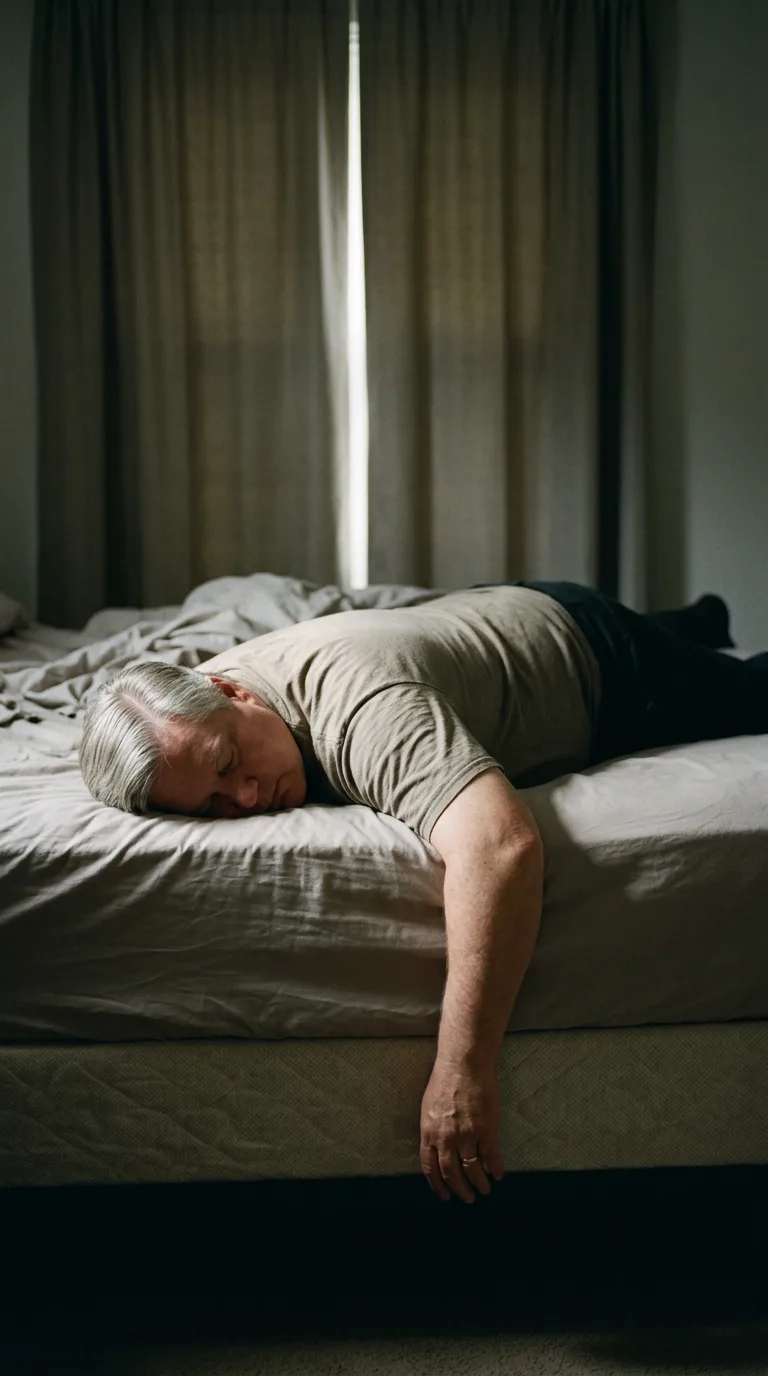
Rarest thing about him: Undertaker — uncommon, 1 in 174
Season 0seed 294503025 · engine v10
Character card
lineage 2NZHHJ
His body-swap story
@colin.hasbrook, wearing Tavita Faleolo, rolled the wheel on and woke up as Russell Halvorsen, spent under a minute in him, then spun the wheel and woke up as Frank Delacroix
The mower is off. That's the first thing. Tavita's hands — small, quick, calloused in a different pattern than any hand you've worn in the last 265 tries — are resting on the handle of a push mower halfway down a strip of grass behind a maintenance shed, and the evening is doing that Philadelphia thing where the heat sits in the concrete after the sun gives up on it. You have been him for two minutes. You already know the whole shape of it: a good back, twenty-three years old, a job that ends at dusk and a beauty mark he's vain about in a way that isn't even vanity, just a boy noticing something true about his own face. It is, by any reasonable measure, a fine body. That is the problem. You didn't spin two hundred and sixty-five times to end up somewhere fine. You spin because fine is exactly the kind of body you stop noticing you're wearing, and the not-noticing is the thing you're afraid of more than any single bad night in anyone's life. So you take your hand off the mower, and you take out your phone, which is his phone, and you open the site anyway, in his fingerprint, on his data plan, because you have never once let a man's own phone stop you, and you spin.
The room turns over before it turns into a room. You are face-down and then you are not; the breath that was coming in ragged pulls comes in one long pull instead, and the arm that had been hanging off the edge of the mattress — a small kindness of gravity, dead weight, wrist limp against carpet — draws itself up like a marionette remembering it has strings. Hands fold at the chest. Nobody taught this body to sleep like that and it doesn't ask permission now. Somewhere behind a gap in curtains a streetlamp is doing the only lighting in the room, and it comes down in a blade across a comforter the color of wet sand.
Fifty-nine years of a man arrive through the backs of your borrowed eyelids, and you let it.
The undershirt against your back first — cotton gone soft from a hundred washes, the collar stretched a little from being pulled over a head that has gotten heavier at the jaw over the years than it was in the wedding photographs. That's where it starts: a morning, not this one, an ordinary one, a hand — his hand, thick-fingered, wedding band scraping faintly against the dresser edge — pulling this exact shirt down off a hanger, shrugging into it while somewhere down the hall a radio has the local farm report on, because that's the station the clock radio remembers even though nobody farms within twenty minutes of Main Street anymore. Russell dressing for a viewing. Black suit, black tie he owns fourteen of and cannot tell apart. Comb through the gray-silver hair, hard part, same part since 1987, since a barber told him it made him look serious and he decided that was worth having forever.
The carpet under bare feet gives you the rest of the house before it gives you a name for it: raised ranch, one main road with a stoplight that used to matter more than it does now, the diner across from the funeral home dark for three years and nobody's opened anything in its place, just a for-lease sign fading in the window like everyone agreed to stop hoping out loud. Halvorsen & Sons, though there's only him now, the sons being a schoolteacher in Columbus and a boy who does something with insurance nobody in the family fully understands and a daughter, the youngest, who calls on Sundays and asks how her mother's doing more than she asks how he's doing, which he has decided not to mind.
The wife is in the memory before you ask for her — Carol, thirty-one years, the two of them meeting at a church potluck when he still had all his hair, her hand steady on his arm at every graveside he's stood at for a stranger's family because she knows what that costs a man even when he never says so. And under that, closer to the surface than it should be for a married man, a woman who isn't Carol — younger, a laugh that came too easy, six months that ended four months ago in the front seat of his own car in a parking lot outside a Kroger in the next county, ended by him, mostly, though not entirely, and never once mentioned to anyone alive. It sits in him the way the blood pressure sits in him — a thing his doctor knows about and his wife doesn't, a low hum under an otherwise decent man.
The viewing room comes back through his feet on that particular carpet, the good carpet, the one that doesn't show footprints, chairs in rows he has straightened eleven thousand times, the smell of carnations and Pine-Sol that never quite leaves a man's clothes no matter how many times Carol runs them through the wash. He is good at this. He has held hands he's never met the living version of, has learned exactly how long silence needs to run before a family wants him to fill it, has buried more of this town than the town has any idea, keeps every name in a book in his own hand because he thinks a man ought to remember who he put in the ground.
None of this — the money, the wife, the ex, the sons and the daughter, the high blood pressure pills by the bathroom sink — announces itself as a story worth being in. It just arrives, unhurried, the way a body's whole life arrives when you've stopped being anywhere else.
You lift your hands off your chest and look at them. Thick, ringed, a life's worth of paperwork and handshakes and closing casket lids gone into the knuckles. Not yours. Never yours, not really, not any of the two hundred and sixty-six now, and that thought comes with its usual small flicker of something you don't examine too closely.
You say, out loud, to the dark and the gap in the curtains and nobody, "Well." Just that. Then you turn your head toward the streetlight, and you do not decide anything yet.