Frank Delacroix
Fictional. Generated by AI — not a real person, and no likeness of one is intended.
55, bartender in San Francisco · rolled by @colin.hasbrook · card — no film
History
who has worn him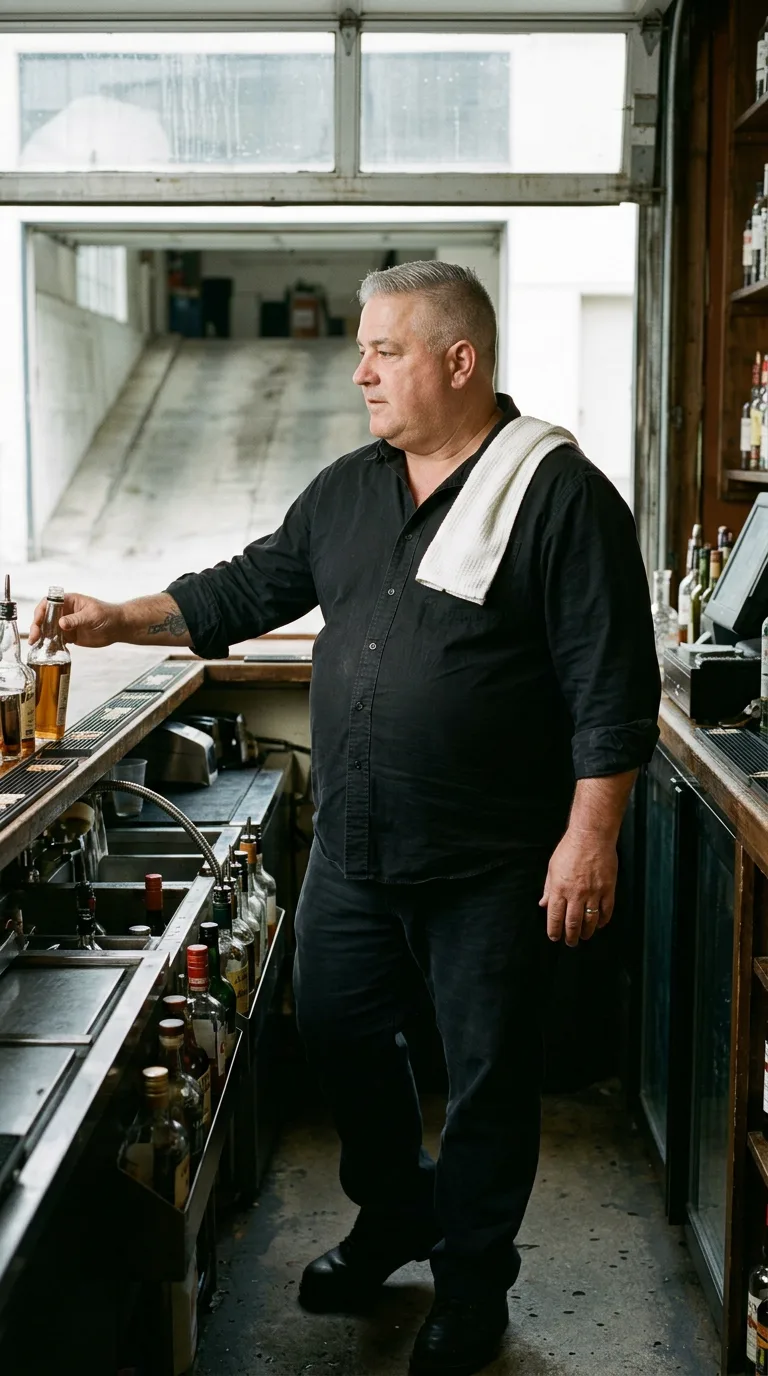
Rarest thing about him: Stutters under pressure — rare, 1 in 80
Season 0seed 1341351185 · engine v10
Character card
lineage 2NZHHJ
His body-swap story
@colin.hasbrook, wearing Russell Halvorsen, rolled the wheel on and woke up as Frank Delacroix, spent under a minute in him, then spun the wheel and woke up as Gary Petrosky
Russell Halvorsen's hands smell like formaldehyde no matter how many times you wash them, and that is the first thing you notice, less than a minute into being him — the smell under the nails, the cheap soap in the prep-room sink, the particular gray quiet of a Small-town Ohio funeral home at night. You are standing over a stainless table you have not touched yet, and already you know you are not staying. Two hundred and sixty-six men behind you and this is the one where the wanting comes fastest, because grief-work is not work you want to feel in a body that remembers every day of it. Russell had a wife who left, a back that aches climbing stairs, a silence he carries into every room he enters professionally. You didn't choose him. You never choose. But you don't have to keep him either. You go to the little laptop on the desk in the corner, the one with the funeral home's insurance forms still open in a tab, and you pull up vessel.cards instead, and you spin, because boredom is a kind of grief too and you have gotten very good at not sitting with either.
The wheel stops on a bar in San Francisco, mid-shift, evening light through a garage door.
You arrive already reaching. Your hand — his hand — is closing around the neck of a bottle of rye, mid-pour, and for half a second the motion goes wrong: the bottle tips too far, well past the pour line, whiskey ghosting over the rim of a rocks glass that isn't there yet because there's no glass, there's no order, this is prep, this is stocking the well before the doors open, and your body — his body — corrects. Slows. Sets the bottle down. Picks it back up. Does it again, correctly, checked. The next ten bottles come out of your hands one by one, each set into its slot with a care that this task has not required in years, because you don't know yet where anything goes and his hands, unsupervised, would have known blind.
The shirt is what opens him first — black cotton, soft at the collar from a hundred washes, and touching the second button down (the one that never quite sat right) gives you a bathroom mirror at six that morning, fluorescent and unkind, his belly under his hands as he did the buttons up from the bottom because that's how he's done it since the weight came on and he stopped fighting it. He'd looked at himself a second too long. Not with hatred. With something more tired than that — recognition, maybe, of a man he'd agreed to be. He'd thought, not for the first time, about the second half of a beer left over from last night in the fridge door, and about not touching it, and about touching it anyway on the walk to the car.
The white towel over the shoulder gives you nothing — too new, too laundered, no history in it yet — but the sink behind you, both hands braced on its cold lip a moment, gives you fifteen years of this exact motion, wiping down a well before open, and under that a night much further back: his wife, Carol, dead six years now from something that took its time about it, sitting on a stool at the far end of this same bar on a slow Tuesday, laughing at a joke he'd told badly on purpose because she liked when he was bad at things in front of her. He'd married a woman who thought his stutter under pressure was the most endearing thing about him, who used to squeeze his hand under tables when he had to speak up at parties, and there is a whole marriage in the ring still on his finger — you feel it there now, a slight drag of metal against the bottle's glass — twenty-six years of a woman who is not there anymore and two grown kids who call on Sundays out of love and a little out of duty, and he can't always tell the difference anymore and has decided not to mind.
The floor under his feet — concrete, cold even through the soles — brings up the garage itself: living under the bay window upstairs, the steep cut of the driveway that ices in the rare cold snap, the particular white light that comes through the roll-up door in the evening this time of year, low and flat and almost kind. He built this bar himself, more or less, out of a space that used to hold a car nobody in this city can afford to park. He is proud of it in a way he'd never say out loud. He checks his blood sugar in the little bathroom off the back before every shift and sometimes forgets, and there's a meter in his jacket pocket right now with a memory in it of last night's number being higher than he wanted, and a decision not to think about that either.
His body under your hands is heavy in the specific way of a man who has stopped being surprised by his own weight, feet a little swollen at the end of a long day already though the day has barely started, hands thick and sure once they know the job — and they know this job, ten thousand pours, so sure that when you check the eleventh bottle and the twelfth and they come out right, some old muscle deeper than you is doing it, not you.
You look down at your hands — his hands, ring and all, whiskey on the fingers — and you turn them over slowly under the flat white light coming through the open garage door, and you don't recognize the calluses, though you can feel exactly what put them there.
"Rye goes on the left from now on," you say, to no one, to the empty bar, to a wife who six years ago would have laughed at you for saying it out loud like she was still listening.
You don't know how long you'll want this one. You never do until the wanting leaves.