Ronnie Bacigalupi
Fictional. Generated by AI — not a real person, and no likeness of one is intended.
36, delivery driver in Boston · rolled by @bryce.kellerman · card — no film
History
who has worn him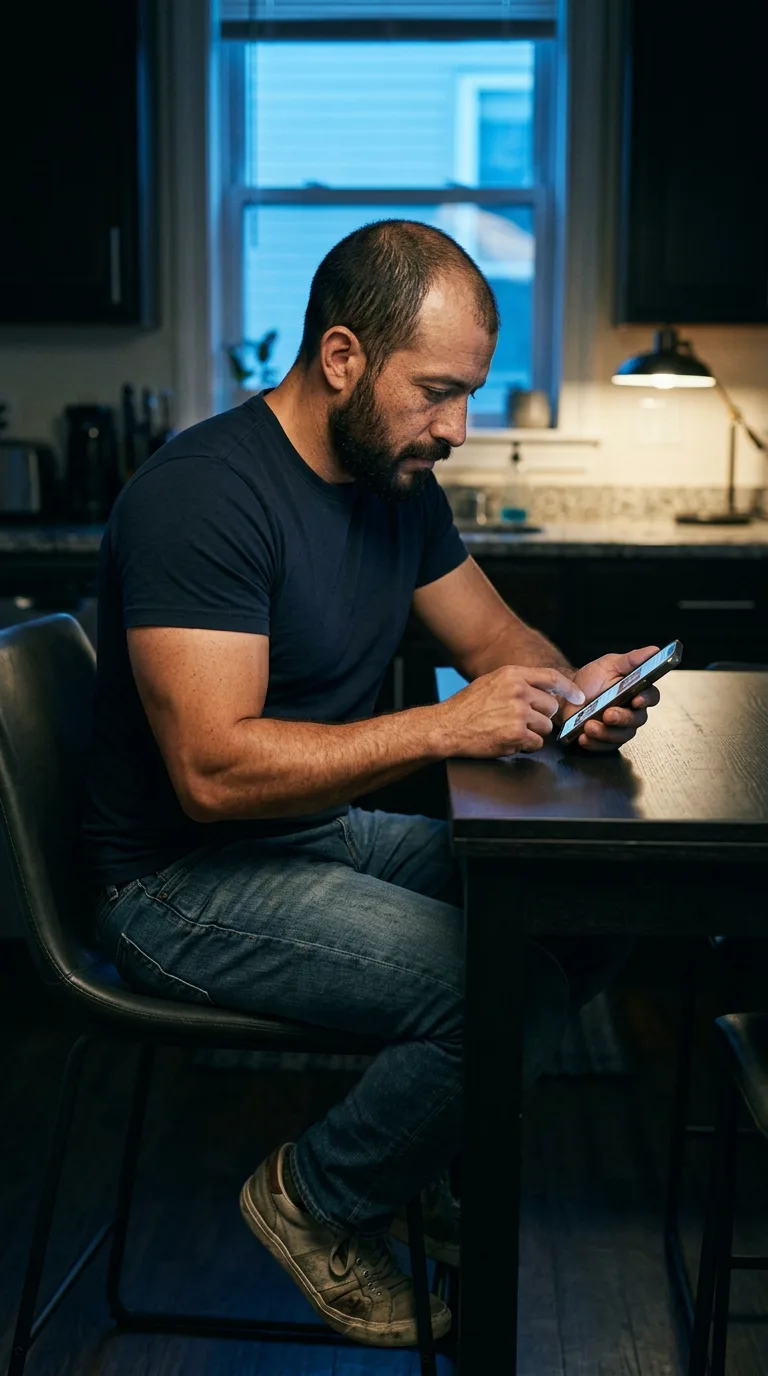
Rarest thing about him: Pulls at his beard — epic, 1 in 365
Season 1seed 416072296 · engine v11
Character card
lineage 9IC4OB
His body-swap story
@bryce.kellerman, wearing Marcus Ojewale, rolled the wheel on and woke up as Ronnie Bacigalupi, spent 4 minutes in him, then spun the wheel and woke up as Nathan Farooqi
Marcus Ojewale's apartment is quiet the way Sundays get quiet in Las Vegas at two in the afternoon, sun flat through the blinds, and you are sitting at his little kitchen table with his laptop open and his coffee gone cold by his elbow, and you are bored of him. Not unhappy — he has a decent life, a job that doesn't hurt him, an ex who still texts him about nothing — but one day in, and already you know the shape of the rest of it, the way you always do. Thirty-three years in an administrative office, a short beard he keeps trimmed to a rule, brown eyes that don't ask for anything. He is comfortable. Comfortable was never why you spin. You open the site with his hand, vessel.cards, the wheel already loaded from last night's tab, and you tell yourself it's just to look, the way you always tell yourself that, and then you pay, and then you spin, because the wanting came back the way it always comes back, quiet and total, like hunger arriving mid-meal.
The wheel lands and there is no in-between. One second you are Marcus's weight in a kitchen chair in bright desert light. The next you are shorter, denser, sitting instead of — no, still sitting, a different chair, a different table, your arm bent at a different angle, a phone warm and small in a thick-fingered hand, thumb lifted a half-inch off the glass like it's been stopped by something. Overcast light instead of desert light. A window with a storm door's shadow crossing it. The smell of a kitchen that has cooked a thousand dinners in it. You feel a beard against your own collarbone when you swallow, longer than the one you just left, itchier. Your shoulders are wider than they have any right to be for how little of you there is above the floor. The phone in your hand shows a watch that costs more than a month of somebody's rent, and your thumb — his thumb — sets it face-down on the counter, on its own, before you've caught up to whose decision that was.
Then it comes, through the phone still warm under your fingers, through the cotton of the t-shirt against your back: Ronnie. The name arrives with the shirt, the good soft navy one he keeps for nothing, for scrolling alone in the dark, not the brown uniform shirt that lives on a hook by the door with his ID clipped to the collar. That one comes with its own flood — six a.m. dispatch lot, the belt scanner heavy on his hip like a sidearm, three hundred packages and a route memorized down to which porches have dogs. His hands know the rhythm of it without him: the twist-and-catch of a box off the shelf, the two-knuckle knock that means don't make me ring twice, the particular ache low in his back by hour nine that never fully leaves even on off days. He is strong the way men get strong from lifting instead of gyms, and he is thirty-six and beginning to feel it in his knees on the porch steps, in the mornings when his crown — thinning, he knows, he catches it in delivery van mirrors and touches it sometimes without meaning to — feels cold before he's even outside.
The chair under you is the kitchen chair from the second photograph, and the wood of the table holds a memory of Sunday dinners with his kids, before, when there was a before — Marisol's laugh from the stove, the two of them small enough to fit under this table and did, for hide and seek, shrieking. That's gone from this house now except on weekends, and this isn't a weekend they're his, so the house is his alone tonight, and that's the second thing besides the price on the phone that put him in this chair scrolling toward something he'll never buy. He believes, doesn't drink except a night here or there with his brother-in-law who still likes him despite everything, has never smoked in his life, tithes what he can when he can. He is embarrassed that he was looking at watches. He would tell you, if he still could, that it isn't really about the watch.
His free hand rises without you sending it and finds his beard, tugs at it once near the chin, an old unconscious habit that has nothing to do with you, and in the half-second of that motion you get the morning entire: him standing in this same kitchen at 5:40 a.m., pulling the brown shirt over his head one sleeve at a time, the fabric already smelling like yesterday's cardboard no matter how many times it's washed, hooking his belt, checking the handheld scanner's battery, catching his own reflection in the dark window glass and not quite looking at it, the thinning patch on top a fact he's stopped fighting and started just knowing, like knowing his own blood type.
You look down at the hand still resting on the phone. Thick fingers, a callus ridge along the palm from gripping a hand truck for a decade, no ring, no marks, freckles scattered even here across the backs of the knuckles like they didn't stop at his face. You turn it over slowly in the gray evening light coming through the window, feeling how low to the ground everything is from in here, how solid.
You lift your eyes to where a phone camera isn't, but where a mirror on the far wall catches you anyway, and you say, quietly, to no one in the empty kitchen: "Didn't even want the watch."