Marcus Ojewale
Fictional. Generated by AI — not a real person, and no likeness of one is intended.
33, administrative assistant in Las Vegas · rolled by @bryce.kellerman · card — no film
History
who has worn him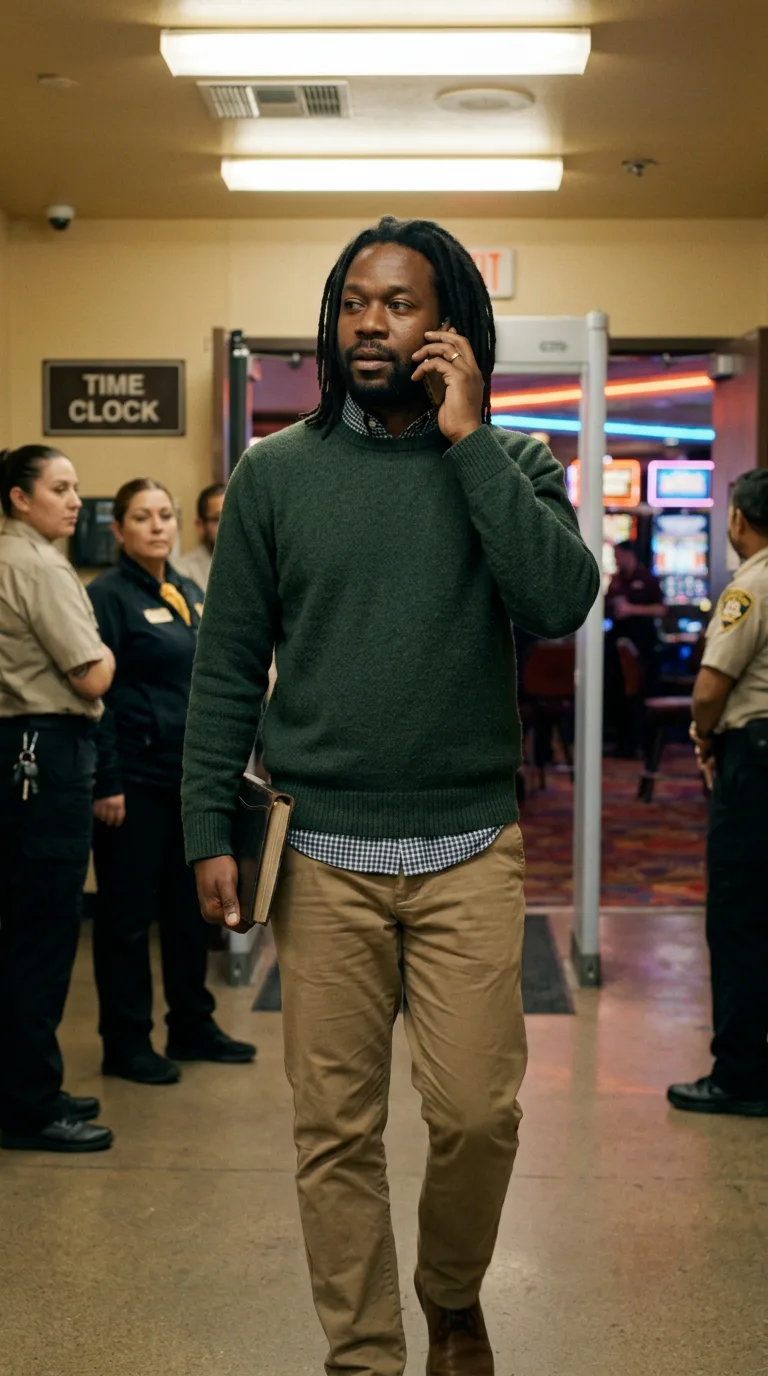
Rarest thing about him: Can't stand still — common, 1 in 51
Season 1seed 1617342709 · engine v11
Character card
lineage 9IC4OB
His body-swap story
@bryce.kellerman, wearing Colin Presswood, rolled the wheel on and woke up as Marcus Ojewale
Two minutes in a body with a gap in its teeth teaches you everything you need to know about it. The cab's still warm from a Fort Worth run, coffee gone lukewarm in the cupholder, some trucker's playlist still queued up — outlaw country, three songs deep — and Colin Presswood's hands are on the wheel doing sixty-eight on a frontage road, and that's it, that's the whole inheritance. No wife. No debt worth mentioning. A gap between his front teeth he probably ran his tongue along a thousand times a day without once thinking about it. Two minutes isn't long enough to want anything from a man. It's barely long enough to know his name. You spun again because there was nothing here yet to leave — that's the plain truth of it, not greed, not boredom, just the itch of a body still cooling, still a stranger's coat on your own shoulders, and the wheel sitting there patient as a slot machine at four in the morning. You'd rather feel something arrive than sit in an empty cab waiting for the road to teach you a man one mile at a time.
The wheel turns and the sun goes wrong. Fluorescent light instead of Texas glare. A phone against your ear instead of a wheel under your hands. Your other hand is closed around something with weight and heft and old leather, and your feet know this floor, the particular give of it, before you do. Somewhere far off a slot machine coughs up its little fanfare. You are mid-stride and mid-sentence and the sentence isn't yours — "—no, tell her I'll call the pediatrician's office myself, I don't want it going through the insurance line again—" and your own mouth is already closing on the last word before you've caught up to having said it.
The book in your hand is a Bible, soft at the corners, spine cracked to a particular Psalm from being opened there so often it opens there itself now. That's the first door. It swings and a whole Sunday comes through it — his mother's voice under the organ, second pew from the front since he was six, and how he stopped believing exactly the way she taught him to and kept going anyway because faith turned out to be a room he still liked sitting in even after he stopped trusting the walls. The book was his father's. He carries it to work most days without knowing why, some mornings slipping it into his bag like a man patting a pocket for keys.
The phone is the second door, warmer, more recent. His wife's voice was just in it — Denise, seven years married, the wedding a backyard thing with too much rain and not enough chairs, and neither of them minding. And under that, quieter, someone he doesn't say to Denise: Angela, who left Vegas for Portland eleven years ago over a fight about nothing, about everything, and who he still thinks of on flights out of McCarran when the plane banks west over the mountains, wondering without meaning to whether she's under that exact stretch of sky right now, still not sure if the thing he feels is love gone unfinished or just the shape a person leaves when they go.
The sweater is the third — the green wool, a birthday gift from Denise two years back, and the memory of pulling it over his locs this morning at some ungodly hour, still dark outside, their daughter asleep down the hall, the fridge humming, him checking his own reflection in the microwave door because there wasn't time to find a real mirror. Buttoning the gingham shirt underneath one hole too high the first try, laughing quietly at himself, redoing it. His hands are steady doing that — thirty-three years old, average build going soft at the middle in a way he's stopped fighting, a body that carries itself well enough at a desk outside a corner office it's been sitting behind for six years now, taking calls that aren't his, guarding a door that isn't his either. His hands know a keyboard, know how to hold a phone with a shoulder while typing, know a stapler's particular jam. They do not know how to sit still — never have, drumming on desks, turning pens, and even now, holding the Bible, the free fingers of that hand are tapping lightly against the leather binding, an old habit outliving whatever thought used to cause it. He hasn't smoked in nine years and his hand still sometimes goes looking for the pack that isn't in his pocket anymore.
The wedding band is a small, constant door, always open a crack: the two of them, the boy, six years old now, who calls him every name for father there is depending on the day. Coming home is the good part of him, the load-bearing wall. Whatever else got worn down at that desk, that part never has.
You look at your hand, the one not holding the phone, and turn it over — the ring catching the fluorescent light, the pad of the thumb worn slightly shiny from turning that same ring in idle moments a thousand times over. You lift your eyes off it into whatever's watching — a camera above the time clock, a guard's face, doesn't matter — and you say, to no one who could possibly understand it:
"Sorry — lost my train of thought for a second there."
Then, quieter, mostly to yourself, tasting the new mouth around it:
"Nine to five. Same as it ever was."