Ronald Speight
Fictional. Generated by AI — not a real person, and no likeness of one is intended.
45, nurse in Eastern Kentucky · rolled by @marco.villagrana · card — no film
History
who has worn him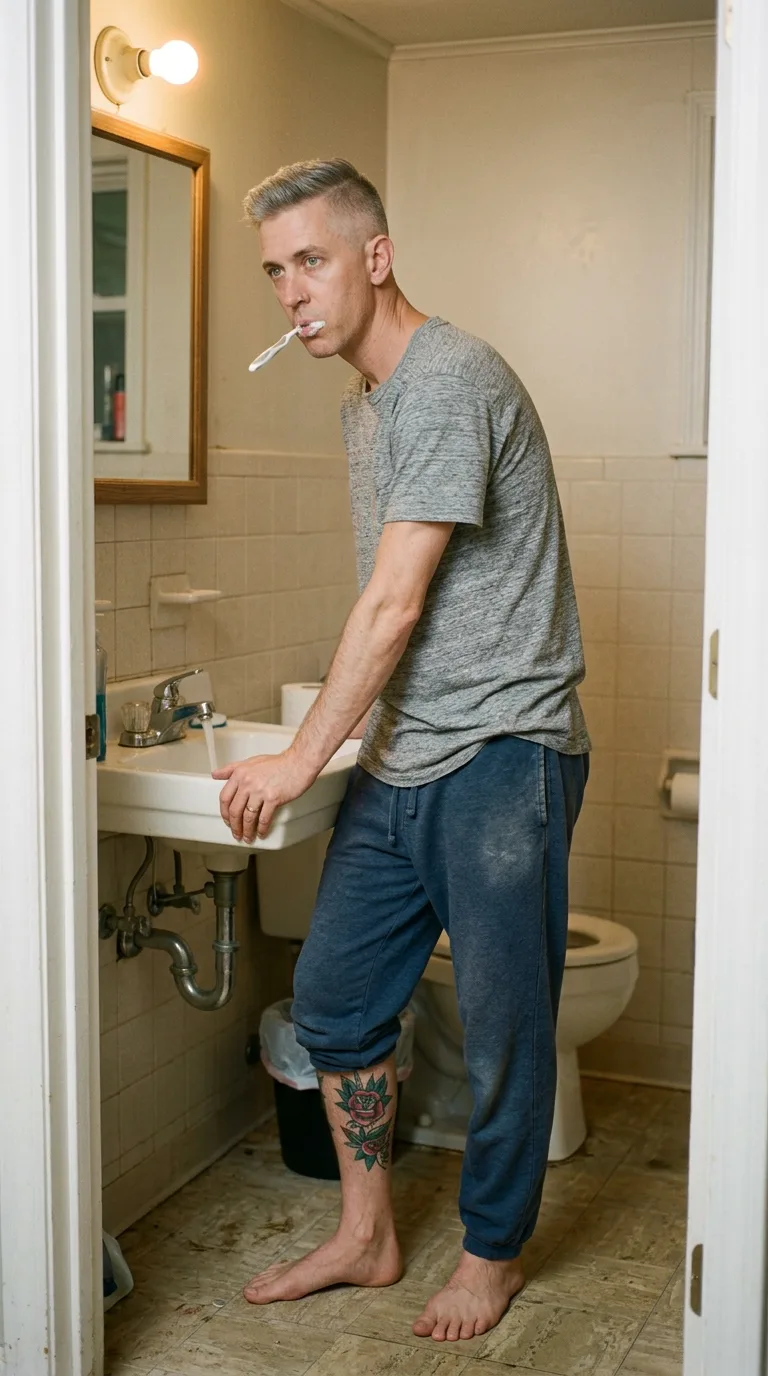
Rarest thing about him: Nose — legendary, 1 in 104
Season 0seed 64226149 · engine v10
Character card
lineage LJL8SV
His body-swap story
@marco.villagrana, wearing Anil Bhagat, rolled the wheel on and woke up as Ronald Speight, spent 4 minutes in him, then spun the wheel and woke up as Gary Pelletier
---
Anil Bhagat's knees are the first thing you notice, three minutes in, kneeling doesn't work the way it used to, and you haven't even done anything yet. You are standing in his kitchen in Small-town Ohio, in a body that smells like pipe dope and Marlboro-less breath even though he doesn't smoke, and there's a laptop open on the counter with vessel.cards still loaded, the wheel slowing on his last spin's afterglow. His hands — spotted, callused at the pads, a scar across one knuckle from some fitting that bit him decades ago — are not interesting to you. That's the whole problem. Fifty-nine and skinny and tired in a way that isn't his tired, it's a tired you inherited with the body, and you have been him for three minutes and already you are bored of the particular ache in this specific lower back. You did not spin again for a reason you'd say out loud. You spun again because three minutes was already too long in a man whose knees remind you, every time he shifts his weight, that you are a tourist standing in a rental, and there is a whole site full of other rentals, and Sunday evening is long, and you are alone with the laptop the way you always are when you do this. You do not let yourself think about the man underneath, the plumber, wherever he's gone. You put your finger — his finger — on the trackpad and you spin.
The stop is a bathroom, not a kitchen. Fluorescent light off tile the color of old teeth, tap running, and there's a toothbrush in your mouth, foam gone thin at the corner of your lip, and your right hand — this hand, this new one — is planted flat on the rim of the sink, weight leaning into it like it knows to protect something above the waist. The stroke you were mid-way through stutters, stops, and you make it start again on the other side, slower, into the back molars, because the last real order this mouth had been given was *brush your teeth* and you are, for a second, only following through on it. You rinse. Twice. You stand the brush up bristle-first, out of a little pool of grey water that has clearly lived in that spot for years, a groove worn into a routine that isn't yours yet.
The shirt is what gives him to you first — thin gray cotton, worn soft at the collar, and touching it, wearing it, standing in it, brings back a woman's hands smoothing this exact collar flat against his chest at six in the morning before a twelve-hour shift, her saying *you're gonna wear through this thing before you retire it*, and him saying *good, then I won't have to pick a new one*, and both of them laughing in a kitchen with country gospel low on the radio. Ronald. The name arrives with the shirt, plain as a tag. Ronald Speight, forty-five, and his back has been talking to him since he was thirty-eight, a low ache along the lumbar that never fully quiets even standing still like this, a joint in his left knee that clicks when the weather turns. You feel it now, dull, present, familiar to him in a way it will never be to you — pain worn in like a path through grass.
The sweatpants at his hips carry a whole year: night shift, four years running now, the strange island of a Sunday evening that is actually his morning-adjacent hour, brushing his teeth before bed while outside it is still bright enough for other people's suppers. The calf tattoo — rose, bold linework, color gone a little chalky at the petals — comes up warm under your palm when your hand brushes it bracing on the sink edge, and with it a night at nineteen, some shop in Ashland, an old girlfriend's name he almost got instead and thank God didn't, because that girlfriend is still out there somewhere, Denise, and he thinks of her sometimes on nights like this for no reason he'd ever admit to his wife, a small guilty warmth he keeps folded away like a receipt he never throws out.
The wedding band is cold and then not, and gives you her — Carla, asleep already down the hall, the smell of her shampoo still in the pillow he'll lie down next to in a minute, seventeen years of her, no children and a grief about that they stopped talking around sometime in their thirties, replaced instead with a dog now gone too and a garden she keeps too well. The badge reel isn't on him now, but his hands know its weight anyway, know the particular fluorescent hush of the nurses' station at two a.m., charting under a hum that gets into your teeth after enough years, the med cart's one bad wheel, a patient's hand gripping his forearm at 3 a.m. hard enough to bruise, saying *don't leave*, and him not leaving. He is good at this. His hands know how to find a vein in the dark by feel alone, how to talk a frightened man's heart rate down just with the pace of his own voice. Church on the Sundays he isn't working, a small one, gospel and casseroles and a pastor who calls him brother and means it. He does not drink anymore, hasn't in a decade, quietly, without a program, just stopped wanting the story it made him tell. He never smoked.
And under all of it, plainly, honestly: forty-five and skinny and tired in the particular way of a man on his feet for twelve hours who is now finally horizontal-bound, back complaining low and constant, knee ready to click on the stairs, crooked nose that healed wrong from something decades gone and nobody left who remembers the fight.
You look at your hands — his hands — turning them slow in the bathroom light, foam still faint at the corner of your mouth.
"Didn't feel a thing," you say to the mirror, and it isn't clear, even to you, whether that's relief.