Rigoberto Salcido
Fictional. Generated by AI — not a real person, and no likeness of one is intended.
65, aircraft mechanic in Miami · rolled by @marco.villagrana · card — no film
History
who has worn him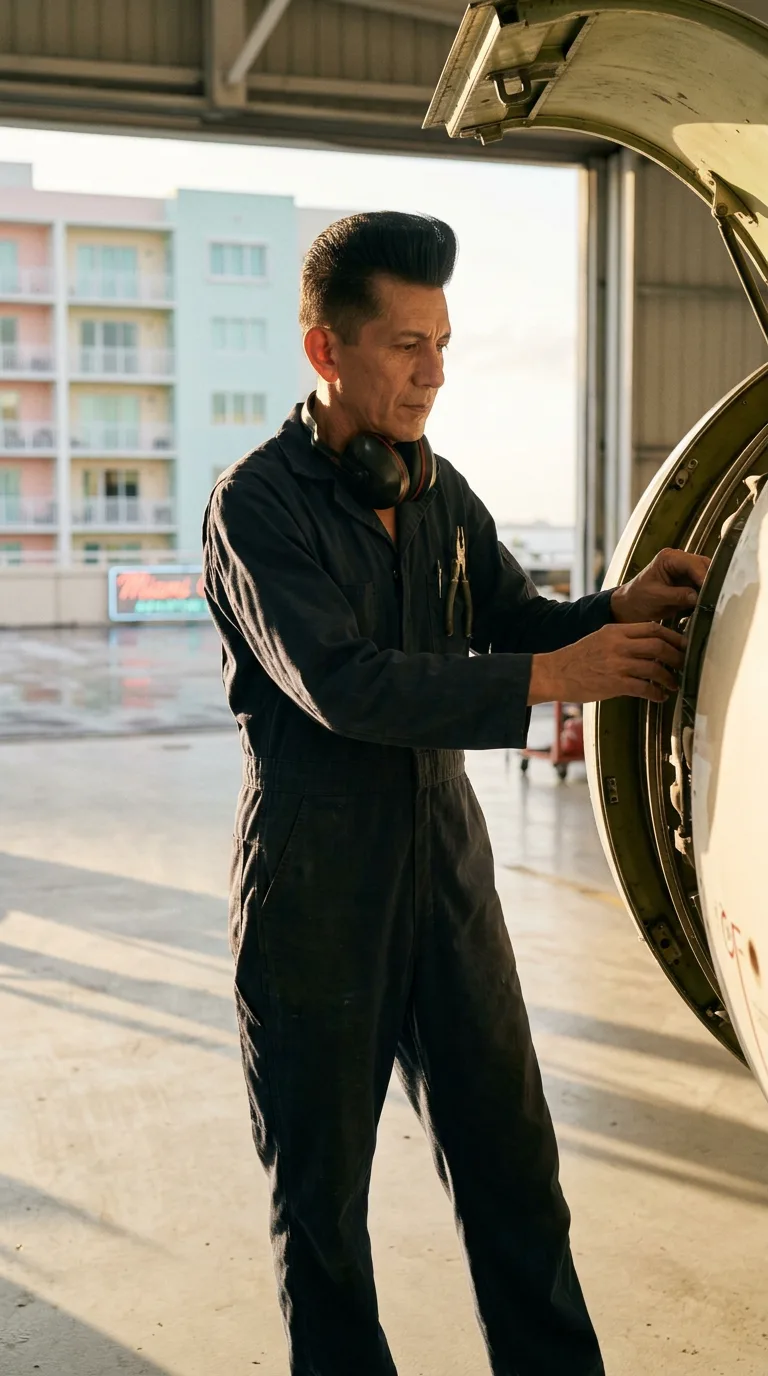
Rarest thing about him: Aircraft mechanic — common, 1 in 573
Season 1seed 742164931 · engine v11
Character card
lineage LJL8SV
His body-swap story
@marco.villagrana, wearing Gary Hufnagel, rolled the wheel on and woke up as Rigoberto Salcido, spent 3 minutes in him, then spun the wheel and woke up as Marcus Delaine
Gary Hufnagel's kitchen smells like microwave rice and old coffee grounds, and you have been him for two minutes, which is exactly long enough to know you don't want the rest of the afternoon in him. The gut sits on you like something borrowed and never returned. The blue laptop light. The gray in the beard you keep catching in the reflection of the dark monitor, waiting for a build to finish. Somewhere in this apartment there's a divorce nobody talks about and a treadmill nobody uses, and you can feel both of those facts pressing on you without needing to touch anything to know them — that's the thing about a body two minutes old, it hasn't told you anything yet, it's just weight and want. You didn't come back for Gary. You came back because 156 men is a number that itches, because somewhere behind his sternum is a boredom that isn't his, it's yours, riding him like ballast. You open the site on his laptop with his thick fingers. You spin.
The wrench stops a quarter-turn off true.
You are bent under the cowling with your right arm up into the guts of the engine, into heat that isn't Anchorage heat, into a smell of jet fuel and hot metal and salt coming off the tarmac, and your hand — his hand, thin-fingered, the knuckles swollen a little with age — has just turned a fitting the wrong way. You feel that half-second of wrongness arrive like a hiccup in someone else's heartbeat, and then you correct it, slow, deliberate, the way a man checks a step he's taken ten thousand times without looking. You do it again. And again. Ten more, each one watched now, each one strange in a job that stopped needing your attention before this man's children were born.
The coveralls are warm from the day's heat still trapped in the fabric, dark navy, worn thin at the elbows, and touching the collar of it — his collar, gone soft with washing — gives you the first flash: a Tuesday morning, early, a little dark still, him buttoning this same shirt-front standing in a bathroom with a mirror gone spotted at the corners, humming something with no name to it, a cigar unlit and waiting on the sink edge for after the shift, not during, never during, that's a rule from his father's father. The pliers in the breast pocket are warm too, and they give you a hand-memory that isn't yours: gripping, twisting, the particular satisfaction of a cotter pin seated right on the first try, four decades of that satisfaction stacked up into something almost like a prayer.
The headphones around his neck, still faintly damp at the pads, give you the roar-under-roar of the hangar, a sound he stopped hearing as noise around 1987. His feet — his boots, steel-toed, cracked across the left instep — know the particular give of this concrete, know where the drain grate is without looking, know a limp he does not have but almost has, a stiffness in the right knee that flares when rain's coming, and it is coming, you can feel the pressure of it in the joint right now, a small ache underneath the working of everything else.
The engine cowling under your left palm is sun-warm from a day going down outside — Miami light going copper and pink through the open hangar door, throwing the pastel apartments across the lot into that particular flamingo-and-mint wash he has looked at ten thousand evenings without once really seeing, until, it turns out, tonight. His body is light in a way Gary's wasn't, skinny, economical, sixty-five years old and still able to fold itself into an intake with a flashlight in its teeth. Something in the lower back twinges when he straightens too fast. His hands know cold beer at a card table on somebody's balcony, know a woman's laugh from a long time ago that he still, at odd hours, misses in a way he'd never admit to the men he works with — Marisol, gone eleven years now to a man in Doral, and still, God help him, the one his chest reaches for on nights like this one is about to become. Two kids grown and scattered, a phone that doesn't ring as much as it should, a rosary in the truck's glovebox he touches out of habit more than belief, though the belief is there too, underneath, old and unbothered.
The last flash comes off the wrench itself, still in your grip: his father's hands, teaching him a socket set at nine years old in a Hialeah driveway, the smell of orange trees two yards over, a whole life folded down into one tool.
You look at your hands. Thin, brown, the tendons standing up along the back, a white fleck of old scar tissue nowhere the facts would let you name it — no, there's nothing, just skin, just sixty-five years of weather on it, and it is somehow more yours in this second than Gary's soft pink hand ever was in two minutes.
You lift your eyes to the open hangar door, to the pink light dying on wet tile, and you say, out loud, to no one:
"Que hora es, que ya me quiero ir a casa."
What time is it — I want to go home already.