Gary Hufnagel
Fictional. Generated by AI — not a real person, and no likeness of one is intended.
50, software engineer in Anchorage · rolled by @marco.villagrana · card — no film
History
who has worn him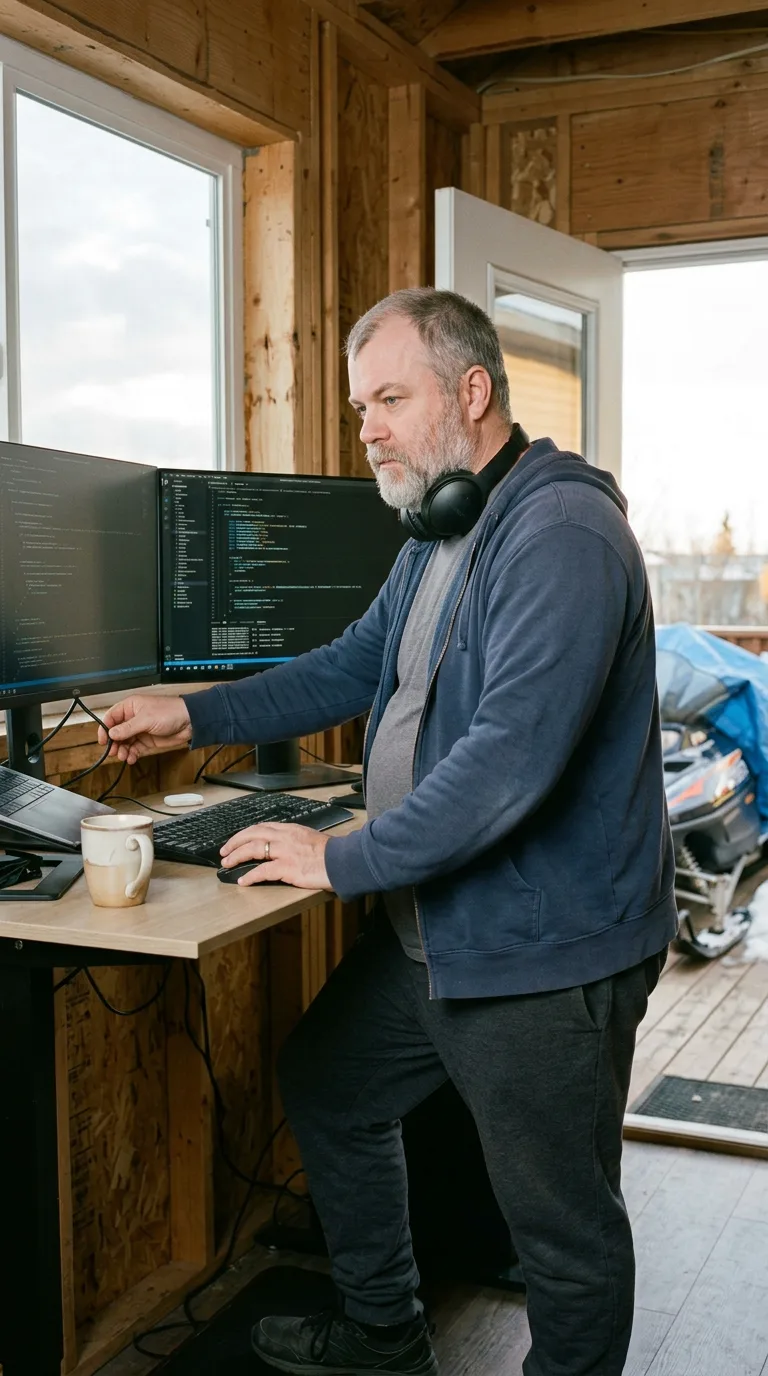
Rarest thing about him: Picks at his cuticles — common, 1 in 34
Season 1seed 458388410 · engine v11
Character card
lineage LJL8SV
His body-swap story
@marco.villagrana, wearing Marcos Villalobos, rolled the wheel on and woke up as Gary Hufnagel, spent 3 minutes in him, then spun the wheel and woke up as Rigoberto Salcido
---
Four minutes in Marcos Villalobos and it is already the cleft chin that undoes you — every time you glance down at yourself in his kitchen window, that little dent looks like a thumbprint left by somebody who ran out of ideas. The apartment smells like his ex-wife's candles, which he never threw out, and the ledger open on his counter has a column that doesn't balance by eleven cents, and eleven cents is the kind of thing an accountant's whole nervous system cannot let go of. You've been him for four minutes and you already know you will be finding that eleven cents in your sleep. That's the tell. That's always the tell — not the big griefs, the small chewing ones. You didn't come back to the wheel because Marcos is broken. You came back because he is fine, and fine is unbearable in a body that isn't going anywhere for the next forty years. You want the cold. You want anything that isn't a kitchen smelling like a woman who left.
You spin.
The desk is real under your palm before you understand it is a different desk — particleboard, cheap, warmer than the granite you just left. Your hand is on a mouse that is not the mouse you knew a half-second ago. Code scrolls on two monitors at a height that makes you realize, distantly, before you realize anything else, that you are standing, not sitting, and that standing is effortful in a way it wasn't in Nevada, because this body is heavier through the middle and the lower back already has opinions about eleven hours of it. Cold coffee is an inch from your left hand. A cursor blinks in a function you did not write and do not, yet, understand. Your hand — his hand — is midway through a keystroke, and for half a second it types the wrong character, catches itself, backs up, and does it again slow, like a man checking his own work for the first time in a decade.
Behind you, through a window with a storm door open onto a deck, the light is amber and low and wrong for what your body insists, underneath everything, ought to be midafternoon.
Then it starts coming in through what you're touching, the way it always does.
The mouse first — smooth-worn on the left edge where a thumb rides it eight, ten, twelve hours some nights — and with it a flood that isn't a memory so much as a decade folded into a single motion: Gary Hufnagel, fixing other people's broken systems since before some of the junior engineers he now supervises were born, good at it in the unglamorous way that never gets you promoted past a certain title but does get you left alone, which he prefers. The keyboard gives you the specific ache at the base of his right thumb, tendinitis he's ignored for six years. The standing desk under your knuckles gives you the reason it's a standing desk at all — a doctor in 2019, a look at the numbers, a wife who was still a wife then and who bought the desk as a small ferocious act of love before the marriage went quietly, undramatically wrong, the way things go wrong up here when winter is nine months long and one person wants to leave it and the other can't picture leaving anywhere.
The headphones, cold rubber against the back of your neck where they hang unused, give you a name — Denise — and a daughter, grown now, in Fairbanks, who calls on Sundays and who he loves without ever having found a way to say it that didn't sound like a work email.
The gray hoodie against your back, zipped halfway, gives you this morning: pulling it on over the t-shirt in a bedroom that's cold because he keeps the thermostat low out of a habit from renting, even though he owns the place outright now, even though the accounts, if you looked, would tell you he hasn't had to think about money in fifteen years and could buy the building, the hill, the whole white slope behind it. Old habits are stickier than money. The sweatpants at your waist remember being pulled on one-handed while the other hand held a phone, half a work call already started before he was dressed, because the client in Austin doesn't know or care what time it is in Anchorage.
Your left hand rises off the mouse on its own, thumbnail finding the cuticle of the ring finger — an old motion, unthinking — and the pale tan line there gives you the last of it, the clean quiet fact under all the rest: a ring worn for twenty-two years and taken off two years ago, in this room, set on this desk, mailed back to Denise without a note because there wasn't a note that would have been the right size for it. He never drinks. He smokes a pack a day out on that deck, next to the tarp over the snowmobile he hasn't ridden since the divorce, and he tells himself each year he'll ride it again next winter.
You feel all of it land in a body that is fifty years old and heavy and tired in the specific ways fifty and heavy and tired feel — lower back, both knees a little, the good strong forearms of a man who used to build the deck himself — and none of it, not one part of it, is unbearable. That's the strange grace of it. There's no eleven cents here. There's just a man standing at a desk in amber light, alone, solvent, unbothered, mid-shift, exactly where he wants to be and exactly nowhere else.
You look down at the hand still resting near the cuticle it was just picking at, turn it over once like you're checking it came with all its fingers, and you find yourself almost sorry for how easy this one already feels.
"Okay," you say, to the empty room, to the cold coffee, to the tarp and the mountain light. "Let's see what you've got."