Raymond Cusick
Fictional. Generated by AI — not a real person, and no likeness of one is intended.
60, farmer in Small-town Ohio · rolled by @colin.hasbrook · card — no film
History
who has worn him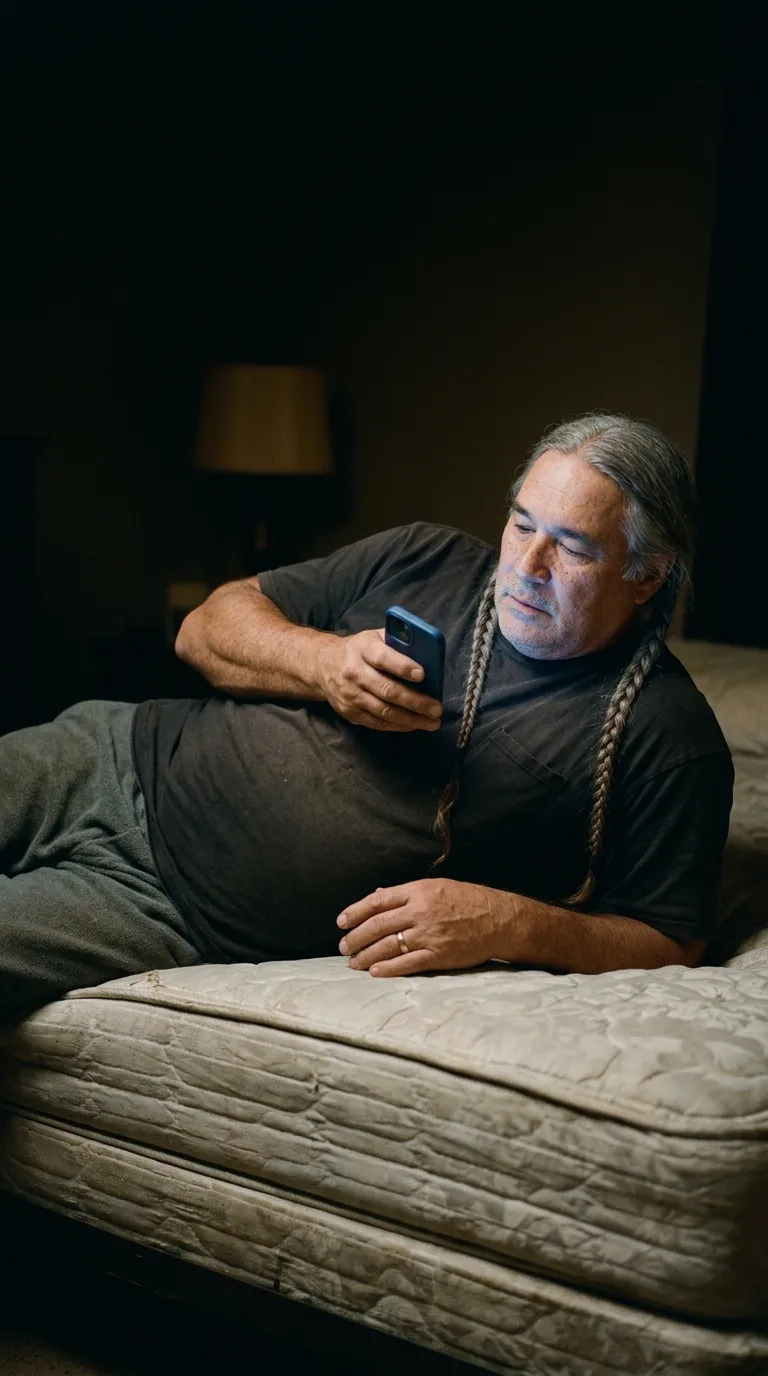
Rarest thing about him: Quitting right now — epic, 1 in 113
Season 0seed 413906367 · engine v10
Character card
lineage 2NZHHJ
His body-swap story
@colin.hasbrook, wearing Marcus Deveraux, rolled the wheel on and woke up as Raymond Cusick, spent under a minute in him, then spun the wheel and woke up as Craig Holloway
The dorm room smells like weed and old pizza, and Marcus Deveraux's eyebrow scar itches the way it always does when you're anxious in his skin, which is often, because being twenty and Black and 5'6" in a body that isn't yours and never asked for you is its own kind of itch. You've been him less than a minute. He was mid-thought about a paper due in six hours, and you inherited the guilt of it along with the scar and the stubborn left knee. It isn't dislike, exactly. It's that you spun into a life that has homework in it, and you have had six hundred and forty-one other lives and none of them made you sit exams. So you open the laptop, and instead of the syllabus you pull up vessel.cards, because you are already rich in ways nobody in this room will ever be, in every way that matters except the one where you get to choose your face, and there's a wheel, and you have never once been able to leave a wheel unspun.
It stops on a farmer.
The bed exhales under new weight that is somehow also old weight — heavier through the middle, thick through the shoulders, a spine that already, in this first second, announces itself with a low ache along the lower back like a held note. The phone is warm and small in a hand three sizes bigger than the one that was holding it a breath ago, and the thumb, your thumb now, keeps moving on its own before you've told it to, scrolling fast and even through a feed some tired, distracted man had stalled on. The room is dark except the screen. There's a lamp across the way, unlit. The mattress under the elbow is bare, no sheet, just ticking, and that detail arrives with a small, specific embarrassment that isn't yours yet — it will be.
It comes in pieces, the way it always does, keyed to what the hands are on.
The phone case first: rubberized, a crack along one corner from a drop in a barn aisle, and with it a flash — kids' photos as the lock screen, two of them, a boy and a girl grown into adults you haven't met yet, a graduation, a wedding, faces caught mid-laugh at something you'll never hear the joke of. Gone before you can hold it.
The ring. Left hand, plain gold, worn thin on the inside from forty years of gripping tools and steering wheels and, once, her hand across a hospital bed rail. Her name comes up sideways, not spoken, just felt — a whole marriage arriving sideways too, decades of it, the specific tired love of two people who've buried disagreements the way you bury a bad crop, deep enough that nothing surfaces most seasons. There was a fight last week about money that wasn't really about money. There is, underneath everything, the plain fact that he loves her, uncomplicated as weather.
The mattress under the shoulder gives you the room itself — the guest room, the actual bed long since given to a grown daughter's old boxes, this bare mattress kept upright against the wall for company that stopped coming, and him sleeping in here more nights than he'd say out loud, because his back can't take her mattress anymore, the pillow-top she insisted on, and because some nights the silence between them needs a wall in it.
The shirt he had on last — no, this is a t-shirt now, soft gray cotton worn through at one shoulder seam — brings the morning back whole: standing at the closet before dawn, the denim shirt on its hook for tomorrow, this shirt pulled on today because the day's work was fence line and mud and didn't call for good clothes. Sleeve over one arm, the joint at the shoulder catching the way it always does lately, a small grunt he'd never admit to making. Boots by the door still crusted. The freckles across his nose from sixty summers of sun he never once put lotion on because his mother didn't and her mother didn't. A hand — his hand, before it was your hand — going up to rub his jaw without thinking, an old habit with no name, just where his fingers go when his mind is elsewhere, which is most of the time now, checking futures prices, checking a text from his son, checking nothing at all.
There's a pack of cigarettes he threw out four days ago, still in the memory of his fingers as an ache for something round and small to hold, worse at night, worse in this dark. There's a bottle of Maker's Mark two-thirds empty downstairs he is not thinking about, except that he is, always, the low hum of wanting it running under the whole of him like a second pulse. There's church on Sunday, a mainline building with a steeple gone gray, where he sits in the fourth pew and doesn't examine his faith too closely because examining it feels like a job he doesn't have time for between planting and the elevator prices.
And under it all, plain and physical: the ache in the lower back that never fully leaves, worse when he's been on his feet all day at the gate watching light go down over a field he has owned longer than his children have been alive. The freckled cheeks warm even in this dim room, sixty years of a body that has done real work and carries all of it, muscular still, gone soft over that muscle the way men do, strong hands, strong forearms, a grip that could still bend a fence post back into true.
You look at those hands now. Wide, weathered, a little swollen at the knuckle from arthritis starting its slow claim. The wedding ring catches no light because there is no light to catch, just the phone's blue glow, and you turn the hand over anyway, feeling for the first time — his first time, really, since he never watched himself do it — the specific unfamiliar heaviness of being sixty and solid and rich in a way that changes nothing about how the back feels lying on a bare mattress in a guest room.
You say, quiet, to no one, in his voice, gravel-soft with disuse this late: "Wrong bed again."
Somewhere down the hall, or maybe two states over, in a life you're not thinking about anymore, a boy named Marcus is still enrolled in a class he will never attend again.