Ravi Chandra
Fictional. Generated by AI — not a real person, and no likeness of one is intended.
30, wrestling coach in Anchorage · rolled by @colin.hasbrook · card — no film
History
who has worn him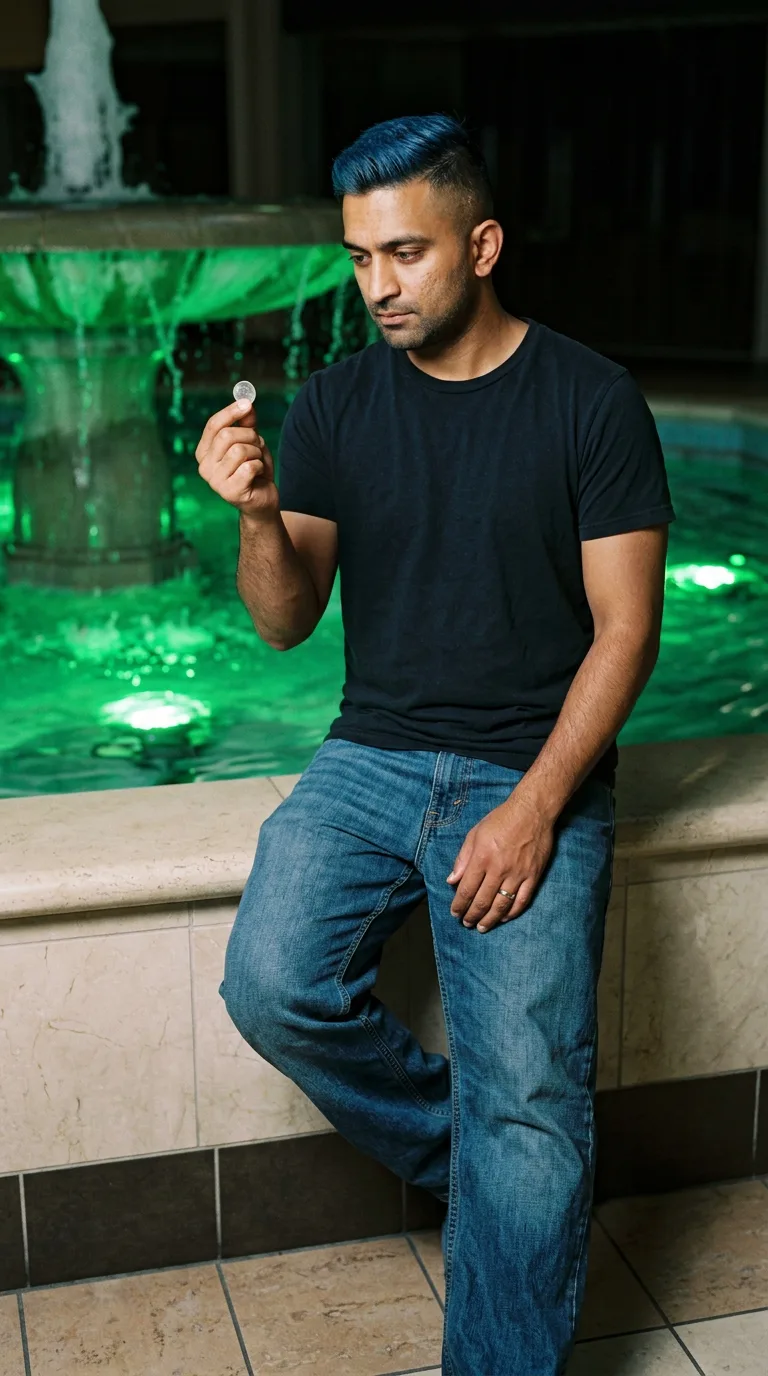
Rarest thing about him: Fashion color — epic, 1 in 56
Season 0seed 1422750512 · engine v10
Character card
lineage 2NZHHJ
His body-swap story
@colin.hasbrook, wearing Nathan Cordero, rolled the wheel on and woke up as Ravi Chandra, spent 6 minutes in him, then spun the wheel and woke up as Earnest Boykin
You are Nathan Cordero for less than a minute, and already the body is boring you.
That is the whole truth of it, though you would not put it that way if anyone asked, because nobody ever asks. You are standing in his kitchen in the flat gray light of a San Francisco afternoon, and your — his — phone is on the counter face-down, and the fridge is humming, and there is a dad-bod softness at the waistband of these sweatpants that you already know you don't want to keep. Twenty-eight years old and tired in the knees like a man twice that. Blue eyes that have seen a hundred domestic disturbance calls and a thousand hours of paperwork. You spun for this four hundred and seventy times ago's worth of wanting and got a cop, and a cop sounded like it might mean something, might meast weight, might feel like consequence — and instead it feels like Tuesday. It has felt like Tuesday since the second you landed in him. There is a case file open on the counter you have no memory of caring about because you don't have his memory, not really, not the parts that would make it matter. Just the shape of a life around you, empty as a stage set.
So you go back to the wheel, standing right there in his socks, thumb finding the site without deciding to. You do not examine the impulse too hard. It is greed wearing the mask of curiosity, same as always. You want to feel something in your hands you haven't felt yet.
You spin.
The coin is already gone from his thumb when you arrive, already falling, and you feel its absence more than you feel yourself — his weight settling into you like a coat dropped onto a hanger, off by an inch, needing adjustment. Water sound. Green light crawling up his forearms, up yours now. The splash comes back wrong, folding inward instead of out, and something in the pit of the stomach you're wearing registers it as *strange* half a second before the strangeness becomes yours to carry. He does not gasp. He does not stagger. He stands there at the lip of the fountain the way he was already standing, one leg crossed over the other, a black t-shirt damp at the collar from steam or nerves, and you are simply, suddenly, the one behind the eyes.
It is the middle of the day here, though the fountain lights say closing time, say evening, say tired mall lights dimming down for the night. That confusion sits in you for one useless second — and then you understand, the way you always eventually understand: he coaches wrestling in the mornings, teaches kids in a gym that smells like rubber and sweat starting at six, and today practice ended early, and he came here on the way to somewhere else, restless in the hour he wasn't expecting to have. Midday idleness. A grown man with nowhere to be, making a wish like a kid.
The whistle is the first thing that talks to you. It's not around his neck now — that's back in a gym bag somewhere — but your fingers remember its weight anyway, cold metal, the specific give of the lanyard cord, and with it comes a boy's face, sixteen maybe, sweating through a third overtime, and the pride that comes up through the sternum like heat when the kid finally, finally learns to sit through a stall instead of panicking out of it. That's not nothing. That's a whole year, right there, compressed into the ghost-weight of a whistle you're not even wearing.
The wedding band is next — plain, unadorned, warm already from his own hand — and it opens onto her, onto Priya, onto the smell of her shampoo in a bathroom with bad ventilation and a fight about money that ended in laughing on the floor for no reason either of them could name afterward. Comfortable, not rich. A joint account that worries them both a normal amount. She texted him something this morning he hasn't answered — you can feel the unanswered weight of it, itchy, at the back of the mind, though the words themselves don't come.
And under that, quieter, guiltier: an ex. A name that surfaces like a stone rolling over in a creek — Meghan — not a person he wants back, just a person who is still, somehow, load-bearing in the architecture of who he decided to become. You don't get the story. You get the ache where the story used to be.
The jeans remember themselves being put on this morning — his hands, not yours, tugging denim over knees that ached faintly the way they always do lately, some slow fire under the joints that the doctor has a long clinical name for and he has a shorter, angrier one. An autoimmune thing. Some mornings his fingers don't want to close all the way until he's had the first cigarette of the day, out on the back step, plywood siding at his shoulder, snowmobile shape under a blue tarp catching the amber slant of a light that in Anchorage never quite commits to being day or night. He likes that light. He has never told anyone he likes that light.
The shirt against your back gives you the vape in the truck's cupholder, gives you the six-pack he didn't finish last night, gives you his hand — this hand, the one holding the coin a second ago — rising without his permission to touch his own jaw when the gym goes quiet and a kid is crying about a loss and he doesn't know what to say yet. A tell he's never noticed in himself. You have.
The coin sinks. The water closes over green light. Somewhere behind these eyes, a wish that was already forming — something small, something about Priya, something about the ache in the knees not getting worse before it has to — dissolves without ever finishing itself, because there is no one left inside to finish it.
You lift the hand that isn't holding anything anymore and look at it: the black hair on the knuckles, the ring catching fountain light, a strength in it that surprises you, callus at the base of the fingers from throwing bodies onto mats for a decade. Not his hand. Yours now, for as long as this lasts, which is a length nobody tells you in advance.
"Huh," you say, out loud, to no one, watching your own fingers curl slow into a fist and open again like you're checking they still work.